
True Crime Case Research Fundamentals
True crime case research is the systematic, evidence-led reconstruction of a specific real case using a bounded case question, identifiable sources and traceable claims. Its purpose is to establish what the available evidence supports—not to imitate a formal criminal investigation—so provenance, independent corroboration, claim status and unresolved uncertainty stay attached to each material claim.

At a glance
Case research evidence map
Use this sequence to keep the research question, evidence, claim status and case record connected from the start.
- Define the case question Set a bounded issue, relevant time period, people or events, and any source-access limits so collection stays tied to a clear purpose.
- Trace each source Record provenance, date and context. A source can document that a statement, filing or event was recorded without proving every claim contained within it.
- Test the material claim Check source independence, corroboration and conflicts. Multiple reports that derive from one origin are repeated sourcing, not multiple independent points of support.
- Preserve the evidence state Connect the claim or event to its source, time, factual status, corroboration or conflict, and uncertainty inside the case record.
Decision boundary: when evidence is missing, restricted, conflicting or inconclusive, keep the limitation visible rather than converting it into certainty. The result is a traceable research record, not an investigative finding.
Publicly available material can support a careful reconstruction of people, events and claims, but the strength of any conclusion is limited by the evidence that can actually be traced and checked. Sound case research collects, evaluates, qualifies and organizes information without extending a claim beyond its factual support.
Table of Contents
What True Crime Case Research Involves
True crime case research is the systematic collection, checking, contextualization, and organization of information about a real criminal case.
It uses a defined case question, identifiable sources, and traceable claims to establish what the available evidence supports and where uncertainty remains.
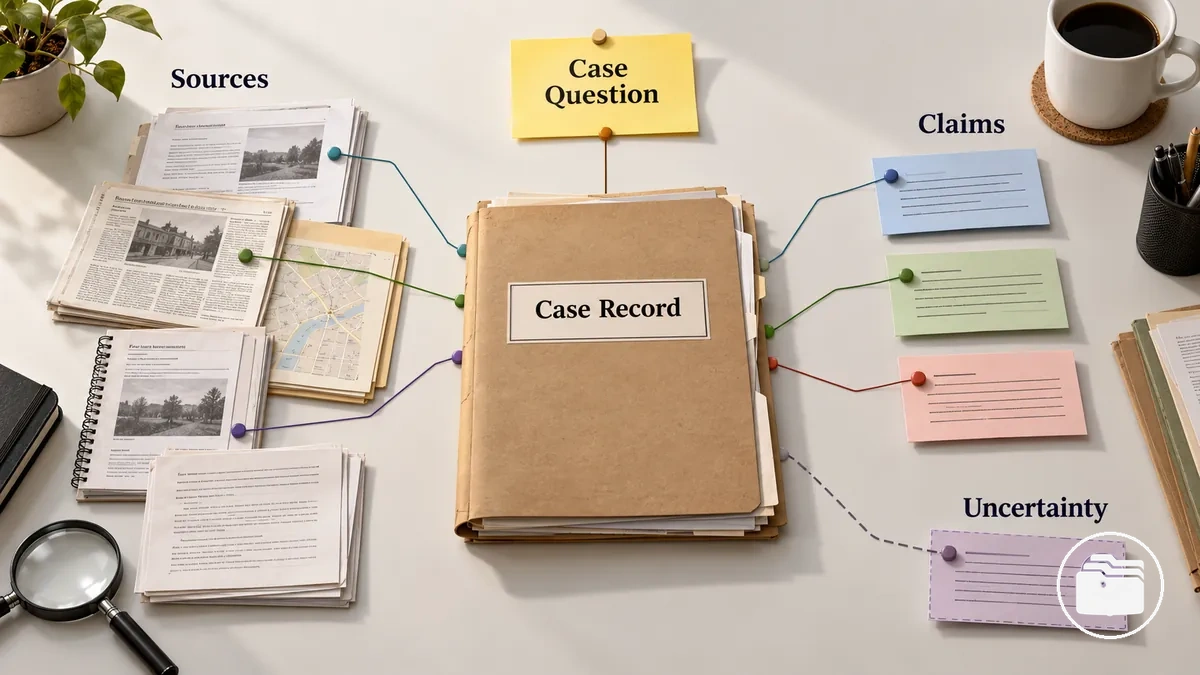
- Case question
- Sets the scope by identifying what the researcher is trying to understand about the case.
- Source provenance
- Keeps the origin of information recoverable, while traceable claims connect each statement to the evidence that supports or qualifies it.
- Uncertainty
- Records where information is incomplete, conflicting or unavailable rather than converting those gaps into factual claims.
- Case record
- Organizes relevant people, events, evidence, sources and claims so their relationships remain clear.
- Research boundary
- Keeps the work distinct from unsupported speculation, narrative reconstruction presented as fact, and formal criminal investigation; inaccessible or incomplete records limit what the research can establish.
True Crime Case Research vs Academic Study of True Crime
True crime case research and academic study of true crime may use overlapping evidence, but their research purpose and unit of analysis differ.
Case research focuses on reconstructing a specific case and assessing claim status, while academic study may examine true crime through media analysis, audiences, criminology, culture, or broader patterns.

| Dimension | True crime case research | Academic study of true crime |
|---|---|---|
| Primary question | What can the available evidence support about a specific case, its events, people, records, and claims? | What can true crime material reveal about a broader scholarly question involving media, audiences, criminology, culture, or related patterns? |
| Unit of analysis | A specific case, event, person, record, claim, or connected set of case facts. | A broader phenomenon such as media representation, audience response, criminological patterns, cultural meaning, or a defined research population. |
| Evidence use | Uses records and other traceable sources for case reconstruction, chronology, and assessment of claim status. | Uses relevant evidence according to the academic research question and methodology, which may include case material alongside scholarly literature, datasets, media texts, or other research sources. |
| Typical output | An evidence-bounded case reconstruction, chronology, or organized account of supported and uncertain claims. | An analytical interpretation, research finding, or scholarly argument addressing the defined academic question. |
Using the same case material does not make the two activities equivalent because evidence use is shaped by the question being answered.
The distinction concerns research function rather than an automatic difference in rigor; the strength of either approach depends on its method, evidence, and execution.
Source Types Used in True Crime Case Research
Source types differ in both the information they contain and what that information can reasonably establish about a case.
Their evidentiary value depends on provenance, completeness, context, and whether relevant claims can be checked against other material rather than on the source class alone.
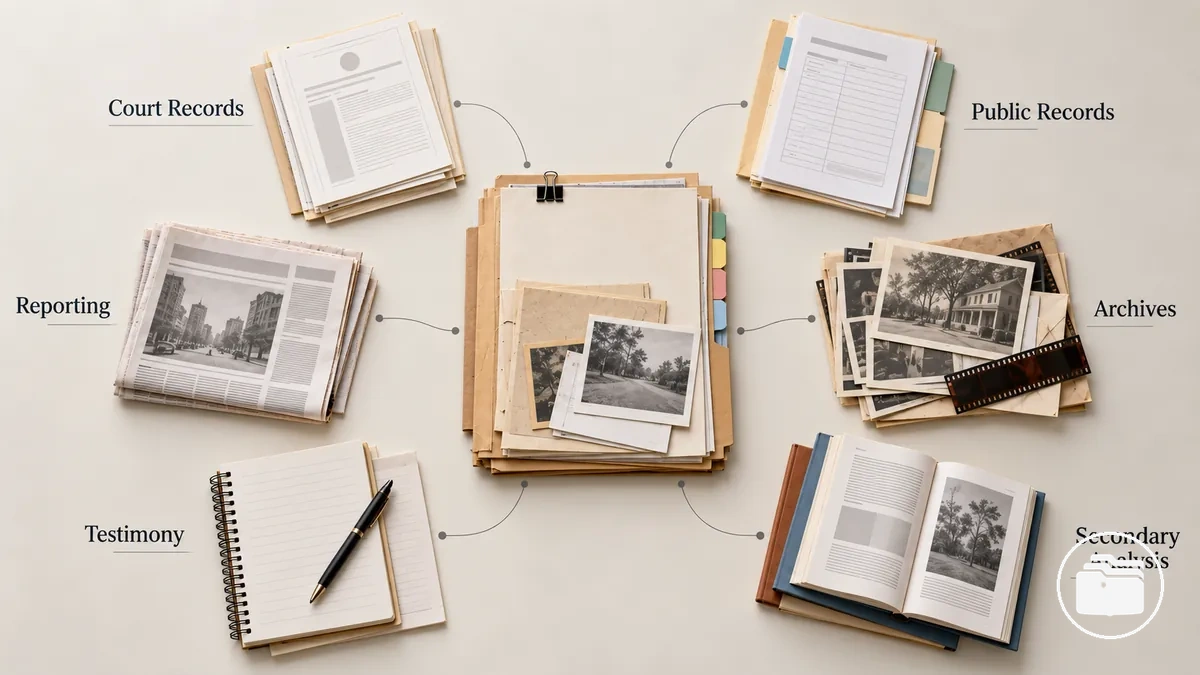
| Source class | Typical information | What it can establish | Main limitation |
|---|---|---|---|
| Court, law-enforcement and other official material | Filings, judgments, orders, transcripts, recorded procedures, official statements or investigative records where accessible. | Documented procedural events, recorded allegations, decisions, dates, testimony or other matters contained in the record. | Records may be incomplete, unavailable, redacted, disputed or limited to what was formally recorded. |
| Public records | Government-maintained records concerning events, filings, registrations or other recorded facts. | The existence and recorded details of a filing, event or status within that particular record system. | A public record may omit surrounding context and does not automatically establish every inference drawn from it. |
| Contemporaneous reporting | News reports and other accounts produced close to the time of an event. | What was publicly reported at that time and, when the reporting identifies its basis, details attributed to named sources or records. | Early reporting can contain errors, incomplete information or repeated claims originating from the same underlying source. |
| Archival material | Historical newspapers, correspondence, photographs, institutional files and preserved documents. | Historical context and details recorded by particular people or institutions at a given time. | Survival, selection and provenance can be uneven, and archived material may reflect the perspective of its creator. |
| Interviews and testimony | First-person recollections, observations, explanations and statements about events. | What a person states, recalls or reports from their position or experience. | Memory, perspective, incentives and access to events can affect the account, so a statement is not automatically confirmation of the underlying claim. |
| Secondary analysis | Books, articles, documentaries and scholarly or professional interpretations built from earlier material. | Context, synthesis, interpretation and connections across multiple sources. | Its conclusions depend on the quality, selection and interpretation of the underlying sources, and several secondary accounts may derive from one original source. |
Court records and law-enforcement material can document procedural events, filings, recorded testimony and official actions when those records are available.
A court document can establish that a filing, judgment or recorded statement exists, but it does not make every allegation contained within that document a proven fact.
Provenance therefore matters: the researcher needs to distinguish what the record itself documents from what a participant claimed within it.
Public records can establish specific recorded details, such as that an event or filing appears in the relevant record system, while contemporaneous reporting can show what was publicly known or reported at a particular time.
Researchers may use public records to anchor a date or filing, then use reporting to understand the surrounding context, provided each source is kept within its evidentiary limits.
Repetition also requires caution because multiple reports may trace back to the same original source rather than provide independent support.
Archival material can preserve historical context that is absent from later accounts, while interviews and testimony record what particular people observed, remembered or asserted.
These sources have different limitations: an archive may be incomplete or selectively preserved, while an interview reflects the speaker's knowledge, memory and perspective.
Secondary analysis can connect and interpret earlier material, but its value depends partly on the provenance and quality of the sources on which the analysis relies.
No source class is inherently sufficient for every research question, and publication status, age or official origin alone does not determine reliability.
Understanding source types clarifies what each class can contribute; locating material belongs to the separate task of how to find case research sources.
Standards for Accurate and Traceable True Crime Research
Research accuracy and traceability depend on whether material claims can be traced to identifiable evidence, checked against independent support, and qualified when the record is incomplete or conflicting.
Each criterion tests a different condition that can strengthen or reduce justified confidence in a claim rather than create absolute certainty.
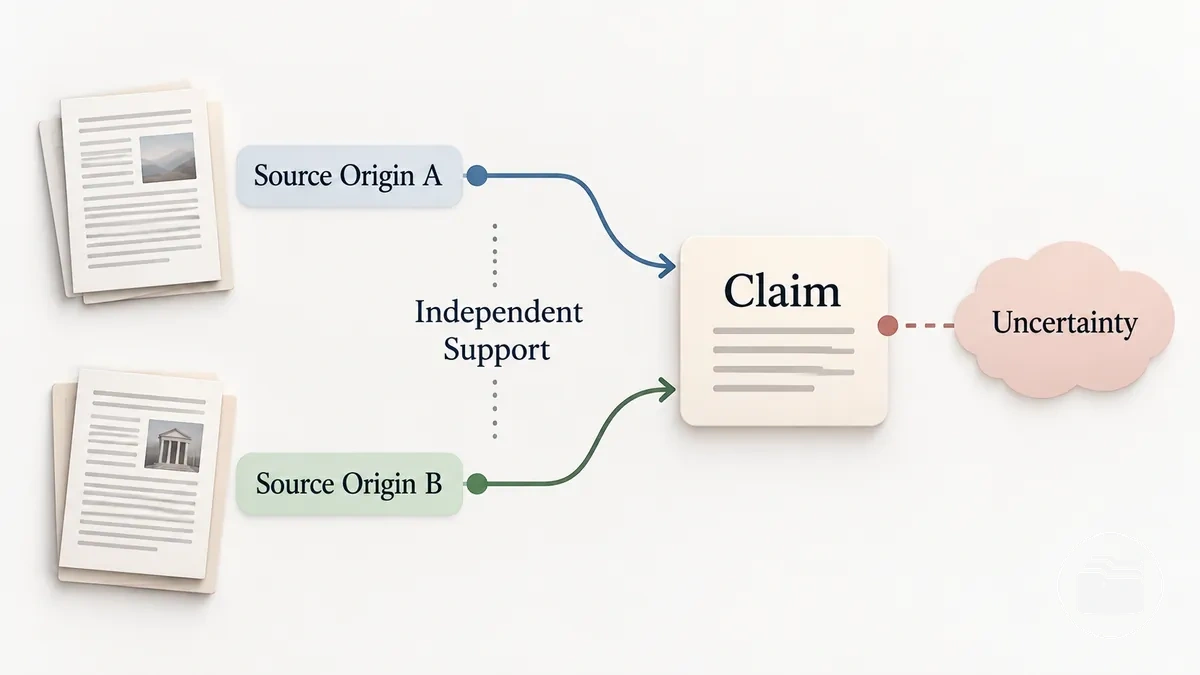
Source provenance establishes where information originated and whether the path from source to claim remains traceable.
Independence matters separately because two accounts do not provide two independent points of support when both ultimately derive from the same underlying source.
Confidence in a claim can therefore strengthen when provenance is clear and corroborating evidence has a genuinely distinct origin, while uncertain or derivative sourcing reduces the confidence the evidence can justify.
The criteria below test distinct conditions that affect how much confidence the available evidence can support.
- Source provenance: The origin and transmission path of a material claim should be identifiable; unclear provenance weakens traceability and limits how confidently the claim can be used.
- Source independence: Supporting sources should be checked for a shared underlying origin; apparently separate accounts provide less corroborative weight when they repeat the same source.
- Date and context accuracy: Dates, circumstances, and surrounding context should match the claim being assessed; a source taken from the wrong period or context can support a misleading interpretation.
- Corroboration: Consistent evidence from genuinely independent sources can strengthen evidentiary support, while unresolved disagreement requires the claim to remain qualified.
- Attribution: Material statements should remain connected to the person, record, organisation, or document responsible for them; missing attribution makes the basis of a claim harder to evaluate.
- Factual status: A claim should be represented according to the status supported by the evidence; overstating that status creates more certainty than the record permits.
- Conflicts and evidence gaps: Contradictions, missing records, inaccessible material, and unresolved gaps should remain documented; concealing them creates a stronger appearance of certainty than the available evidence supports.
Date and context accuracy prevent a correctly quoted source from being applied to the wrong event, period, or circumstance.
Corroboration, attribution, and factual status then influence how confidently a claim can be represented, while documented conflicts or gaps preserve uncertainty where evidence does not resolve the issue.
These criteria interact, so a clearly attributed statement can still require qualification if its context is incomplete or independent support is absent.
Confidence in true crime research should remain proportional to the evidence available for the particular claim.
No single criterion guarantees accuracy, and the relative importance of provenance, independence, context, corroboration, attribution, factual status, and uncertainty depends on what the claim asserts and what evidence exists to support or challenge it.
Corroborating Information Across Independent Sources
Corroboration is stronger when genuinely independent sources support the same material fact rather than repeat information from a shared source origin.
Agreement alone is not enough: provenance determines whether apparent support represents independent evidence or derivative repetition.
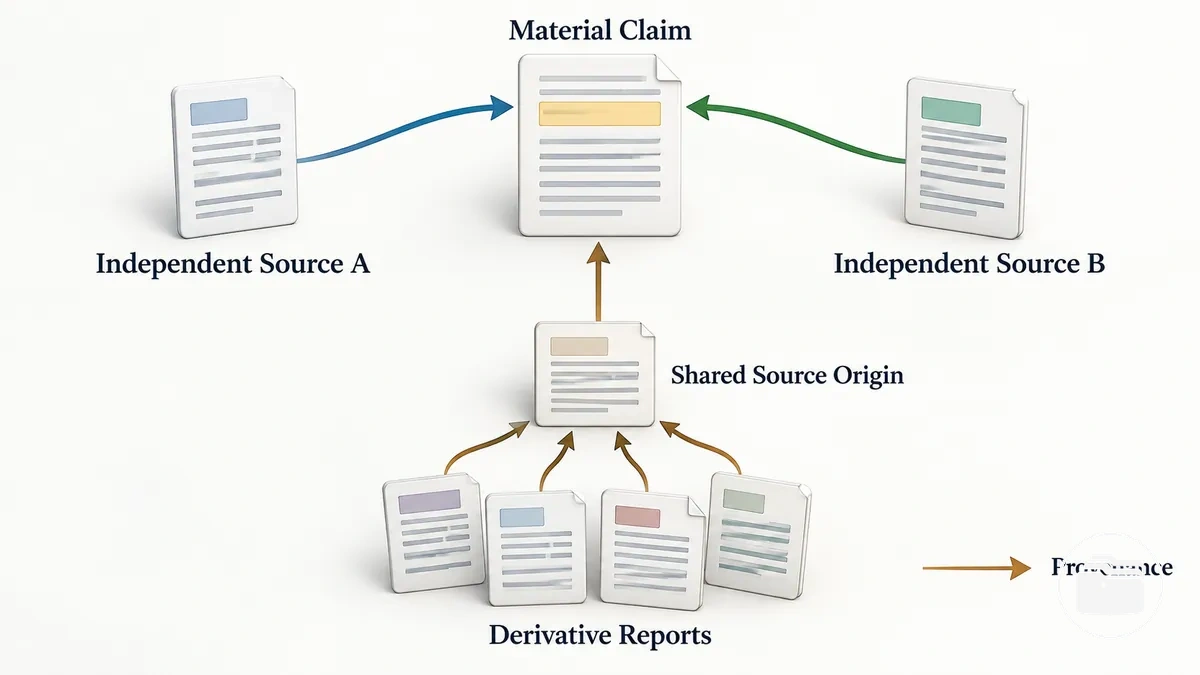
Source-origin checks establish whether each account derives from separate evidence or from the same statement, document, report, or intermediary.
Consistency checks then compare the specific material fact each source can support, including relevant dates, locations, identities, quotations, and event details.
A conflict does not automatically invalidate every source because differences can reflect error, different vantage points, incomplete records, or genuinely different information.
The following checks distinguish independent support from repeated sourcing without assigning a numerical score.
- Source origin: Trace each account to its earliest identifiable provenance; sources that converge on one origin provide repeated reporting rather than separate corroboration.
- Independence: Determine whether each source obtained the information through a genuinely separate evidence path; shared witnesses, documents, feeds, or intermediary reports reduce independence.
- Matched material fact: Identify the exact fact being compared; two sources corroborate only the detail they both independently support, not every claim surrounding it.
- Contextual consistency: Compare dates, locations, identities, quotations, and event details within their original context; agreement is more meaningful when equivalent facts and conditions are being compared.
- Conflicts: Record disagreements and determine whether they reflect error, perspective, timing, or incomplete evidence; absence of contradiction by itself does not establish confirmation.
Several derivative sources may present separate reports or URLs while still tracing back to one original statement and therefore representing a single evidentiary origin, whereas genuinely independent sources based on separate records or observations can provide stronger support for the same material fact.
These criteria establish the boundary for when researchers need to verify and corroborate information in greater depth rather than treating source count as confirmation.
Distinguishing Documented Facts, Allegations and Speculation
Claim status should follow the available evidence, source status, attribution and corroboration rather than repetition or emotional force.
The diagnostic table organizes each claim state by its evidence condition, attribution requirement and appropriate writing implication.
A claim's factual status can change if new evidence alters what the record supports.
| Claim state | Evidence condition | Attribution requirement | Writing implication |
|---|---|---|---|
| Documented fact | Identifiable evidence supports the specific statement, with source status and relevant context clear enough to establish what is being documented. | Attribute the source when attribution is material to understanding the basis, scope or authority of the statement. | State the supported fact directly without extending the wording beyond what the evidence establishes. |
| Allegation | A person, filing, report or other source makes the claim, but the available evidence does not establish the allegation itself as fact. | Keep the allegation explicitly attributed to the person or source making it. | Use wording such as 'alleged by' or 'according to' and preserve any unresolved evidentiary status. |
| Speculation | The statement is an inference, interpretation or proposed explanation that is not supported as a documented claim by the available evidence. | Identify the statement as interpretation or speculation and, where relevant, identify who is making it. | Do not present the inference as a competing factual account or treat lack of evidence as proof that the inferred event did or did not occur. |
A documented fact is supported by identifiable evidence, while an allegation remains an attributed statement that has not been established as fact and speculation remains an inference or interpretation unsupported as a documented claim.
Corroboration can strengthen evidentiary support, but source status and attribution still determine how the claim should be written.
When evidence remains incomplete or conflicting, the claim should remain unresolved rather than being assigned a stronger factual status.
For example, if several articles repeat one person's accusation but ultimately derive from the same original statement, the accusation remains attributed despite the repetition; if a separate dated record independently documents that a particular event occurred, that event can be stated more firmly within the limits of that record.
Applying the same evidence-and-attribution test helps separate facts from allegations without converting speculation or repetition into factual support.
Recording Attribution, Uncertainty and Conflicting Information
Attribution and uncertainty should remain explicit when sources conflict or the available record does not support a single definitive account.
Each competing version should stay connected to its source, and any unsupported or unresolved portion should remain identified as uncertain rather than being reconciled by assumption.
- Attribution
- Record who made the claim, where it appears, and the date it was recorded or published.
- Supported portion
- Identify what the evidence directly supports and separate it from details that remain uncertain or unsupported.
- Conflict
- Keep a competing source as a separate account and name the exact disagreement, such as date, sequence, quotation, identity or event detail.
- Resolution state
- If the evidence does not resolve the conflict, preserve both supported accounts and leave the disputed point unresolved.
How True Crime Case Research Is Organized
True crime case research organization connects research scope, case questions, sources, claims, people, events, chronology, uncertainty, and the case record into one traceable system.
The organizing logic is the relationship among scope, evidence evaluation, chronology, and records rather than any particular software or template.
At a high level, research organization moves from defining the scope to preserving traceability across the resulting evidence and records.
This sequence represents the organizational logic connecting the major research objects rather than the full research method.
- Define: Set the research scope and case question so later sources and claims remain connected to a clear purpose.
- Collect: Gather relevant sources while keeping their origin and relationship to the research scope identifiable.
- Evaluate: Assess what each source supports, what remains uncertain, and which claims require qualification.
- Connect: Link claims with the relevant people, events, chronology, and supporting evidence inside the case record.
- Preserve traceability: Keep the path from each important claim back to its source, context, and uncertainty recoverable.
This organizational model explains how the major parts of a case-research system fit together, but it does not replace the detailed process used to research a true crime case.
Researchers may implement the organization differently as long as scope, evidence evaluation, chronology, case records, and traceability remain connected.
Establishing the Research Scope and Case Questions
A defined research goal and bounded case question determine which evidence, people, events, and claims belong within the research scope.
The case question should set a practical research boundary before large-scale collection begins, so new material can be included or excluded according to its relevance to the inquiry rather than its general interest.
Start with the research goal, the known facts that frame the inquiry, and the unresolved questions that still require examination.
Define the relevant time period and geographic boundary, identify the relevant actors or events that can materially affect the case question, and note any jurisdictional context that may constrain available records or source classes.
Source constraints should also be recorded in advance because unavailable, restricted, incomplete, or uneven records can constrain what the inquiry can reasonably establish.
These planning criteria translate the case question into concrete inclusion decisions for the case record.
- Research goal: Define the specific issue the inquiry is intended to clarify and exclude material that does not materially contribute to that goal.
- Case question: Frame a bounded question about a particular event, decision, timeline conflict, or documented claim rather than an open-ended attempt to explain the entire case.
- Known facts and unresolved questions: Separate what the available record already supports from the questions that remain open so collection stays directed toward identifiable information gaps.
- Time period: Set the temporal boundary required by the case question and include earlier or later material only when it directly affects the event or claim under examination.
- Geographic boundary: Identify the locations or jurisdictions relevant to the inquiry and exclude unrelated places unless evidence connects them to the defined scope.
- Relevant actors and events: Include people, organisations, decisions, and events when their relationship to the case question can be stated clearly rather than merely inferred from proximity to the broader case.
- Source constraints: Identify foreseeable limits on available records or source classes and use those constraints when deciding what the inquiry can support or leave unresolved.
A vague question such as “What really happened in the whole case?” creates no clear boundary for deciding what belongs in the research record, whereas a question such as “Which available records support the reported time of this specific event?” defines a narrower evidentiary target.
The bounded question constrains collection to material relevant to that event and its timeline while leaving weakly connected details outside the current scope.
Building the Case Chronology
A case chronology orders each event by its supported event time while preserving the source, factual status, uncertainty, and any conflict attached to that timing.
Event time must remain distinct from report or publication time because a source can describe an event long after it occurred, and an approximate date or time range should not be converted into false precision.
The chronological sequence should organize timing together with evidence status so gaps, overlaps, and conflicting accounts remain visible.
For each event, record the people or locations involved where relevant and distinguish what the source supports from what remains unresolved.
- Identify the event: Record the specific occurrence separately enough that it is not merged with another event for narrative convenience.
- Record the date or time range: Enter the supported event time, using an approximate date or bounded time range when the evidence does not support greater precision.
- Attach the source and factual status: Connect the event to the source that supports it and record the factual status justified by that evidence.
- Compare conflicting timing: Check whether another source supports the same event but conflicts with its date, time range, sequence, people, or location, and retain each supported version.
- Flag unresolved gaps: Mark missing periods, uncertain ordering, or timing conflicts that the available evidence cannot resolve rather than forcing a definitive chronology.
For example, two sources may support that the same event occurred while one places it in the late afternoon and the other places it in the early evening; the chronology should retain both timing accounts and the associated uncertainty unless further evidence resolves the conflict.
A researcher can then build a case timeline in greater detail without treating chronological proximity alone as proof that one event caused another.
Connecting Sources, Claims and Events in the Case Record
A case record should keep every material claim and event connected to the source, provenance, date, factual status, corroboration, conflict, and uncertainty that justify its inclusion.
Storing quotations, names, documents, or events as isolated fragments weakens traceability because the evidentiary relationship between the information and its support becomes harder to recover.
The relationship fields should make it possible to recover why each claim or event appears in the record, what source supports it, and what material may conflict with it.
The table records the minimum connections needed to preserve source provenance, timing, factual status, corroboration or conflict, and notes about unresolved questions.
| Claim or event | Source | Date or time | Factual status | Corroboration or conflict | Notes |
|---|---|---|---|---|---|
| Claim about a person's involvement in an event | Record the specific source and its provenance rather than storing the claim without attribution. | Record the relevant event date or time and, where necessary, distinguish it from the source's publication date. | Record the status supported by the available evidence without extending the claim beyond that support. | Link corroborating material and any source that conflicts with the claim. | Flag relevant people, evidence gaps, and any unresolved question requiring further checking. |
| Event included in the case record | Link the event to the source or sources that document it and preserve their provenance. | Record the supported date, time, or time range without forcing greater precision than the evidence permits. | State what portion of the event is supported and preserve uncertainty where its factual status remains limited. | Record material that corroborates the event and any competing version that conflicts with its timing or details. | Keep involved people, contextual details, and unresolved questions attached to the event rather than separating them into isolated notes. |
An unresolved question should remain attached to the relevant claim or event so later evidence can be compared with the same source, provenance, date, factual status, and conflict context rather than evaluated in isolation.
This relationship design provides the foundation needed to organize a case file while keeping the underlying evidence connections visible instead of collapsing them into a definitive narrative.
How Source Availability Changes the Research Approach
The research approach should change according to source availability, accessibility, age, independence, and consistency because those conditions determine what the available evidence can reasonably establish.
Source conditions therefore affect both the research scope and the verification strategy, while the strength of any conclusion should remain limited by the evidence that can actually be traced and compared.
Well-documented recent cases may provide accessible records, contemporaneous reporting, and multiple independent sources, which can support narrower questions and more direct comparison of specific claims.
Abundant material does not by itself strengthen the evidence if many accounts are derivative or repeat the same underlying source.
The useful condition is independent, relevant, and sufficiently consistent support for the particular point being examined.
- Abundant and independent material: When several accessible sources provide genuinely separate support, the research can compare specific claims across sources and maintain a relatively narrow research scope while still recording conflicts or uncertainty.
- Older or archive-dependent material: When source age shifts important evidence into archives or historical collections, availability may become uneven rather than inherently weaker; the appropriate adaptation is to broaden relevant source classes and research older cases within the limits of what has survived and can be accessed.
- Inaccessible or sparse material: When missing records, restricted access, or major evidence gaps limit what can be checked, the research question may need to narrow and the uncertainty range should remain wider rather than treating absence of a public record as proof that an event did not occur.
- Derivative or conflicting accounts: When many accounts depend on the same origin or materially conflict with one another, source quantity offers limited additional support; the research should trace provenance, separate independent evidence from derivative accounts, and stop short of a conclusion where the conflict remains unresolved.
Older, inaccessible, sparse, derivative, or conflicting material changes the practical limits of verification because some claims may depend on archives, incomplete records, or evidence that cannot be independently reproduced.
In these conditions, accessibility and consistency may justify a broader search across relevant source classes, while weak independence or missing records may require a narrower question and more explicit uncertainty.
The aim when researchers research older cases is therefore to preserve the distinction between what surviving material supports and what remains unresolved rather than assuming that source age determines reliability.
The appropriate adaptation may be to broaden source classes, narrow the research scope, preserve a wider uncertainty range, or stop short of a conclusion when the available evidence cannot support one.
The final account should remain proportional to the source conditions and evidentiary limitations actually present.