
Distinguishing Facts, Allegations, and Speculation in True Crime Research
An established fact is a specific case proposition that the available evidence supports strongly enough to state as established within that evidence’s scope. An allegation or reported claim remains attributed to its source unless separate evidence establishes the underlying proposition, while speculation goes beyond the available support; an inference is a reasoned conclusion from evidence, and a rumour is an unverified circulating claim. When support is partial, conflicting, absent, or insufficient to settle the proposition, use a qualified status such as partly supported, disputed, unsupported, or unresolved rather than forcing a true-or-false conclusion.

Classification guide
Use the narrowest factual status the evidence supports
Start with one specific proposition, then classify the relationship between that proposition and the available material. Attribution, repetition, or inference should not be treated as direct establishment.
- Does the evidence directly support the proposition itself?Established — but only within the scope of the supported detail.
- Does the material establish only that a source made the assertion?Allegation or reported claim — keep the claimant or source attached to the statement.
- Is the conclusion reached by reasoning from evidence rather than stated directly by it?Inference — identify the reasoning step instead of presenting the conclusion as observed fact.
- Is the claim circulating without adequate verification?Rumour — preserve its unverified and attributed status; repetition is not corroboration.
- Is support only partial, conflicting, or insufficient to settle the proposition?Partly supported, disputed, or unresolved — qualify only the component affected by that evidentiary condition.
- Can no adequate supporting material be identified?Unsupported — lack of support does not, by itself, establish that the proposition is false.
Boundary: this classifies the factual status of a proposition. It is not, by itself, a judgment about source reliability, corroboration, or guilt.
In true crime research, factual status classifies each specific proposition according to its current evidentiary support. It describes the proposition’s evidentiary state—not its importance, perceived confidence, popularity, or repetition—and the appropriate status may change as the record changes.
An established detail does not establish broader conclusions. Likewise, documenting that an accusation, report, rumour, or official record exists may establish that a statement was made without establishing the truth of the underlying proposition.
Classifying factual status is a diagnostic task, not a complete verification workflow, source-ranking system, or judgment about guilt. Accurate wording should match what the evidence currently supports and preserve uncertainty where the record remains incomplete.
Table of Contents
The Factual Status of Case Information
Factual status is the degree to which a case statement can responsibly be treated as established, reported, disputed, inferred, or unsupported on the available record.
The status applies to the specific proposition being examined rather than to the case as a whole.
Available support determines what can currently be asserted about that proposition and which wording is appropriate.
A change in the available record can therefore change the appropriate factual status.
A case statement with sufficient support may justify established wording, while incomplete, conflicting, indirect, or absent support may require reported, disputed, inferred, or unsupported wording instead.
Factual status does not measure how highly a source ranks, how often a proposition is repeated, or how persuasive it appears.
The illustration separates a case statement from the records or evidence used to assess its current status.
This distinction shows why the proposition and its supporting material must remain separate when choosing appropriate wording.

Established Facts
An established fact is a proposition supported strongly enough by the available evidence or record to be stated as established within the research context.
A fact is established only to the extent that the evidence provides direct support for the specific proposition being asserted.
Factual wording should therefore match the exact detail the record establishes rather than extend to a broader conclusion.
For example, suppose a timestamped access log reliably shows that a door opened at 9:15 p.m.; that record may directly support the narrow proposition that the door opened at that time, but it does not establish who opened it or why.
The image illustrates this scope difference by separating the established detail from a broader statement that still requires separate evidence.

Allegations and Reported Claims
An allegation or reported claim is a statement asserted by an identifiable claimant, institution, document, or publication that has not thereby become an established fact.
Attribution identifies the source and the proposition being asserted: a source says X is not equivalent to X is established.
The illustration separates who made the claim from the evidence needed to determine whether the underlying proposition is established.

Documenting that a claimant or source made a statement can establish the existence of the report without establishing the truth of its contents.
Repetition by additional outlets, or appearance in an official or media source, does not automatically supply the evidence needed to establish the underlying proposition.
When that proposition remains unestablished, wording should preserve attribution rather than present the allegation or reported claim as fact.
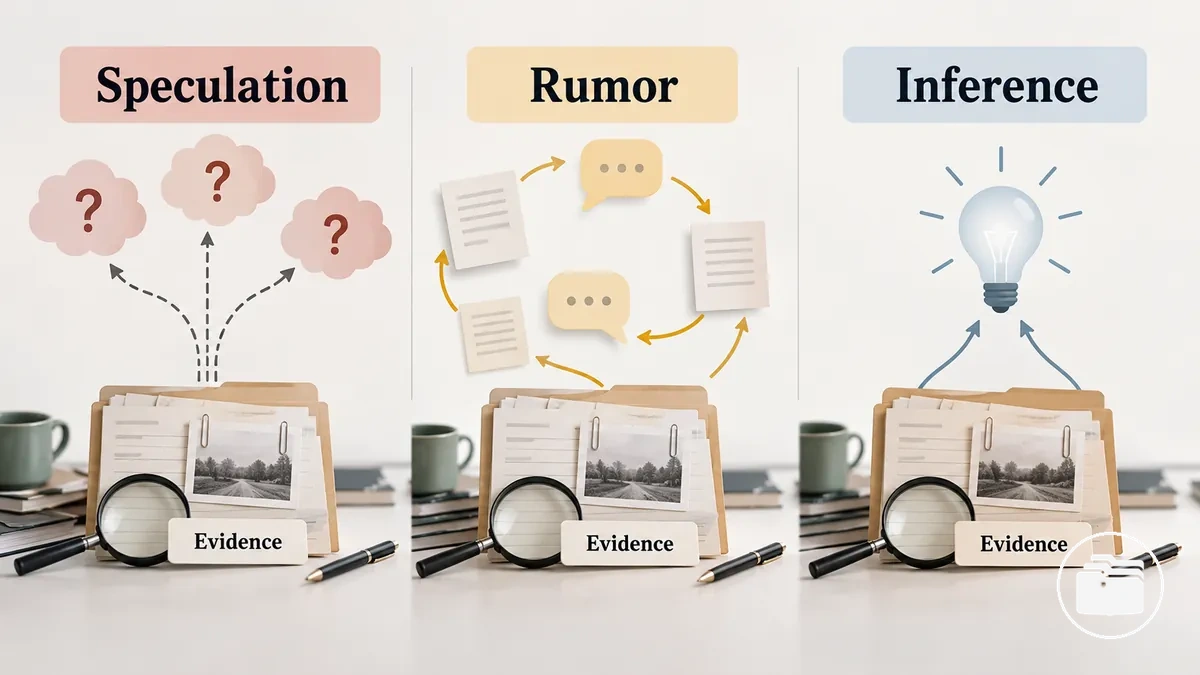
Speculation, Rumour, and Inference
Speculation, rumour, and inference describe uncertain case information with different evidentiary bases.
Speculation is conjecture that goes beyond what the available evidence directly supports, while rumour is an unverified claim that circulates without sufficient verification of its substance.
Inference is a conclusion drawn through reasoning from evidence, but the conclusion itself may lack direct support as an established fact.
Accurate labelling should therefore reflect whether information rests on conjecture, circulation, or evidence-based reasoning.
A reasoned inference can have meaningful evidentiary support without becoming a directly established proposition, and its strength depends on the evidence and reasoning connecting that evidence to the conclusion.
Repetition does not turn a rumour into corroborated information, just as an evidence-based inference should not automatically be labelled speculation.
The comparison graphic distinguishes the evidentiary basis of speculation, rumour, and inference so each can be labelled according to how the information is supported.
How to Classify a Case Statement by What the Evidence Establishes
Classify a case statement by the narrowest factual status that the available evidence actually supports.
The proposition being assessed should remain separate from the records, reports, or reasoning offered in support of it.
A stronger classification is justified only when the evidence relationship supports that stronger status; missing or conflicting support may leave the statement unresolved rather than disproved.
The diagnostic checks distinguish direct support from attribution, inference, rumour, unsupported assertion, and unresolved information.
Each check asks what the available material establishes about the specific proposition rather than what the researcher suspects may be true.
Where evidence is incomplete or conflicting, the classification should remain limited to the status that can be defended from the available record.
The resulting wording should state that status without converting attribution or indirect reasoning into direct establishment.
- If the evidence directly supports the proposition being asserted, classify the statement as established only within the scope of that direct support.
- If the material establishes only that an identifiable source or claimant made the assertion, classify it as a reported claim and preserve attribution.
- If the conclusion is drawn from evidence through reasoning rather than directly established by the record, classify it as an inference; if an unverified claim is circulating without adequate support, classify it as rumour.
- If the proposition has no adequate supporting material, classify it as unsupported; if the available material is incomplete, conflicting, or insufficient to resolve its status, classify it as unresolved rather than treating absence of evidence as disproof.
- Use wording that matches the resulting classification and does not imply a stronger evidentiary state than the evidence supports.
Suppose a door log records that a door opened at 9:15 p.m., while a witness states that a particular person entered at that time: the log may directly support the door-opening proposition, while the witness statement remains a reported claim; whether the identity proposition can be treated as an inference or remains unresolved depends on other evidence.
The image illustrates how separating direct support from attribution or inference leads to the narrowest defensible classification and matching wording.

Evidence Directly Establishes the Statement
Evidence directly establishes a statement only when it provides direct support for the specific proposition being asserted.
The relevant record must contain the detail needed to support that proposition rather than merely relate to the broader case.
Use three criteria to test whether that relationship is direct and limited to what the evidence can establish.
- Direct relevance: the evidence must address the proposition itself rather than only a surrounding event, person, or circumstance.
- Contained detail: the record must actually contain the detail being stated; a conclusion added through interpretation is not directly established by the record alone.
- Scope limit: the factual implication must stay within the supported detail and must not extend to a broader conclusion that requires additional evidence or inference.
Each criterion keeps the evaluation at proposition level because evidence can establish one attribute without establishing every interpretation associated with it.
For example, suppose a record shows that a door opened at a recorded time; that detail may be established while who opened it and why remain unresolved.
Factual wording should therefore describe only the detail established by the available evidence and keep any inferential extension separate.
A Source Reports the Statement but Does Not Establish It
A source can establish that a reported claim was made without establishing that the underlying claim is true.
What the record may establish
The source or claimant made the reported statement. The record can support that source-level fact even when the content of the statement remains unresolved.
What it does not establish by itself
The truth of the underlying proposition. Keep attribution attached unless separate evidence supports the contents of the claim.
Example
If interview notes record that a witness said a car was blue, the notes may establish that the witness made that claim; without separate support, the car’s colour remains unresolved.
The Statement Is Inferred, Rumoured, or Unsupported
A statement may require classification as an inference, rumour, or unsupported assertion when its evidentiary basis does not provide direct support for the proposition as stated.
Recognition depends on how the statement is connected to the available evidence, not on assuming that the proposition is false.
Common cues include reasoning that extends beyond the documented record, unverified circulation, or wording for which no supporting material can be identified.
These cues diagnose how the statement is supported and guide appropriate labelling.
- Missing direct support: the available evidence does not directly establish the proposition being asserted.
- Inferential leap: the statement reaches a conclusion through reasoning that goes beyond the detail directly contained in the evidence.
- Circular or anonymous repetition: the claim circulates through repeated reports without identifiable independent support for the underlying proposition.
- Wording beyond the record: the statement presents a detail or conclusion more strongly than the documented material supports, leaving it as an unsupported assertion unless another evidentiary basis exists.
A defensible inference is linked to evidence through identifiable reasoning, even when the conclusion lacks direct support, whereas a rumour depends primarily on unverified circulation rather than that evidentiary connection.
An unsupported assertion lacks adequate support for the proposition and should not be treated as false solely because that support is missing.
Labelling should therefore reflect whether the statement rests on reasoned inference, rumour, or insufficient evidentiary support without collapsing those different states into one category.
How to Treat Partly Supported, Disputed, and Unresolved Claims
Partly supported, disputed, and unresolved claims require different qualified classifications because their evidence patterns are not the same.
Partial support means some claim components are supported while others remain uncertain, a disputed claim involves conflicting evidence or accounts about the same proposition, and an unresolved claim lacks enough information for a settled classification.
None of these states should be reduced automatically to a binary true-or-false label.
Wording should preserve what the evidence supports while keeping the remaining uncertainty explicit.
The comparison below distinguishes the evidence pattern, current classification, permissible wording, and residual uncertainty for each state.
Mixed support permits a narrower statement about the supported detail, while conflicting evidence requires the disagreement to remain visible in the classification.
Insufficient information requires an unresolved status unless later evidence supports a more specific conclusion.
These differences matter because the same broad claim can contain supported, disputed, and still-unknown components at the same time.
| Status | Evidence pattern | What can be stated | What remains uncertain |
|---|---|---|---|
| Partly supported | Evidence supports one or more claim components but not the full proposition. | State the supported detail with qualified wording limited to that scope. | Unsupported components and any broader conclusion remain uncertain. |
| Disputed | Relevant evidence or accounts conflict on a material part of the claim. | State that the claim is disputed and identify the supported points without resolving the conflict beyond the evidence. | Which conflicting account or interpretation is correct remains unsettled. |
| Unresolved | Available information is insufficient to support or reject the proposition at the required scope. | State that the claim is unresolved or that the available evidence does not settle it. | The proposition remains open because the evidentiary record is incomplete or inconclusive. |
For example, suppose a claim states that a particular vehicle arrived at a location with a named person driving it: without supporting material, the claim is unresolved; footage showing the vehicle but not the driver would give the broader claim partial support.
If later witness accounts conflict about who was driving, the identity component becomes disputed while the vehicle's presence may remain supported.
The wording should change with those evidence conditions and remain limited to the current classification of each claim component.
Partial Support Does Not Establish the Whole Claim
Evidence supporting one claim component does not automatically establish the rest of the claim.
Supported component
State only the specific attribute or event the evidence supports.
Unsupported extension
Any broader conclusion requires separate support rather than being inherited from the established detail.
Example
A record showing that a vehicle arrived at a location at a particular time may establish the arrival. It does not by itself establish who was driving, why the vehicle was there, or what happened afterwards. Those elements remain unsupported in relation to that record unless separate evidence addresses them.
Scope-matched wording states the established detail without extending its implication beyond what the evidence supports.
Conflicting Accounts Remain Attributed Claims
Conflicting accounts should remain explicitly attributed unless evidence resolves the specific point of conflict strongly enough to establish one account over the others.
Each account should remain tied to its source through clear attribution so the disagreement is not converted into a single factual statement.
Repetition, confidence, official status, or narrative plausibility does not by itself resolve the conflict.
For example, suppose Source A's account and Source B's account agree that a vehicle arrived at a location but identify different drivers.
If independent evidence supports the arrival, that shared detail can be stated as an agreed fact, while the disputed detail remains attributed: Source A identifies one driver and Source B identifies another.
Until evidence addresses that specific disagreement, the driver's identity remains unresolved rather than being represented as a settled conclusion.
Lack of Supporting Evidence Does Not Automatically Make a Claim False
A claim that lacks supporting evidence is unsupported or unresolved, but it is not automatically false.
Missing evidence means the proposition is not established on the available record.
A claim is disproved only when the evidence supports a stronger conclusion than mere lack of support.
Expected evidence is absent
The absence may weigh against a claim when that evidence would reasonably be expected if the claim were accurate, but the implication depends on context and is not automatic disproof.
Evidence contradicts the proposition
Contradictory evidence affirmatively conflicts with the claim and may support a conclusion that it is disproved when the contradiction is strong enough.
Keep the wording distinction explicit: not established and disproved are different evidentiary conclusions.
How to Label Uncertain Information Without Presenting It as Fact
Label uncertain information with factual wording that preserves its current status rather than silently presenting it as established fact.
A reported claim should retain attribution, while unresolved information or an inference should carry the qualifier needed to show that uncertainty.
The language should be no stronger than the evidence supports and should not imply confirmation where the underlying information remains uncertain.
Four wording controls help keep the information state clear to the reader: attribution, uncertainty, scope, and the distinction between observation and inference.
Attribution should identify the claimant or source when the sentence reports what someone said rather than what the record establishes.
An uncertainty marker should reflect the actual status, such as unresolved or disputed, while scope precision limits the statement to the detail that is supported.
When a sentence moves from an observation to an inference, the wording should make that reasoning step explicit instead of presenting the inferred conclusion as an observed fact.
- Attribution: identify the source or claimant when presenting a reported claim instead of allowing the claim to appear as an unattributed fact.
- Uncertainty state: use a qualifier that matches the information state, such as unresolved or disputed, rather than vague hedging that does not explain the uncertainty.
- Scope: state only the part of the proposition that is established and keep unsupported extensions outside the factual wording.
- Inference: distinguish what the evidence directly shows from the conclusion drawn from it so an inference is not silently converted into an observation.
For example, change “The witness saw the suspect leave the building” to “The witness reported seeing the person leave the building” when the available record establishes the witness's statement rather than the underlying event.
Likewise, change “The vehicle was used to escape” to “The vehicle was seen leaving the area, which may support an inference that it was involved” when the observation is established but the purpose remains unresolved.
Precise, status-matched wording preserves uncertainty without adding blanket hedging to every sentence.
Identify Who or What Makes an Allegation or Reported Claim
A material allegation or reported claim should identify the claimant or source responsible for the assertion when that information is available.
Explicit attribution makes clear who is asserting the proposition without implying that the proposition is established.
If the source cannot be identified reliably, the wording should preserve that limitation rather than invent or obscure attribution.
A reporting verb should connect the claimant or source to the proposition, while a status qualifier should preserve any part of the claim that remains unestablished.
Vague
“It is believed that the driver left before midnight.”
Attributed
“The witness stated that the driver left before midnight.”
When the witness is the known source and the record establishes only the report, attribution identifies responsibility for the assertion without turning repetition into endorsement or proof.
Preserve Uncertainty When a Claim Is Unresolved
An unresolved claim should be phrased so the known detail remains separate from the uncertain attribute rather than weakening the whole statement.
State what the evidence establishes directly, then qualify only the part that remains unknown, disputed, or unverified.
A qualified statement should make the evidentiary condition visible without implying a stronger conclusion than the available support justifies.
This keeps established information intact while preserving the exact scope of the remaining uncertainty.
- Unknown / unresolved
- There is not enough information for a settled conclusion. State the attribute as unknown or unresolved.
- Disputed
- Conflicting support or accounts prevent resolution. Preserve the conflict rather than selecting an unsupported winner.
- Unverified
- The attribute has been asserted but lacks sufficient confirmation. Identify it as an unverified claim.
Attach the qualification to the uncertain attribute itself so an established detail is not unnecessarily weakened and competing explanations are not presented as equally plausible without evidence.
Label Speculation, Rumour, and Inference Explicitly
Speculation, rumour, and inference should be labelled according to their different evidentiary bases rather than presented as interchangeable forms of uncertain information.
Speculation signals conjecture that extends beyond the available support, while a rumour should remain identified as an unverified circulating claim with appropriate attribution.
An inference should be labelled as a reasoned conclusion drawn from evidence without implying that the conclusion itself is directly established.
Speculation
“It is speculation that the vehicle was used to leave the scene.” This explicitly labels conjecture not established by the observation.
Rumour
“An unverified rumour attributed to a circulating report claims that the vehicle was used to leave the scene.” This preserves both the unverified status and the source of circulation.
Inference
“The vehicle’s presence may support an inference that it was connected to the event.” This identifies a reasoned conclusion without presenting it as confirmed fact.
Explicit labelling helps the reader distinguish unsupported conjecture and unverified circulation from an evidence-based inference whose strength remains limited by its underlying support.
Factual Status Is Not the Same as Source Reliability or Corroboration
Factual status, source reliability, and corroboration answer related but different questions about case information.
Factual status concerns what can responsibly be asserted about a proposition, source reliability concerns how much confidence to place in the source providing information, and corroboration concerns whether independent support exists for the claim.
A reliable source does not automatically make every reported proposition established, and repeated reporting does not by itself create independent corroboration.
The comparison separates the object being evaluated, the core question applied to it, the evidence relevant to that question, and the resulting implication for wording.
For factual status, the object is the proposition and the central issue is what the available evidence establishes about it.
For source reliability, the object is the source and the issue is how its characteristics or record affect confidence in the information it provides.
For corroboration, the object is the claim's support across independent material, which can strengthen the evidentiary basis without replacing the need to state the proposition at the status the evidence actually supports.
| Concept | Object evaluated | Core question | Wording implication |
|---|---|---|---|
| Factual status | The proposition being asserted | What does the available evidence establish about this proposition? | Use wording that matches whether the proposition is established, reported, disputed, inferred, unsupported, or unresolved. |
| Source reliability | The source providing information | How much confidence should be placed in this source for the information it provides? | Source confidence may affect evaluation, but it does not by itself convert a reported claim into an established fact. |
| Corroboration | The claim's independent support | Does independent evidence support the same material proposition? | Independent support may strengthen the claim's evidentiary basis, while repeated non-independent reports should not be described as corroboration. |
For example, a credible source may report an allegation accurately as an allegation while the underlying proposition remains unresolved because independent support has not established it.
The source's reliability affects confidence that the report was made accurately, whereas corroboration and other evidence determine whether the proposition itself can support stronger factual wording.