What Public Records Can Establish in True Crime Research
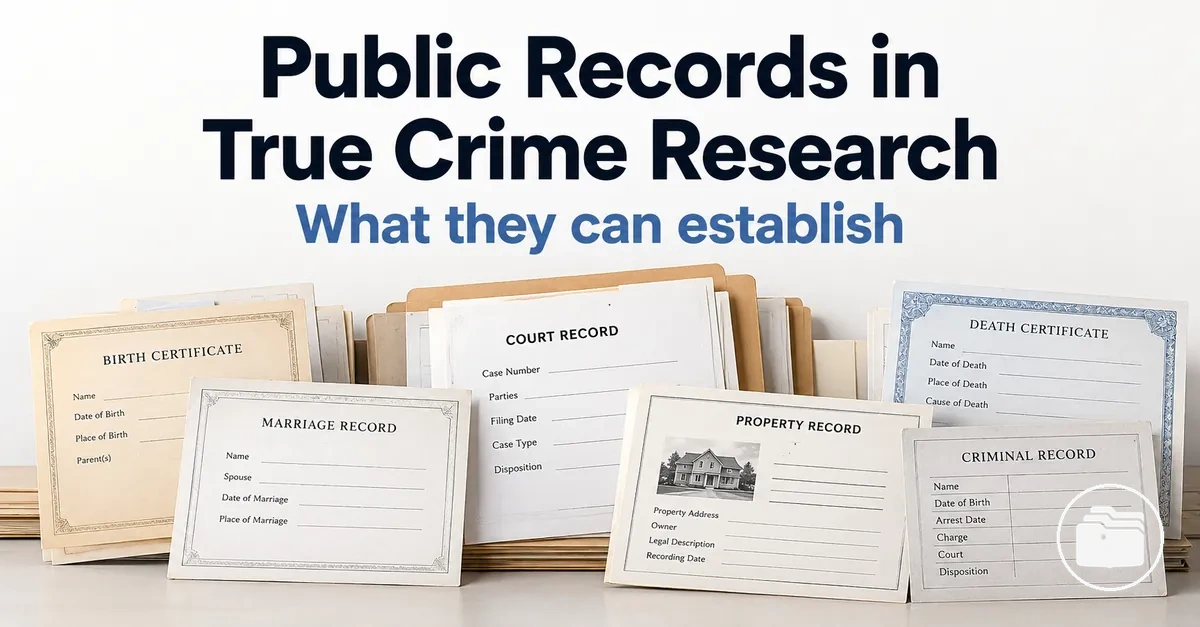
Public records can establish that an official action, status or finding was recorded—for example, a filing, arrest, order, disposition or formal finding—when the document directly records it. They do not automatically prove every underlying allegation, the complete case narrative, or that an unrecorded event did not occur; the defensible conclusion must match the document’s purpose, procedural stage, version and access context.
What a public record can establish
Match the claim to the exact action, status, finding or statement the document records. The strongest conclusion is usually the narrowest one that the record directly supports.
Directly recorded action or status
Can establish: that a filing, arrest, hearing, order, disposition or other official event was recorded or issued at the stated procedural stage.
Boundary: the recorded action does not, by itself, prove every allegation contained in the same document.
Allegation or attributed statement
Can establish: that the allegation or statement appears in the official record and was attributed or recorded there.
Boundary: an asserted claim remains distinct from an adjudicated finding unless the relevant process determines it.
Official finding or disposition
Can establish: the formal finding, order, conviction, disposition or recorded status expressed by the competent authority.
Boundary: interpretation remains tied to the document’s scope, date, jurisdiction and any later correction, amendment or superseding order.
Missing or inaccessible record
Can establish: only the access or search state that is actually known—for example, not found online, restricted, unindexed or not located in the material examined.
Boundary: absence becomes meaningful negative evidence only when the event should have been recorded and the relevant record set is sufficiently complete and accessible.
Decision rule: report what the document directly records first; then state any broader inference separately and only to the extent the record’s purpose, procedural stage and version support it.
In true crime research, the key distinction is between what an official record documents and what a researcher wants to infer from it. Record scope depends on institutional purpose, jurisdiction, procedural stage and availability, so the same document may establish a narrow procedural fact while leaving broader factual questions unresolved.
Table of Contents⌄
Case Facts and Procedural Details Public Records Can Document
Public records can document a recorded identity, date, charge or allegation, and procedural events such as a filing, hearing, order or disposition.
Each entry establishes a recorded fact or recorded status within the document and its procedural context.
The illustration labels typical recorded attributes without implying that those fields independently prove the underlying case facts.
These attributes have different documentary meanings because the recorded value or state determines what can legitimately be concluded.
The following entries map each principal case attribute to the narrow procedural fact or status it can establish.
Recorded identity: a named person, organisation or party establishes how that identity is recorded in the document, subject to the role and context of that record.
Date: a recorded date establishes the date assigned to the documented event, entry or action; its significance depends on what that date identifies.
Charge or allegation: a listed charge establishes that the charge was recorded at that procedural stage, while an allegation remains a recorded assertion unless a later determination establishes something further.
Filing: a filing entry establishes that a document or procedural action was entered into the record at the stated stage of the matter.
Hearing: a hearing entry establishes that a hearing was recorded as scheduled or held according to the status shown in the record.
Order: an order records a direction or determination issued by the relevant authority and establishes that procedural action within the scope of the order.
Disposition: a disposition records the procedural outcome or status assigned to the matter at that stage and supports conclusions limited to that recorded outcome.
Charges, filings, hearings, orders and dispositions represent different procedural states rather than interchangeable case facts.
A charge records an accusation or formal allegation, whereas an order records an authoritative procedural action and a disposition records an outcome or case status.
The legitimate inference therefore depends on both the recorded status and the type of procedural entry.
For example, if a record states that a charge was filed on a particular date, the documented fact is that the filing and date were recorded; the entry does not independently establish that the alleged conduct occurred.
A later order or disposition may document a different procedural state, but its significance remains limited to what that entry actually determines.
Types of Public Records and the Information They Preserve
Public-record types are distinct record classes because each is created to preserve a different category of case information and procedural activity.
Court records, law-enforcement records, coronial or inquest records, and criminal-history records therefore support different research conclusions according to the information preserved and the document's procedural purpose.
The illustration groups these four record families by documentary role rather than implying that one class is inherently more reliable than another.
The Federal Court of Australia describes court files as containing materials such as filed documents, orders and judgments, while the Coroners Court of Victoria describes written findings as recording matters such as identity, time, date, location and coronial findings.
The Australian Criminal Intelligence Commission states that a nationally coordinated criminal-history check can disclose specified police and court information, including charges, convictions, court appearances, court orders and pending matters when releasable under the applicable rules.
The comparison therefore organizes each record class by documentary function, information preserved, what that information can establish and its principal limitation, rather than by presumed reliability.
Record class
Typical information preserved
What it can establish
Key limitation
Court record
Filed documents, hearing or listing events, orders, judgments and dispositions
Formal procedural actions, court determinations and recorded case status
A filing may contain allegations rather than findings, and an interim order may not represent the final disposition
Law-enforcement record
Police reports, arrest records, recorded observations, allegations, charges and agency actions
What law enforcement recorded, alleged or formally did at a particular stage
An arrest, allegation or police-recorded statement is not itself a later judicial determination
Coronial or inquest record
Identity, time, date and location of death, evidence summaries, findings and recommendations where recorded
The findings and circumstances formally recorded through the coronial investigation or inquest
The scope of a finding depends on the investigation, and published material may not contain every item of underlying evidence
Criminal-history record
Disclosable charges, convictions, findings of guilt, court appearances, court orders and pending matters
The criminal-history information disclosed for the relevant check at that point in time
Disclosure depends on the purpose of the check and applicable legislation or information-release policy
Record classification answers what kind of information a located record is designed to preserve and what evidentiary function that information can serve; it does not determine where the document can be obtained.
Finding case sources is a separate research task, so the appropriate record class should be identified from the case attribute or procedural question being investigated.
Court Records: Filings, Proceedings, Orders and Dispositions
Court records document formal procedural events and statuses through entries such as a filing, proceeding or hearing, order, and disposition.
Each court document establishes what was recorded at that procedural stage, while the underlying allegation may remain unresolved.
The annotated court-record image labels these procedural entries without implying that they establish the truth of every statement they contain.
The four entry types below distinguish the procedural event or case status recorded by each document class.
They may occur at different stages and do not imply that every matter follows the same sequence.
Each supports a limited inference tied to the specific entry recorded by the court.
Filing: records that a document, claim or procedural action was submitted or entered in the matter; an allegation in a filing is not itself a judicial finding.
Proceeding: records a hearing or other court proceeding and the procedural status shown for that event.
Order: records a direction or determination issued by the court; an interim order represents a procedural state that may precede later orders or the final disposition.
Disposition: records the outcome or status assigned to the matter or charge at that stage; a final disposition identifies the recorded resolution without establishing the truth of every earlier allegation.
A filing records that a claim or procedural action was made, whereas a judicial finding records a court determination at a particular procedural stage.
An interim order and a final disposition therefore represent different case statuses and should not be treated as equivalent conclusions.
The legitimate inference from any court record remains limited to the procedural event, determination or status that the specific entry documents.
Law-Enforcement Records: Police Reports and Arrest Records
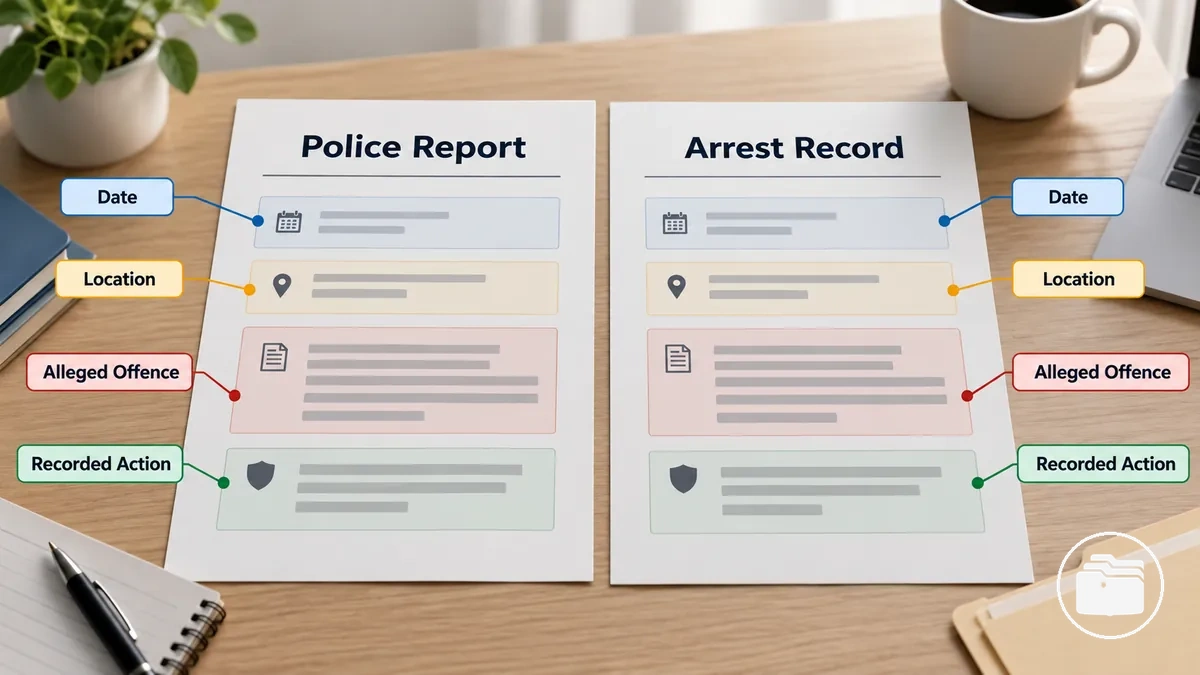
Law-enforcement records such as a police report and arrest record document agency-recorded observations, allegations and official actions connected to a case rather than a final legal determination.
An arrest record establishes that an arrest was recorded; it does not by itself establish guilt, and the annotated example shows typical recorded law-enforcement information without presenting those entries as adjudicated findings.
How to read police and arrest records
Recorded observation
Establishes what an officer or agency documented. It does not automatically establish that every recorded statement was independently verified.
Allegation or charge
Shows conduct that was asserted or formally recorded at that stage. It remains distinct from any later adjudicated finding or disposition.
Arrest action
Establishes that law enforcement recorded the action of arresting a person in connection with an alleged offence; an arrest does not by itself establish guilt.
Common fields
May include the date and location of the recorded event, named parties or neutral identity fields, the alleged offence and the law-enforcement action taken.
Practical implication: use these entries to describe what the agency recorded about the event and its own action; use the relevant later adjudicative record for a later legal determination.
Coronial and Inquest Records: Findings About Deaths and Circumstances
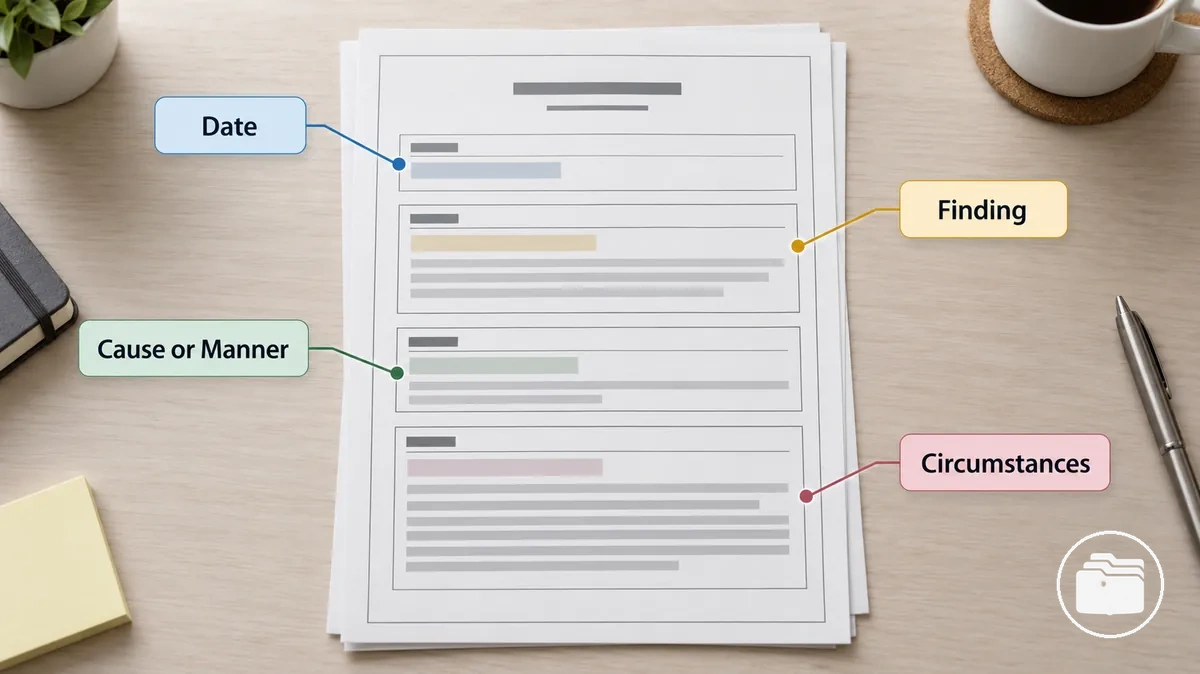
Coronial and inquest records may document an official finding about a death, including its recorded circumstances, but terminology, procedure, availability and legal effect depend on the jurisdiction.
The illustration identifies common finding fields without depicting the death itself or implying conclusions beyond the coronial record.
The Coroners Court of New South Wales states that an inquest considers the identity of the deceased and the date, place, manner and cause of death, while the Coroners Court of Victoria describes a written finding as a formal document that will usually, where possible, record identity, time, date, location and information about the circumstances of the death.
A coronial record or inquest record can therefore establish the identity, date and other death-related attributes expressly stated in the official finding.
Cause, manner, medical or procedural findings and formally stated circumstances support conclusions only to the extent that the relevant jurisdiction and record actually determine or record them.
A procedural finding or related statement should likewise be interpreted according to its recorded status rather than treated as a broader determination of responsibility or motive.
For example, if an inquest finding records a cause of death but leaves another circumstance unresolved, the recorded cause may be reported as the official finding while the unresolved question remains separate.
A witness statement or other reported assertion should also remain distinct unless the coroner expressly adopts it as part of the finding.
Criminal-History Records: Charges, Convictions and Record Status
A criminal-history record can document a charge, a conviction and record status, but these are distinct recorded states with different legal implications.
A charge records that an accusation or charging action exists in the recorded history, whereas a conviction records an adjudicated outcome; the table separates each state by what it indicates and what it does not establish.
Recorded state
What it indicates
What it does not establish
Charge
An alleged offence or formal charge was recorded at the relevant stage
That the person was convicted of the charged offence
Conviction
A conviction was recorded following the relevant legal disposition
That every earlier charge produced the same outcome or remains in the same status
Record status
The current status or historical status shown for an entry at the time represented by the record
That the status is permanent or cannot change through a later legal process
Charge status and conviction status therefore answer different questions within a recorded criminal history.
A charge identifies an accusation or formal charging state, while a conviction identifies a recorded adjudicated result associated with a disposition.
Record status describes how that entry is represented at a particular point rather than converting one legal state into another.
A criminal-history record may show both historical status and current status when later legal processes affect how an entry is recorded.
The significance of a status change depends on the jurisdiction, procedure and time represented by the record, so an earlier recorded state should not automatically be treated as the current state.
An individual criminal-history record describes recorded legal states associated with a particular person; it is not a substitute for aggregate population data.
Population-level conclusions require separate crime data and statistics rather than inference from one person's recorded history.
When Criminal Case Records Are Public and When Access Is Restricted
Public access to criminal case records varies according to jurisdiction, record class, case status, privacy rules and any specific restriction applying to the record.
A record may have a public legal status while still being subject to limits on disclosure, practical availability or online availability.
Access status is therefore a separate attribute from the factual accuracy or evidentiary value of the information recorded.
The main access criteria identify the condition that can change availability and the practical consequence for research.
They should be applied to the particular record and jurisdiction rather than treated as universal disclosure rules.
Current law, procedural status and administrative practice may change the result even for records that appear similar.
Jurisdiction: the governing disclosure rules determine whether a record is public, restricted or available only under specified conditions, so access must be assessed under the law and practice applying to that court or agency.
Record class: different official record categories may have different disclosure conditions, meaning that public access to one document type does not establish access to every document connected with the same case.
Case status: an open, concluded, sealed or otherwise specially treated matter may have a different access status, so procedural status can affect what is available at a particular time.
Privacy: personal information, protected identities or other privacy interests may lead to redaction, limited disclosure or restricted access even when other parts of the record remain public.
Specific restriction: sealing orders, statutory restrictions or other applicable controls may limit public disclosure of a particular record or portion of it.
Practical and online availability: a legally public record may still require an in-person, written or administrative request when it has not been published through an online system.
Public, online, free and unrestricted describe different access conditions and should not be treated as synonyms.
A public record is not automatically available online, online availability does not necessarily mean free access, and public status does not eliminate every restriction on disclosure.
The appropriate conclusion is conditional: determine the record's legal access status first, then its practical availability under the current jurisdiction, case status, privacy rules and administrative conditions.
Availability Varies by Jurisdiction, Record Type and Case Status
Record availability can change independently according to jurisdiction, record type and case status, so similar criminal-case records can have different access states without creating a universal disclosure rule.
What changes availability
Jurisdiction
The governing legal and administrative framework determines the applicable access conditions.
Record type
Different document classes can be public, access-controlled, delayed, partially available or unavailable under different rules.
Case status
Procedural developments can change whether a record is openly accessible, delayed, restricted or only partly available.
Online status
“Not found online” is not the same as “not legally available”. A record may remain available through another court or agency channel even when it is absent from an online search.
Interpret these variables separately: a change in one does not necessarily produce the same access result as a change in another.
Privacy, Sealing and Active-Case Restrictions Can Limit Access
Privacy protection, a sealing order or restrictions connected to an active case can limit public access even when the underlying record exists. Record existence and public accessibility are separate states.
Restriction type and access consequence
Privacy protection
May limit disclosure of personal or protected information while leaving other material accessible.
Sealing order
May withhold a record or part of it from public view according to the order’s scope, without establishing why the order was made.
Active-case restriction
May limit access according to procedural status; the scope or duration can change as the case develops under the applicable rules.
Do not collapse different record states
Restricted access
A known record exists, but access to all or part of it is limited.
Missing record
Expected material has not been located in the material or repository examined.
No known record
No identified record currently establishes that the document exists.
Boundary: none of these access or search states, by itself, establishes that the underlying event did or did not occur.
How Accurate Public Records Are Depends on the Claim Being Made
The accuracy and evidentiary usefulness of a public record depend on the specific claim being tested.
A record may strongly support one recorded attribute while being insufficient for a broader conclusion about the same case.
The controlling question is therefore whether the document's recorded information actually matches the claim being made.
Claim fit can be evaluated through the record purpose, issuing authority, procedural stage, date, amendment history and the status of the information within the document.
These criteria identify what the record was created to document and how far its documentary authority extends.
They evaluate the record against the claim rather than ranking one record class as inherently more reliable than another.
Record purpose: if the document was created to record the attribute being claimed, it can provide direct support for that attribute; information outside that purpose may require additional support.
Issuing authority: an issuing authority can establish official provenance for the document and the actions or information it formally records, but that provenance does not make every embedded statement true.
Procedural stage: a record from an early or intermediate stage supports the status documented at that stage and should not be treated as establishing a later disposition unless the document records it.
Date: the recorded date can establish when a filing, entry or other documented event was recorded, while later developments may affect claims about the current state of the matter.
Amendment history: amendments, corrections or later versions can change which recorded state is relevant, so a claim based on an earlier version should remain tied to that version and date.
Directly recorded or asserted: a directly recorded fact supports a claim about what the official record itself documents, whereas an asserted statement records that the assertion was made without automatically establishing the assertion as fact.
Official provenance establishes that a document comes from the identified official source or process; it does not establish the truth of every statement contained within it.
An asserted statement may therefore have official documentary provenance while remaining an allegation, account or other unverified assertion at that procedural stage.
For example, a filed document can be authoritative for the filing date while remaining insufficient to prove the underlying allegation described in the filing.
The evidentiary conclusion should stay limited to the attribute or state the document actually records.
A public record alone is insufficient when the claim extends beyond its purpose, procedural state, directly recorded content or applicable version.
In that situation, corroborating record-based information may be needed to support the broader claim without extending the record beyond what it establishes.
An Official Record Can Establish a Recorded Action Without Proving Every Allegation
An official record can establish a recorded action when it directly documents a filing, arrest, hearing, order or comparable official event. The conclusion must remain narrower than the truth of every allegation or embedded statement in the same document.
Key distinction: action recorded vs claim proved
Recorded action
A filing can establish that material was filed; an arrest record can establish the recorded arrest action; a hearing entry can establish the hearing status shown; and an order can establish that the recorded direction or determination was issued.
Substantive allegation
An allegation contained in those records remains an asserted claim unless the relevant process produces an adjudicated finding that determines it.
Example: a filing that describes alleged conduct establishes that the allegation appeared in the filed document and that the filing occurred. A later adjudicated finding may establish a different legal state, but the earlier filing alone does not convert the allegation into a finding or conviction.
Errors, Amendments and Later Orders Can Change What the Record Shows
An earlier record may stop being the controlling statement of a case when a clerical error is corrected, a filing is amended, or a later order changes the recorded legal state. The key attributes are the document date, version and relationship to the later modification.
How to interpret a changing record
Identify the earlier state. Record what the original filing, entry or order showed at its own date.
Locate the later change. A corrected entry can replace an erroneous detail; an amended filing can alter allegations, parties, dates or other information; a later order can change the legal or procedural status.
Check the scope of the change. A later document matters only to the extent that it actually corrects, amends, modifies or supersedes the earlier state.
Separate historical from current status. The earlier document still records the prior state, while the later version or superseding authority controls the attribute it expressly changed.
Example: if a corrected entry or later order explicitly changes a previously recorded case status, report the earlier status as historical and the later controlling status as revised or current.
What Public Records Cannot Establish and Where Gaps Arise
Public records cannot by themselves establish every event, motive, private interaction or disputed factual claim connected to a criminal case.
Their evidentiary value is limited to what the available records actually document and the scope for which those records were created.
A gap in the record therefore leaves uncertainty in the case narrative rather than supplying evidence for an unrecorded explanation.
Documentary limitations can arise from known constraints on the available material or from information whose existence or recording status is uncertain.
Incomplete scope, restricted material and fragmented documentation constrain what can be examined within an existing record set, while a temporal gap can leave part of the sequence undocumented.
Unrecorded information creates a different limit because an event, interaction or detail may never have entered an official record at all.
Incomplete scope: a record may document only the matters within its official purpose, limiting any inference about events or attributes outside that scope.
Restricted material: relevant material may remain unavailable for examination, creating an access limitation that prevents the available record set from supporting a complete inference.
Fragmented documentation: related information may be distributed across separate records or preserved unevenly, leaving connections within the case narrative uncertain when the available documents do not close those gaps.
Temporal gap: missing documentation between recorded events can leave the sequence or intervening circumstances uncertain without establishing what occurred during the undocumented period.
Unrecorded information: private interactions, motives or other details that were never formally recorded cannot be established from the public record merely because surrounding events were documented.
Each record gap limits the strength of the inference that can be drawn from the available documentation.
Restricted, fragmented or absent information may leave a proposition unresolved, but the gap alone does not establish an alternative account or explain why the information is missing.
Where the record does not support a definitive conclusion, the appropriate evidentiary state is uncertainty rather than a complete reconstruction of the case.
Official Records Do Not Capture the Entire Case Narrative
An official record is produced for a defined legal, administrative or procedural purpose. Procedural completeness is not the same as narrative completeness.
Official function vs complete case narrative
What the record is designed to preserve
Information the issuing body needs for its institutional function, such as procedural events, findings, orders, identities, dates or other required case attributes.
What may remain outside that scope
Background circumstances, private interactions, motives or other details that were irrelevant to the document’s purpose, never formally recorded, or simply beyond what that record was designed to preserve.
Boundary: the absence of contextual detail does not by itself show suppression, falsity or intentional exclusion. It marks a limit on what the official record can support while broader context remains unresolved.
Missing, Unindexed or Fragmented Records Create Blind Spots
A missing, unindexed or fragmented record creates a documentary blind spot because the observable material may not represent everything that once existed or was preserved. The result is greater uncertainty about what the available record set can establish.
Different gaps support different conclusions
Cannot locate
The document has not been found within the material examined. This does not establish that it never existed.
Unindexed
A record may exist without appearing in a digital search because indexing and discoverability are incomplete.
Fragmented repository
Related documents may be divided across collections or systems, leaving connections difficult to observe from one repository alone.
Restricted record
The record is known to exist, but it is not fully accessible for examination.
Known not to exist
Non-existence has been established within the relevant record context; this state is different from simply failing to locate a document.
Digital coverage describes what a particular search environment exposes, not necessarily the complete historical record. Older matters may involve additional fragmentation because preservation practices, repository boundaries and digitisation can leave parts of the record difficult to observe.
Practical implication: the absence of an accessible document still calls for uncertainty unless the relevant record context supports a stronger conclusion.
Absence From a Record Does Not Prove an Event Did Not Occur
Absence from a located public record is not, by itself, proof that an event did not occur. The strength of a negative inference depends on whether the event should normally have appeared there and whether the relevant documentation is sufficiently complete and accessible.
When documentary silence is informative
Stronger negative inference
The expected record should be present, the register or record set is designed to capture that type of event, and the relevant documentation is sufficiently complete and accessible. In that situation, a missing expected entry can be informative.
Inconclusive absence
The expected record is uncertain, the record set may be incomplete, or access limitations may hide relevant material. In that situation, the supported conclusion is only that no qualifying entry was found in the material examined.
Positive evidence is a recorded entry that directly documents the event or state at issue. Negative evidence arises only when the expected entry is absent under conditions that make that absence meaningful.
Public Records and News Reports Provide Different Kinds of Case Information
Public records and news reports are different source classes with different informational functions, so they should be compared by shared criteria rather than ranked as universally superior or inferior.
Relevant criteria include source purpose, proximity to official procedure, narrative context, update speed, embedded claims and common limitation.
The research implication depends on which type of claim or question each source is being used to support.
Public records primarily document information produced through an official procedure, such as filings, orders, recorded statuses or other institutional actions within the scope of the document.
News reports may provide narrative context, chronology, quotations, updates and synthesis that connect developments for readers but can also contain embedded claims attributed to officials, witnesses or other sources.
Documentary function and reporting function therefore answer different parts of a research question, and neither function removes the need to consider the scope and limitation of the specific source.
The comparison below separates documentary function from narrative function using the same dimensions for both source classes.
It shows what each source may contribute and the research implication of that difference without treating overall quality as a single ranking.
Dimension
Public records
News reports
Research implication
Source purpose
Documents official actions, statuses or information within an institutional purpose
Reports, explains or synthesizes events for an audience
Match the source purpose to the claim being examined
Proximity to official procedure
May directly record filings, hearings, orders, dispositions or other official events
May describe official procedure through reporting, quotations or document-based summaries
Use the official record for what the procedure formally documents and reporting for supported context around it
Narrative context
Often limited to information relevant to the document's procedural or administrative function
May provide chronology, background, quotations and explanatory context
Narrative detail can clarify context but does not automatically establish an official procedural fact
Update speed
Reflects the timing of official entry, filing, publication or release
May report developments quickly as information becomes available
A faster update may describe a developing situation before the official record reflects a later procedural state
Embedded claims
May contain allegations, statements or assertions alongside formally recorded actions and findings
May quote or summarize claims from officials, witnesses, documents or other reporting sources
Identify whether the relevant statement is a recorded fact, finding, allegation, quotation or attributed claim
Common limitations
Scope is constrained by institutional purpose, procedural stage, access and document content
Scope depends on reporting quality, available sources, timing and the context included in the article
Interpret each source within its own documentary or reporting limitation
The appropriate source therefore changes with the claim type rather than with a blanket judgment about source class.
Public records can support claims about documented procedural facts, while news reports may add narrative context, quotations or synthesis that remain subject to evaluation according to their sourcing and timing.
Combining those functions does not make their evidentiary roles interchangeable.
Source suitability ultimately depends on the specific research question and on what the claim requires the source to establish.
The separate task of prioritizing source types is therefore a methodological question distinct from comparing the informational functions of public records and news reports.