
How to Verify and Corroborate Claims in True Crime Research
To verify a true crime claim, define the exact proposition and confirm that its cited evidence supports the wording, identifiers, qualifiers and context. Corroboration requires a genuinely independent evidence path that supports the same material point; if a material conflict remains after checking provenance and the underlying evidence, record the claim as disputed or unresolved rather than treating repetition as confirmation.
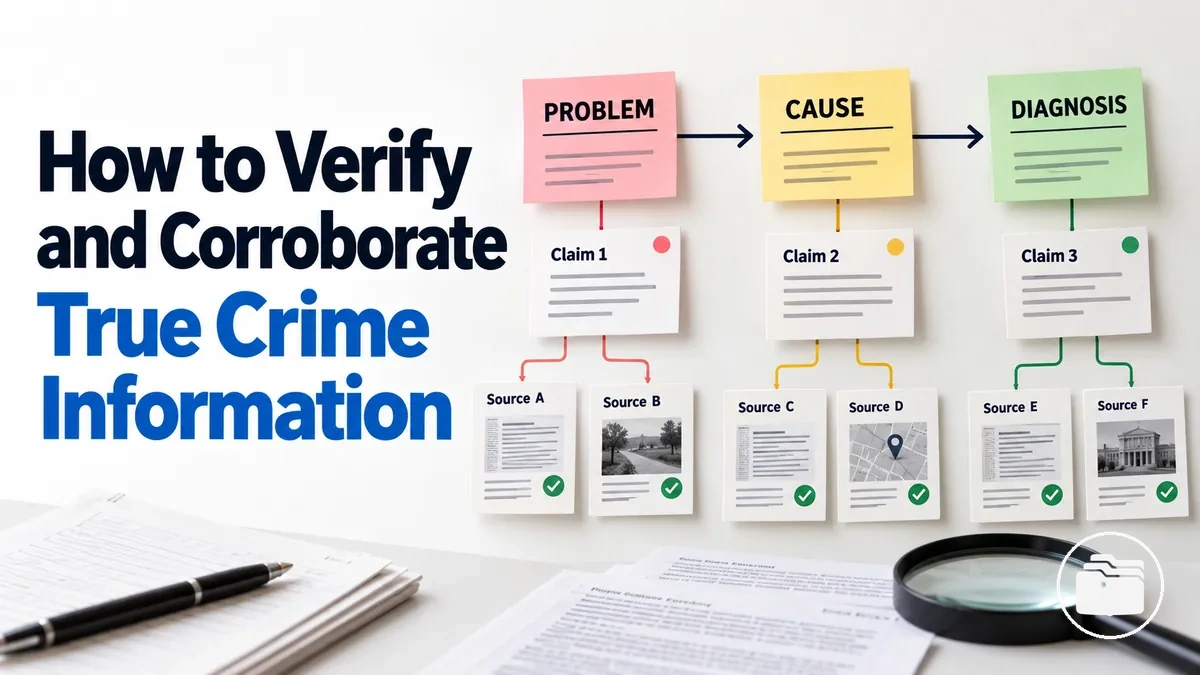
Claim verification workflow
Use these checks in sequence. A checked box records that the condition has been reviewed; it does not, by itself, prove the claim.
Key distinction: repetition is not independent corroboration when multiple reports share one source chain.
Table of Contents
How Verification Differs From Corroboration
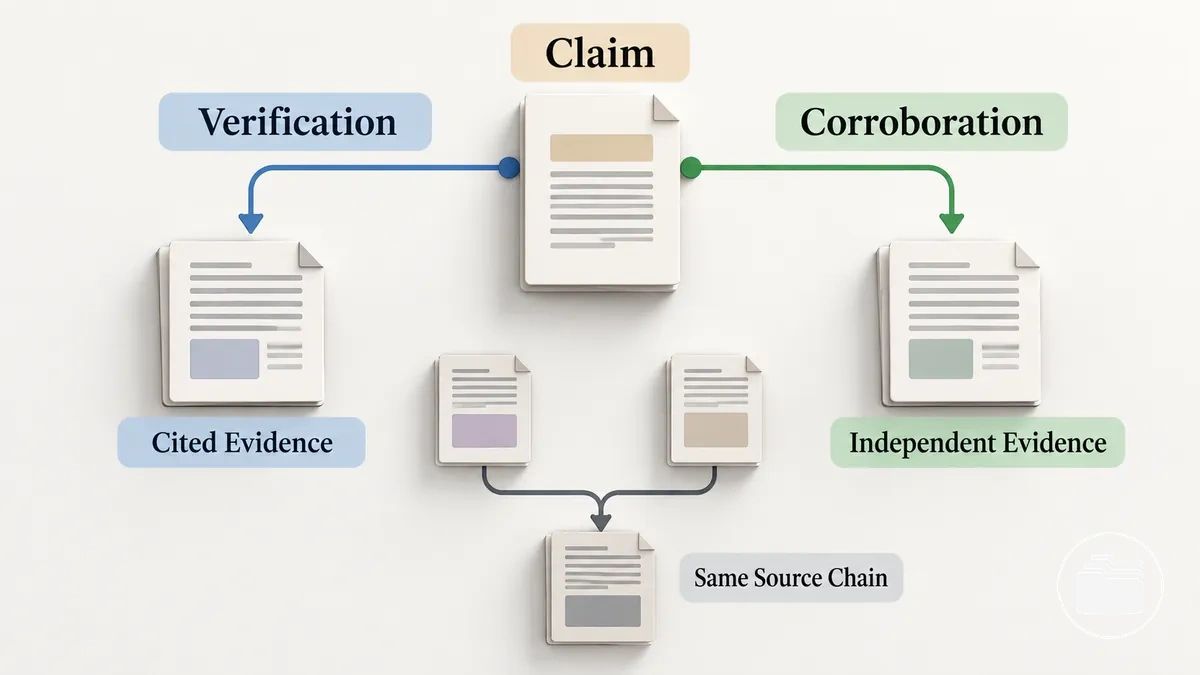
Verification and corroboration test the same claim through different evidence relationships.
Verification checks whether the cited evidence supports the claim as worded, while corroboration checks whether an independent source with separate provenance supports the same material point.
The comparison below separates their purpose, evidence relationship, independence, and effect on confidence.
The image illustrates source-chain provenance, while the table compares the two research functions.
| Dimension | Verification | Corroboration |
|---|---|---|
| Purpose | Tests whether the evidence associated with a claim supports its wording. | Tests whether separate evidence supports the same material point. |
| Evidence relationship | Compares the claim with its cited or underlying evidence. | Compares the claim with evidence from a separate source chain. |
| Independence | Independence is not the primary test; the focus is claim-to-evidence support. | The supporting evidence must have sufficiently independent provenance to add corroboration. |
| Confidence | Specific supporting evidence can strengthen confidence in the claim-to-source relationship. | Independent agreement on material details can strengthen confidence, while unresolved conflicts limit it. |
A claim can be verified against its cited source yet remain uncorroborated when no independent evidence supports it.
Repeated reporting does not necessarily add corroboration when multiple publications ultimately depend on one original report, because the resulting source chain is derivative rather than independent.
Define the Exact Claim Before You Check It
A claim must be specific enough to test before its evidence can be evaluated.
Define one testable proposition by fixing the subject, asserted event or relationship, date, location, source attribution, and any qualifier that changes its meaning.
The image labels these claim elements so their boundaries are visible before evidence checking begins.
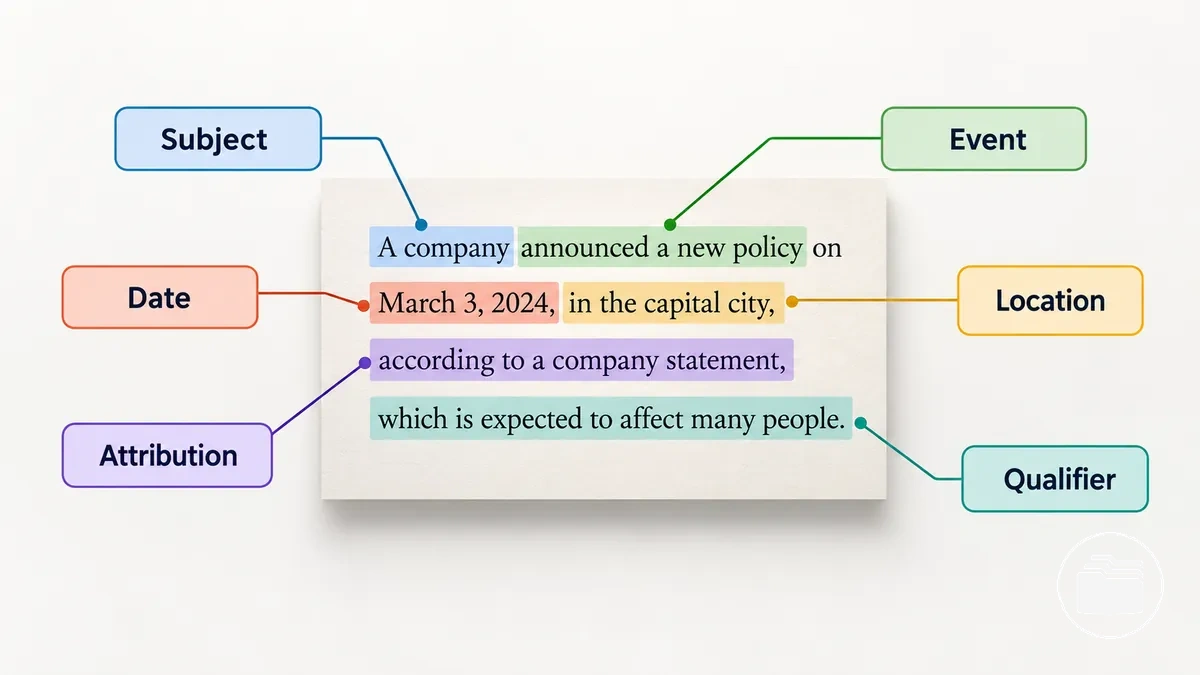
Each field affects verification scope because a mismatch or material qualifier can change what would count as support:
- Subject: identify the person, organisation, object, or event the claim concerns.
- Asserted event or relationship: specify exactly what is being claimed about the subject.
- Date: record the relevant date or bounded time reference when timing changes the proposition.
- Location: specify the place or jurisdiction when it affects which event or record is being described.
- Source attribution: preserve who made or reported the assertion when attribution forms part of the claim.
- Qualifier: retain wording such as approximate, reported, alleged, before, after, or according to a source when it materially changes the claim's scope.
“Person A was at Location B.”
“Source C reported that Person A was at Location B on 12 May.”
The narrower wording fixes source attribution, subject, location and date, turning the statement into a proposition that can be checked against evidence.
Verify the Claim Against the Evidence It Cites
Verify a claim by comparing its exact wording with the underlying evidence it cites, not with later summaries or assumptions.
The image illustrates the claim-to-evidence relationship so the source record and any unsupported extension remain visually distinct.
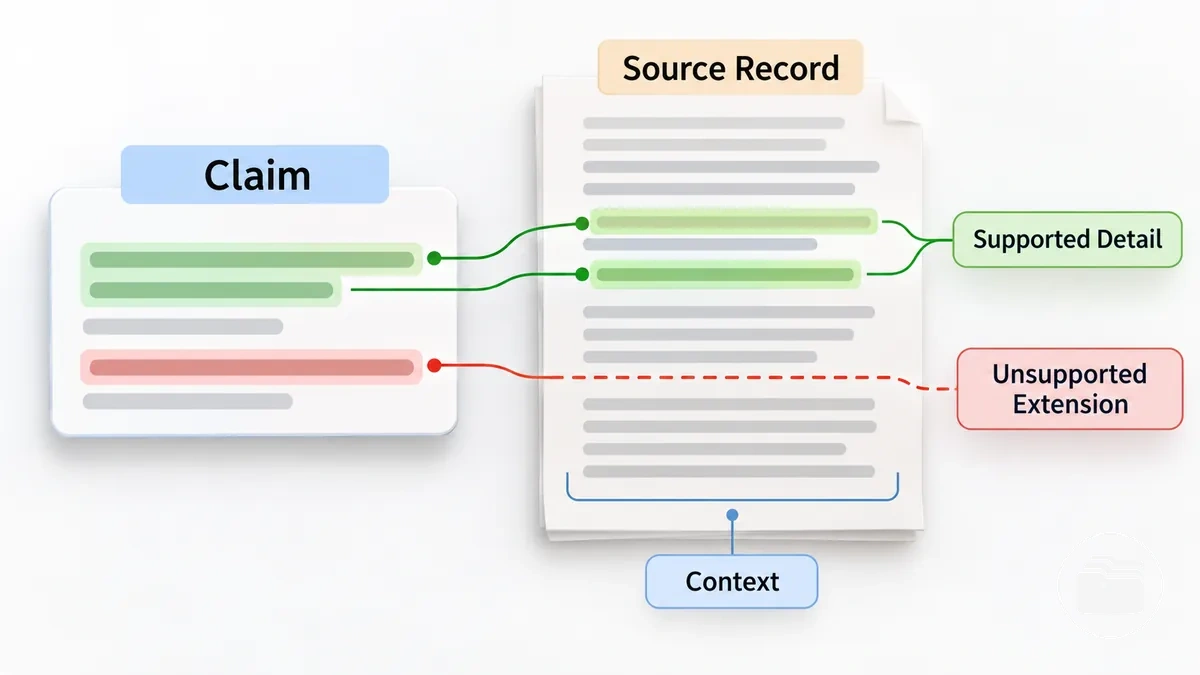
Separate evidence retrieval from interpretation by following the same sequence for each claim:
- Locate the underlying evidence: trace the citation to the original source record or closest available source material.
- Identify what the source states: record the relevant wording, event, date, relationship, or other detail without adding inference.
- Compare source and claim: check whether the cited evidence supports the claim with sufficient specificity, completeness, and context.
- Record any extension: identify details or conclusions in the claim that the underlying source does not directly or indirectly support.
Claim-to-evidence fit depends on source proximity, specificity, completeness, context, and the amount of inference required.
In a hypothetical example, a source record stating that Person A attended an event may support that attendance claim but not the stronger assertion that Person A participated in every activity there; that added detail remains unsupported unless the evidence establishes it separately.
Confirm That the Source Supports the Claim as Stated
Support depends on what the source statement actually establishes relative to the exact claim wording, including any limitation or inference.
The image shows where a generic claim matches the source record and where an overstated paraphrase exceeds it.
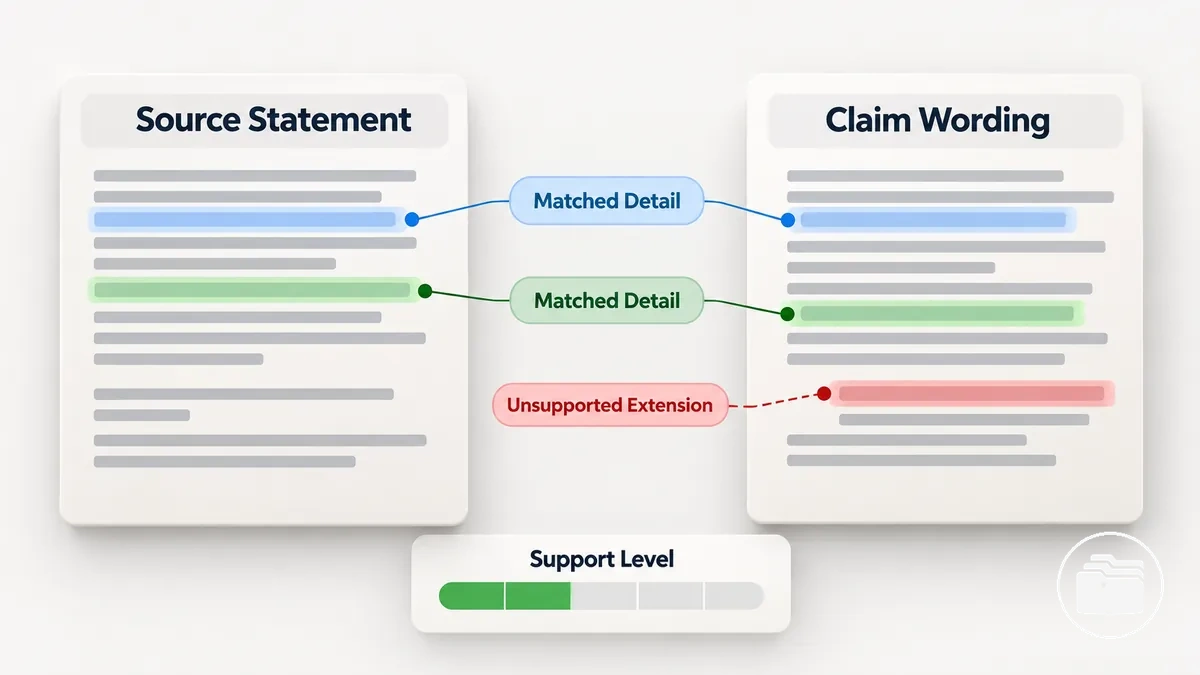
- Direct support
- The source explicitly establishes the material claim.
- Partial support
- The source establishes only some elements of the claim.
- Contextual support
- The source provides relevant context without establishing the proposition itself.
- Absence of support
- The evidence does not establish a required claim element.
For example, if a generic source states that Person A attended an event, paraphrasing it as Person A organised the event adds an inference beyond the literal source content; the attendance detail is supported, while the organising claim exceeds the source.
Check Names, Dates, Locations, and Case Identifiers
Concrete identifiers prevent evidence from being attached to the wrong person, event, record, or case.
The image labels the main disambiguation fields and highlights how one meaningful variant or mismatch can change which record is being verified.
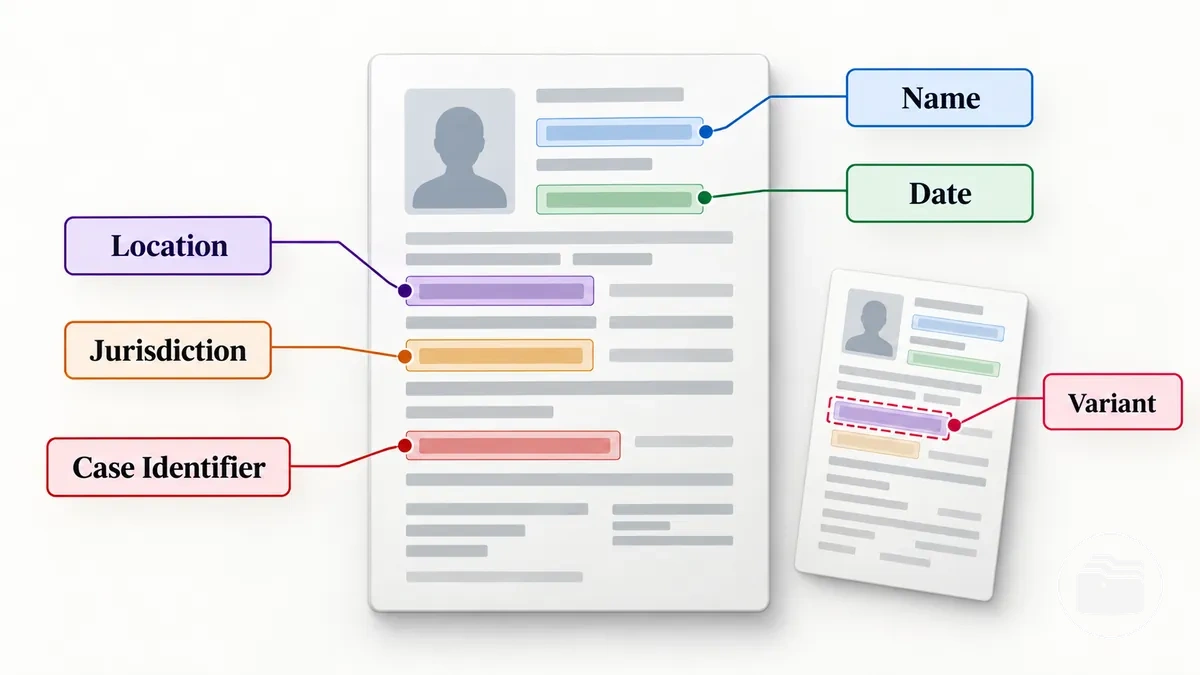
Treat each field as a disambiguation control, but distinguish substantive conflicts from variations that context resolves.
An alias, historical place name, approximate date, or different date convention may still refer to the same subject when the surrounding record supports that interpretation.
- Name: compare the recorded name with expected spelling variants and any known alias; an unexplained mismatch may indicate mistaken identity.
- Date: compare the stated date or time reference with the record and its date convention; a material mismatch may place the evidence in the wrong chronology.
- Location: match the place to the event being checked, allowing for changed place names when context clearly identifies the same location.
- Jurisdiction: confirm the relevant authority or geographic jurisdiction because similarly named places or cases can belong to different record systems.
- Case identifier: compare the available case number, docket reference, or equivalent identifier; a substantive mismatch may indicate that the wrong case record has been retrieved.
- Other unique identifiers: check any additional record-specific reference that distinguishes otherwise similar people, events, or documents without assuming that one matching field alone confirms identity.
Corroborate the Claim With Independent Evidence
Corroboration requires a genuinely separate evidentiary path that independently supports the same material claim.
A second publication does not add independent evidence when its information traces back to the same source chain.
Test provenance before treating agreement as corroboration, because repetition from a common origin is not independent confirmation.
Use the sequence below to separate source independence from agreement on the material fact.
- Identify the proposition: state the specific material fact that requires independent corroboration.
- Locate a separate evidence path: trace the provenance of the additional evidence and check that it does not merely derive from the first source chain.
- Compare material facts: assess whether the independent source agrees on the relevant fact with sufficient directness and specificity rather than merely using similar wording.
- Record agreement and limitations: note what the sources independently support, where they differ, and any limitation that reduces the corroborative value.
The strength of corroboration depends on provenance, independence, directness, specificity, and agreement on material details rather than on a fixed number of sources.
For example, a separately created documentary record that independently records the same material fact can add corroborative support, whereas several reports derived from one original report remain derivative reporting with limited independent value.
Distinguish Independent Sources From Repeated Reporting
Source independence depends on information origin, not publisher count.
Different websites, authors, or publication dates add corroborative value only when their evidence independently originates rather than tracing to the same source origin or citation chain.
- Provenance: trace where each source obtained the material; independently documented provenance supports independence, while a common origin suggests dependency.
- Citation chain: follow citations backward to determine whether apparently separate reports ultimately derive from the same underlying record or earlier report.
- Underlying record: direct access to separately obtained records can add independent evidentiary value, whereas several publications relying on one record remain part of one source lineage.
- Shared quotation: distinctive identical wording or a shared quotation may suggest that one report copied or derived material from another source, especially when provenance is unclear.
- Identical error: the same unusual factual error across reports can suggest a shared source chain, although the relationship should be verified rather than inferred from the error alone.
- Wire material: a report whose relevant information comes from common wire material or republished agency copy is a derivative source and adds limited independent corroborative value.
- Publication timing: close timing may help diagnose source lineage, but timing, publisher, author, or domain differences alone do not establish independence.
Apply these criteria together when distinguishing signals of independence from signals of a shared source chain.
For example, several reports may appear separate yet collapse into one evidentiary chain when each traces to the same agency report, while a source based on a separately obtained underlying record may contribute additional corroborative value.
Judge Corroboration by Evidence Quality, Not Source Count Alone
What determines corroborative strength
No universal number of sources determines whether a claim is adequately corroborated. Repetition can add little when the reports share one evidentiary chain.
Judge each source by the support it independently contributes. Stronger corroboration combines clear provenance, independence, directness, specificity and consistency, with the importance of the material claim also shaping how much support is needed.
- Directness: evidence that directly addresses the material fact contributes more support than evidence requiring several layers of inference.
- Reliability: a source with a clear basis for its information contributes more evidentiary strength than unsupported or poorly substantiated reporting.
- Independence: a source adds independent support when its relevant information does not merely descend from the same source chain as existing evidence.
- Specificity: evidence that matches the precise person, event, date, place, or other material detail contributes more than vague or broadly related information.
- Consistency: agreement on material details can strengthen corroboration, while unresolved contradictions or substantial omissions can leave the claim uncertain.
- Provenance: clear provenance helps establish where the evidence originated and whether its corroborative value is independent or derivative.
- Material importance: the more central a claim is to the research conclusion, the more consequential limitations in directness, reliability, independence, specificity, consistency, or provenance become.
Resolve Conflicting Evidence Before Accepting the Claim
Conflicting evidence should first be reduced to the exact disagreement before either account is accepted.
The diagnostic flow below separates discrepancies that can be traced to documentary or contextual differences from conflicts that remain unresolved.
- Isolate the disagreement: identify the precise fact that differs between the sources rather than treating the entire accounts as incompatible.
- Test plausible explanations: check whether the discrepancy may result from source date, source proximity, terminology, jurisdiction, transcription, a later correction, document version, or confusion about the event or person being described.
- Compare underlying evidence: examine the records, documents, or other evidence supporting each statement and determine whether the apparent conflict reflects different source material or interpretation.
- Assign a provisional interpretation: resolve the discrepancy only when the underlying evidence supports an explanation; otherwise record the conflict as unresolved and limit confidence accordingly.
Decision boundary for conflicting evidence
A discrepancy may have a testable explanation when source date or proximity, terminology, jurisdiction, transcription, a later correction, document version or event identity accounts for the different wording or values.
Treat these as explanations to test against the underlying evidence, not as reasons to assume that the newest or most convenient account is correct.
If the sources still disagree on the same material fact after those checks, the conflict remains unresolved. Confidence should stay limited rather than being converted into a definitive conclusion.
Identify the Exact Point of Disagreement
A broad disagreement should be reduced to the smallest material proposition on which the sources actually differ.
Isolate the disputed attribute, such as the person, action, date, place, sequence, wording, record status, or event identity, and compare what each source states about that factual dimension before drawing a broader interpretation.
Key distinction
If the sources match on the person, action, date, place and sequence but use different wording, the difference may be terminological rather than substantive.
A different action, date, place, record status or event identity changes the proposition and should remain classified as a substantive disagreement until the underlying evidence resolves it.
Keep the Claim Unresolved When the Conflict Cannot Be Reconciled
Leave an unresolved claim unresolved when the available evidence cannot support one version with adequate confidence.
Uncertainty is an evidentiary state requiring qualification, not a research failure, and the criteria below identify conditions that justify withholding a definitive conclusion.
- Persistent material contradiction: when sources still conflict on a material fact after relevant checks, confidence remains limited and the claim should be reported as unresolved.
- Lack of independent evidence: when apparent support traces to the same information chain, the claim lacks sufficient independent evidence to resolve competing versions.
- Missing primary documentation: when primary documentation needed to distinguish the accounts is unavailable, further targeted checking may change the status if that supporting record becomes accessible.
- Equally plausible interpretations: when the evidence supports more than one plausible interpretation without a reliable basis for preferring one, the qualification should preserve that uncertainty rather than manufacture certainty.
- Unresolved identity or chronology: when an identity issue or chronology issue prevents the evidence from being tied confidently to the same person or event, the claim remains indeterminate until further checking resolves that condition.
Unresolved status should not create false balance when one account is materially better supported; wording can state that one interpretation has stronger support while the competing point remains unestablished.
The status may change if new independent evidence, primary documentation, or a resolved identity or chronology question materially increases confidence.
Record What the Evidence Establishes and What Remains Uncertain
The final record must separate what the evidence establishes from what remains unverified, disputed, or unknown.
Record the strongest claim element the supporting evidence can justify, then preserve any limitation or uncertainty that prevents a broader conclusion.
Record status and evidentiary basis together
- Established
- The supporting evidence justifies the material claim element; note any independent corroboration separately.
- Unverified
- The required claim element has not been established by the available supporting evidence.
- Disputed
- Sources conflict on the same material fact and the disagreement remains unresolved.
- Unknown
- The evidence needed to determine the material value is unavailable or does not establish it.
For each material claim element, record:
- what the supporting evidence establishes;
- what independent corroborating evidence supports;
- whether a material conflict remains;
- which limitation affects the interpretation; and
- what future evidence could revise the assessment.
Until that evidentiary basis changes, the conclusion should retain its qualification because transparent uncertainty is preferable to unsupported certainty in true crime research.