
Prioritizing Sources in True Crime Research
In true crime research, prioritize sources by how well they can establish the specific claim, not by source type alone. Give greater initial weight to evidence with clear provenance, strong claim fit, and appropriate directness, then assess authority, transparency, accuracy signals, independence, and timing; the resulting priority remains provisional until the information is verified.
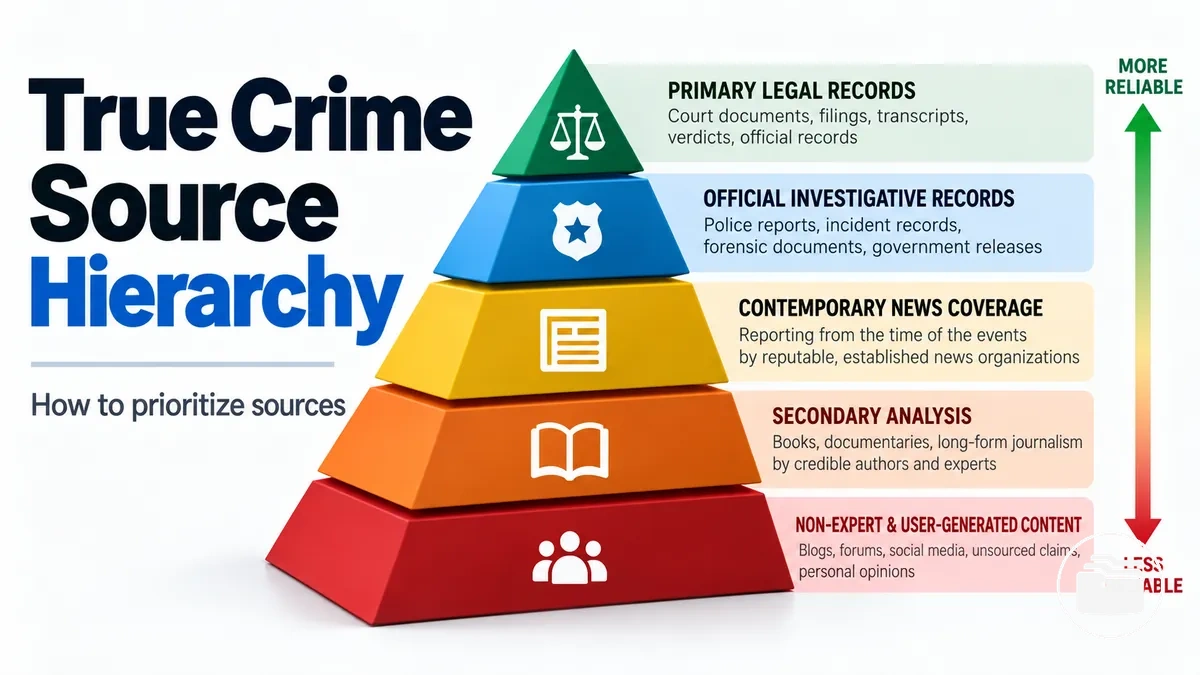
Source-priority decision path
Choose source priority from the claim, not the label
Use this sequence to decide which evidence deserves first attention before full verification.
- Define the exact claim. State the person, event, action, date, quotation, relationship, or interpretation that must be established.
- Identify the evidence relation. Decide whether the claim needs direct observation, an original or official record, attribution, or contextual synthesis.
- Evaluate source fit. Compare provenance, directness, authority, transparency, accuracy signals, independence, contemporaneity, and scope.
- Assign provisional weight. Prioritize the source that best fits the claim, while keeping its limitations visible and verifying the information separately.
Decision rule: a source type is never a permanent winner. The strongest initial source is the one whose traceable evidence most appropriately addresses the claim being tested.
A useful source hierarchy ranks evidence relative to the claim, not by source label alone.
The aim is to decide which source deserves greater initial weight while keeping reliability separate from assumptions that a source is automatically accurate.
That weighting depends on the source's provenance and traceability, its proximity and directness to the event or underlying information, its authority and transparency, observable accuracy-related signals, its independence, and its timing in relation to the event.
Each attribute changes evidential value only in context: close proximity can improve access to relevant information without eliminating error, while authority can strengthen credibility without removing limitations in scope or method.
Firsthand, primary, official, or institutional sources can still be incomplete, mistaken, biased, or narrowly focused; secondary sources can provide valuable context and synthesis without automatically carrying greater weight for the underlying claim.
Source prioritization therefore identifies which evidence merits closer attention before the separate work of source discovery, verification, factual-status classification, public-record evaluation, or archival research.
The next question for a source hierarchy is what characteristics it should measure when assigning that conditional source weight.
Table of Contents
What a Source Hierarchy Measures
A source hierarchy is a structured way to compare the evidential usefulness and reliability of available sources for a particular research claim.
It assesses how well each source fits the claim being examined and translates that fit into relative source weight rather than treating the source type itself as a fixed measure of credibility.
The source hierarchy measures attributes including provenance, or the traceability of a source's origin, and proximity, or its closeness to the event, record, or underlying evidence.
It also considers authority, transparency, independence, accuracy-related signals, and contemporaneity because each attribute can increase or limit evidential value depending on the research claim.
 Source weight therefore represents how strongly the available characteristics support using that source for the specific claim, not a permanent judgment about the source as a whole.
A source hierarchy evaluates fitness and evidential weight for a claim; it does not assign a permanent reliability score to a source type.
For example, an official record may deserve greater weight for establishing what an institution formally recorded while carrying less weight for an event the institution did not directly observe.
The relative priority therefore changes with the claim being evaluated.
Criteria for Evaluating Source Reliability
Source reliability should be evaluated by combining several criteria rather than treating any single signal as decisive.
The weight of each criterion depends on the research claim, because a source can show strong general credibility while remaining a poor fit for a particular fact or event.
Source-wide credibility signals include authority, expertise, transparency, observable accuracy practices, correction history, and independence, while claim-specific evidential fit depends more directly on provenance, proximity, contemporaneity, and relevance to the exact claim.
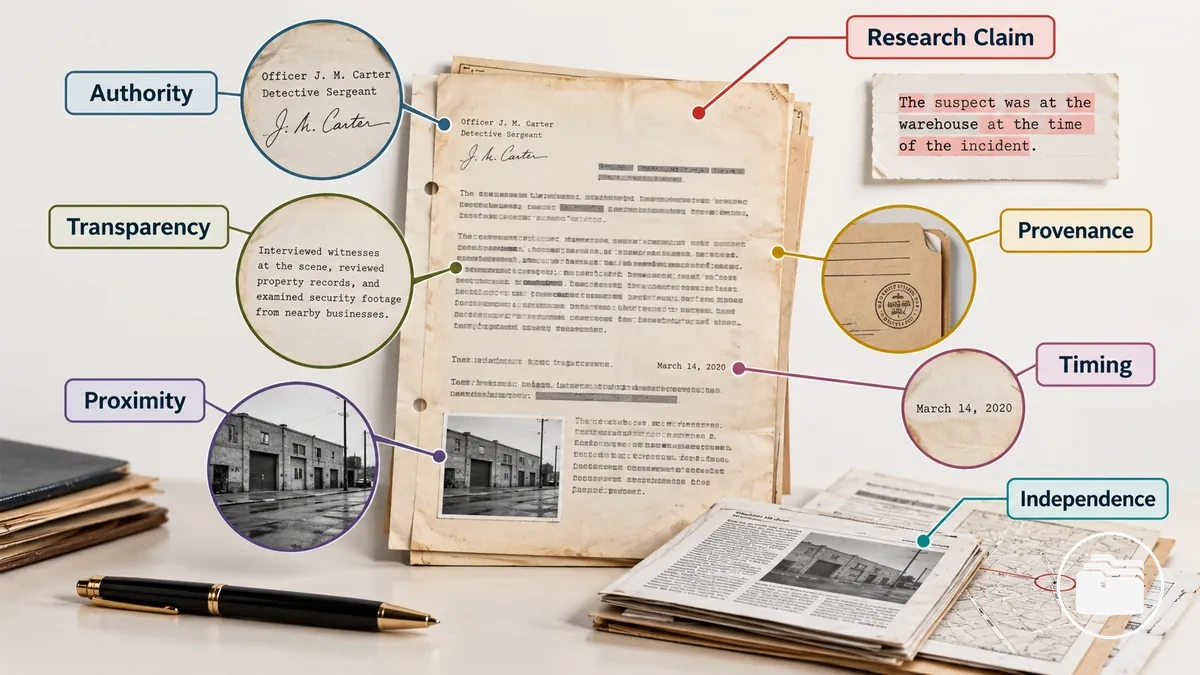 These dimensions interact, so institutional prestige or recent publication alone does not establish reliability.
The criteria represent different evaluation dimensions, and each one should be inspected for its condition and implication for source weight:
- Authority and expertise: Check whether the author or issuing body has relevant knowledge or responsibility for the subject; relevant expertise can support credibility but does not by itself establish the accuracy of a specific claim.
- Transparency: Check whether authorship, methods, sourcing, affiliations, and supporting information are visible; greater transparency makes the basis and limitations of the information easier to assess.
- Accuracy and correction history: Check whether claims are supported by evidence and whether errors can be identified or corrected; observable correction practices provide useful accuracy signals.
- Provenance: Check whether the origin and transmission path of the information are traceable; clearer provenance helps determine how the information reached the researcher.
- Proximity: Check how close the source is to the event, record, or underlying evidence; greater directness can increase evidential value for some claims without guaranteeing accuracy.
- Independence: Check whether the source provides independent information or repeats another account; independent sources can provide stronger support when evaluating a claim.
- Contemporaneity: Check when the information was created relative to the event or evidence; timing can affect usefulness when facts, records, or circumstances change.
- Claim fit: Check whether the source is capable of addressing the exact research claim; a source's evidential value depends on how well its scope and evidence match the question being investigated.
A highly authoritative but distant summary may be useful for broad context, while a less prominent source with direct, well-documented access may carry greater weight for a narrow event detail.
Reliability emerges from the interaction of criteria and their relationship to the research claim, not from a fixed score or universal ranking.
Provenance and Proximity to the Event
Provenance concerns where information originated and how traceably it travelled to the researcher, while proximity concerns how close the source is to the event, observation, record, or underlying evidence.
A source can have clear provenance but limited proximity, or close proximity with an uncertain transmission history, so the two attributes affect evidential weight in different ways.
Provenance is established by tracing the source origin and transmission chain: material may be an original source, a copied record, an edited document, a quotation, or a later intermediary account.
Proximity describes the degree of directness between the source and the event or evidence being examined.
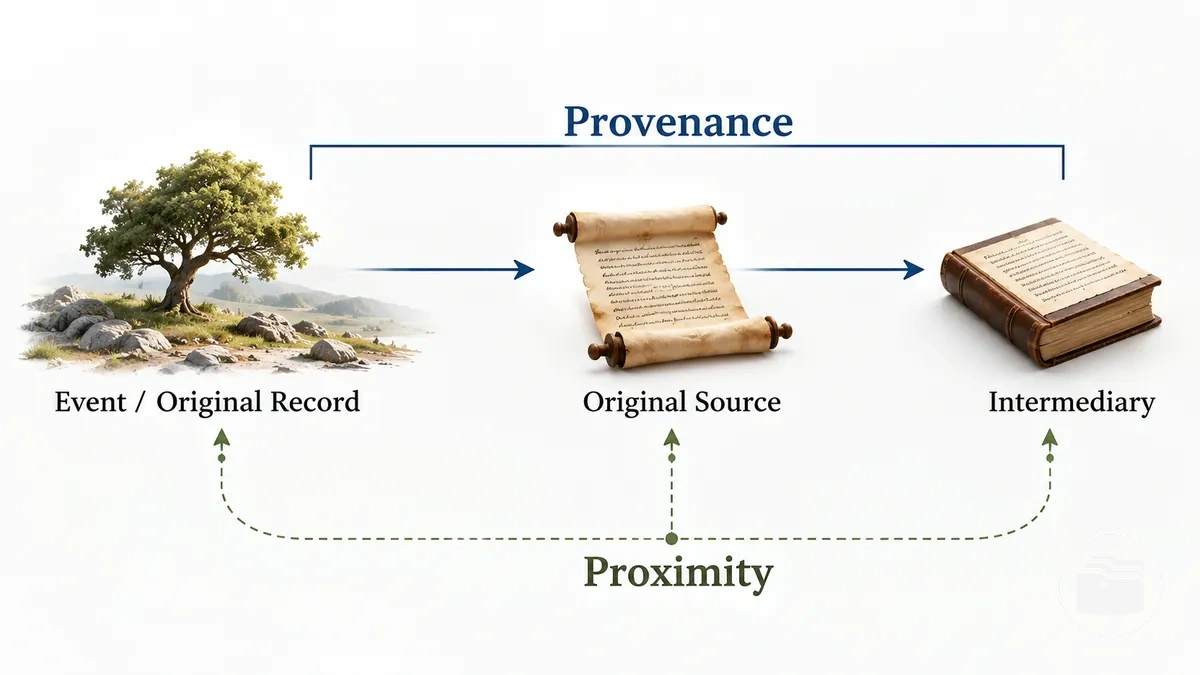 A shorter transmission chain can make context easier to trace, while greater proximity can make a source more directly relevant, but neither attribute by itself proves accuracy.
For example, in an older case, a later newspaper article that reproduces an earlier report may have traceable provenance but lower proximity to the original event than the contemporaneous report it cites.
That transmission history can introduce missing context or editorial changes, so provenance and proximity should be treated as separate conditions that affect evidential weight rather than as proof of accuracy; archival research is a separate task from evaluating these two attributes.
Authority, Transparency, and Accountability
Authority, transparency, and accountability answer different trust questions about a source, so they should be evaluated as distinct attributes.
Authority concerns relevant expertise or institutional competence, transparency concerns whether the source exposes its authorship, method, and sourcing, and accountability concerns whether responsibility, review, or correction mechanisms can be identified.
These attributes become useful when their observable features can be inspected rather than inferred from reputation or institutional status.
An attributable, method-transparent source gives the researcher more basis for interpreting its claims than an opaque source whose credentials, methods, or sourcing cannot be checked.
 The image highlights these inspectable features without treating any one of them as a guarantee of accuracy.
Authority without transparency does not create certainty.
- Authority and expertise: Check whether the author or issuing body has relevant knowledge or competence for the subject; relevant expertise can support credibility, while unrelated credentials provide limited evidence for the specific claim.
- Transparency: Check whether authorship, methods, sourcing, and supporting material are visible; greater transparency makes the basis and limitations of the information easier to interpret.
- Accountability: Check whether responsibility, review, or correction mechanisms are identifiable; observable accountability can provide useful evidence about how errors or disputed claims are handled.
- Affiliation disclosure: Check whether relevant affiliations or interests are disclosed; disclosure helps the researcher interpret the source's perspective and possible bias risks.
Accuracy, Independence, and Contemporaneity
Accuracy signals concern demonstrated factual care and correction history, independence concerns the source's separation from an interested party or originating account, and contemporaneity concerns timing and immediacy relative to the event.
These attributes are not interchangeable, because each can strengthen or limit evidential value under different conditions.
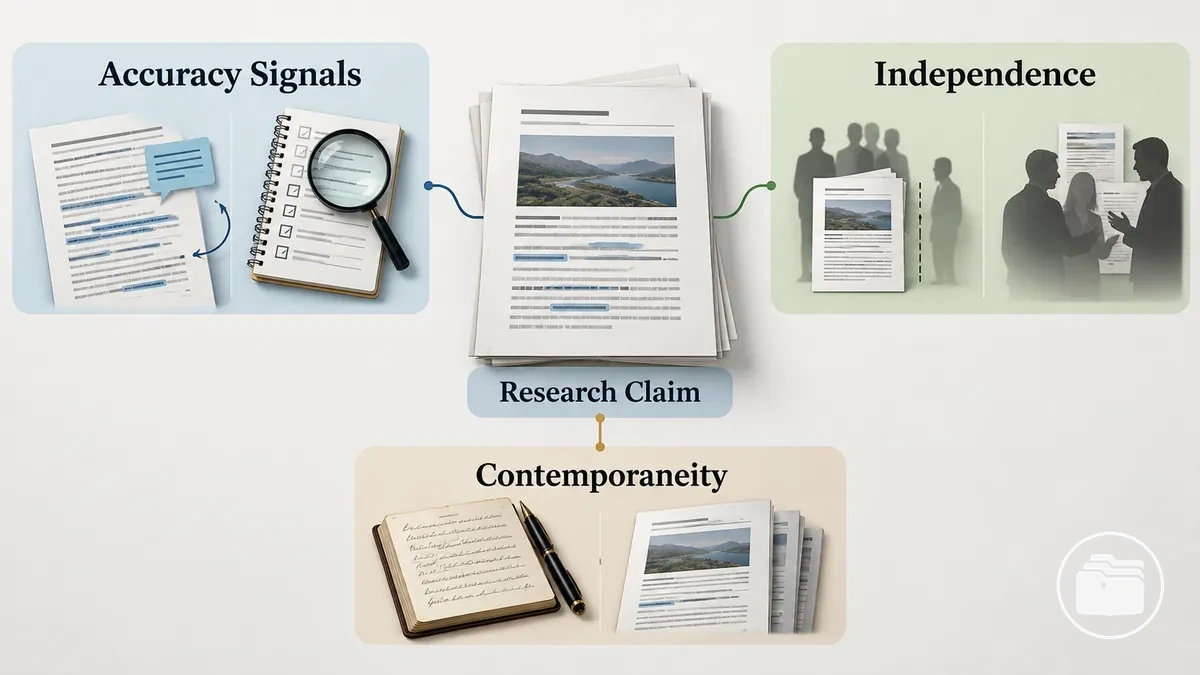
- Accuracy signals: Check whether the source demonstrates factual care through supported claims, identifiable corrections, or a documented record of handling errors; these signals can strengthen evidential value without guaranteeing that the current claim is correct.
- Independence: Check whether the source is separated from an interested party and whether its account is independently developed rather than copied from the same originating claim; greater separation can strengthen corroboration, but independence does not establish neutrality.
- Contemporaneity: Check when the source was created relative to the event and what information was available at that time; a contemporary account can preserve immediacy, while a later account can provide additional context but may be less direct.
Consider a contemporary eyewitness account with direct timing but limited correction history, alongside a later independent account that documents its sourcing carefully but is further removed from the event.
The first may have stronger immediacy, while the second may offer stronger independence or factual-care signals and added later perspective; the limitation is that neither advantage alone establishes reliability, and the relevant context is the research claim.
How Common Source Types Fit the Hierarchy
Common source classes provide starting expectations about evidential value, not fixed reliability scores.
Firsthand sources, primary sources, official records, institutional records, news reports, and secondary accounts can each occupy different positions depending on the research claim, so their source priority should be assessed in context rather than treated as a permanent tier.
The comparison below uses consistent dimensions: directness, traceability, accountability, contextual interpretation, and evidential role.
These dimensions describe typical tendencies for each source class, while the claim and available record context determine the weight given to a particular source.
| Source type | Typical strength | Typical limitation | Best evidential use |
|---|---|---|---|
| Firsthand or primary sources | Greater directness to an observation, event, or underlying material can preserve original detail. | Direct access does not eliminate error, selective observation, or missing context. | Establishing what a person directly observed or what an original source records when provenance and context are sufficiently clear. |
| Official or institutional records | Traceable documentation and identifiable accountability can clarify what an institution formally recorded within its scope. | The record may reflect only what the institution knew, recorded, or was responsible for, leaving other evidence outside that scope. | Establishing what an institution formally recorded, reported, or decided rather than treating the record as complete evidence of every underlying event. |
| News reports or secondary accounts | Contextual interpretation and synthesis can connect information from multiple sources and clarify chronology. | The account may be several steps removed from the underlying evidence and may inherit limitations from quoted or relied-upon sources. | Providing broader context or synthesis while using underlying records or more direct evidence for claims about what those records themselves state. |
These differences show why source type does not determine reliability by itself.
A firsthand source may provide strong directness but limited corroboration, while an official record may offer strong accountability within a defined scope without establishing everything that happened.
A news report may add useful contextual interpretation even when its evidential role is secondary to the underlying record.
For example, a secondary account can be useful for synthesising how an event was reported, while an underlying primary or official record is more directly suited to establishing what that record states.
The appropriate source priority therefore depends on the research claim, the source's traceability and context, and the limitations of the particular account rather than on a universal ranking.
Source Type Does Not Determine Reliability by Itself
Key distinction: classification is not reliability
Source type classifies the material
Labels such as primary, secondary, official, and news describe a source's origin or function. They are useful starting categories, not fixed credibility tiers.
Attribute evaluation sets evidential weight
Priority depends on the particular claim and on directness, provenance, transparency, accuracy signals, independence, contemporaneity, scope, and other relevant limitations.
For example, a primary account may be close to an event but incomplete, affected by limited observation, or missing important context.
A well-sourced secondary account may provide greater contextual depth and clearer traceability across multiple accounts, making it useful for interpretation while remaining further removed from the underlying event.
Neither position is automatically decisive, because the strengths and limitations of each source depend on the claim and the available evidence.
Firsthand and Primary Sources
Firsthand and primary are related, but not identical
- Firsthand source
- Information based on direct observation or experience, such as an eyewitness account.
- Primary source
- Original material or the first recorded layer relevant to the claim, such as an original record.
- Relationship
- A source can be firsthand, primary, or both; the label describes origin or access rather than guaranteed accuracy.
- Evidential value
- Primary status can increase directness for a particular claim, but weight still depends on perspective, timing, preservation, traceability, context, and other limitations.
The evidential value of a firsthand or primary source depends on directness, contemporaneity, perspective, memory, perception, preservation, and traceability.
A source created close to the event may preserve useful detail, while limited observation or later alteration can restrict what the source reasonably establishes.
Memory and perception can affect a firsthand account, and self-interest or missing context can also shape its evidential value.
An original record may have strong traceability while still reflecting a defined scope or recording purpose.
For example, an eyewitness recollection may provide direct evidence about what that person observed, but memory, perception, perspective, or self-interest can limit what it establishes.
A contemporaneous original record may preserve a different set of details, yet its scope, preservation, or later alteration can also affect its evidential value.
The two sources can therefore carry different strengths and limitations even when both are primary, so the specific claim determines what each can reasonably establish.
Official and Institutional Records
Official and institutional records are attributable records created by an agency, court, institution, or other accountable body for a defined administrative, legal, investigative, or reporting purpose.
Their evidential value comes partly from identifiable creation context and recordkeeping responsibility, but official status does not make a record complete, neutral, or automatically correct.
What the record can establish depends on its purpose, scope, recording rules, and the type of statement it contains.
Before assigning high priority to an official or institutional record, check the attributes that determine what the document actually represents.
These checks help distinguish the existence and wording of the record from the underlying event, allegation, observation, or institutional conclusion.
- Issuing body: Identify the agency, court, institution, or other accountable body that created or issued the record, because its role defines the record's creation context.
- Record purpose: Determine whether the record was created for an administrative, legal, investigative, operational, or reporting purpose, since purpose shapes what information was collected and retained.
- Creation date and version: Check when the record was created and whether later versions or amendments exist, because timing can affect which information and wording the record contains.
- Scope: Establish what people, events, period, jurisdiction, or activity the record covers, because a record may be authoritative within its defined scope while saying little about matters outside it.
- Definitions and recording rules: Check how relevant terms, categories, observations, or events were defined and recorded, because institutional rules can determine what appears in the document.
- Amendments and omissions: Look for later amendments, corrections, missing material, or known gaps, because the current record may not represent every earlier version or every relevant fact.
- Statement type: Distinguish an observed fact or procedural event from an allegation, reported claim, or institutional conclusion, because each statement type carries a different evidential implication.
For example, an official record can establish that an agency created a document, that the document contains particular wording, and that a stated procedural event was recorded; it does not automatically prove an allegation or the accuracy of every institutional conclusion.
The record's evidential weight therefore still depends on its scope, recording context, amendments, omissions, and statement type when evaluating public records.
News Reports and Other Secondary Accounts
A secondary account is information that synthesizes, interprets, or relays material from other sources, while a news report is a common form of secondary reporting that may draw on official statements, records, direct interviews, firsthand accounts, or prior reporting.
Its evidential usefulness depends on how clearly it identifies the underlying evidence and source chain, rather than on the publication label or outlet reputation alone.
For example, a news report that identifies an underlying record and distinguishes that record from the reporter's interpretation gives the researcher a clearer basis for evaluating the claim.
A report that merely repeats an unattributed assertion leaves the underlying evidence and intermediary chain unclear.
The difference is therefore the transparency of the source chain and the report's evidential role, not the reputation of the outlet alone.
How to Prioritize Sources for a Specific Claim
Source prioritization should start with the research claim, because the source that deserves the most attention depends on what the claim requires as evidence.
Define the proposition first, then identify the evidence relation that could most directly establish or contextualize it.
A useful rule is to prioritize the source that best fits the claim while still meeting relevant credibility criteria.
The sequence below converts the claim into source-priority decisions rather than a universal ranking.
Each step connects the claim, the evidence needed, and the relevant source attributes to a provisional evidential weight.
- Define the research claim: State the specific proposition being investigated, including the relevant person, event, action, date, relationship, or interpretation where those details determine what evidence is needed.
- Identify the evidence needed: Determine whether the claim calls for direct evidence, an original record, a procedural record, contextual interpretation, or another evidence relation that could address the proposition most directly.
- Evaluate candidate-source attributes: Compare candidate sources for claim fit, directness, traceability, transparency, and general credibility, while noting limitations that could reduce their usefulness for this particular claim.
- Assign provisional priority: Give greater initial attention to the candidate whose source attributes most closely match the evidence requirement, without treating that priority as proof or a fixed hierarchy.
- Retain supporting context: Keep secondary or contextual sources that help interpret the primary evidence, explain relationships, or provide useful background even when they are not the strongest source for the central claim.
General credibility and claim fit should be considered together.
A source can have strong traceability or a credible provenance while still being poorly suited to a claim that requires direct evidence, whereas a source with direct access may deserve closer attention despite having narrower context.
The provisional priority therefore reflects fitness for purpose and evidential weight rather than a universal source score.
For a procedural date, a record created as part of the relevant procedure may receive higher initial priority because its content directly addresses when that event was recorded.
For an interpretive claim about why an event occurred, a source offering broader contextual evidence may deserve more attention, even if it is less direct.
These priorities remain provisional; the separate task of verifying information from sources tests the information more fully after sources have been prioritized.
Match Source Priority to the Claim Being Evaluated
A research claim or proposition determines the evidence relation required, so claim type changes which source attributes matter most and therefore changes source priority.
The attribute that must be established may be a date, a quoted statement, or broader context, and each evidential need can favour different source characteristics.
Source priority should therefore reflect claim fit rather than a universal source winner.
First identify what the claim requires to be established, then identify which source characteristics best satisfy that evidential need.
The table maps the claim, evidence relation, and source characteristics to a priority implication without treating the mapping as a deterministic rule.
| Claim need | Evidence relation | Source characteristics | Priority implication |
|---|---|---|---|
| Establishing a filing date | Direct evidence of the date recorded for the filing | Dated record, clear provenance, traceability to the relevant filing | Prioritize a source that directly records the filing date; contextual reporting can provide supporting context. |
| Documenting a quoted statement | Evidence attributable to what the person said | Firsthand record, transcript or recording, clear attribution, relevant timing | Prioritize a source that preserves or directly attributes the statement, subject to its scope and limitations. |
| Explaining broader context | Synthesis and interpretation across relevant evidence | Transparent sourcing, contextual depth, identifiable underlying evidence, clear separation of evidence and interpretation | Give greater initial weight to a source that adds traceable context while retaining more direct sources for narrower claims. |
A filing date creates an evidential need for a directly dated record, while a quoted statement creates a stronger need for attribution to the speaker and an appropriate firsthand record.
A contextual claim can instead require synthesis across several sources, so the relevant source priority changes with the attribute being established.
This claim-to-source fit is separate from the task of classifying factual status.
Prefer Direct and Traceable Evidence Over Retellings
How transmission can change source priority
- Underlying evidence
An original record, direct observation, or other close source can make provenance and attribution easier to inspect. - Intermediary account
A secondary account can preserve useful information and add context, while also compressing, selecting, or interpreting material. - Later retelling
Additional layers can make the chain harder to trace and can reduce retained context or attribution, although a retelling does not automatically introduce error.
Priority rule: when claim fit is otherwise comparable, prefer direct and traceable evidence. Directness does not guarantee truth, and a secondary source can still be more useful when the task is context, orientation, or synthesis.
For example, suppose a later report repeats a claim attributed to an earlier account.
Tracing that statement backward to the earliest available identifiable source may reveal an underlying record whose wording is more specific than the later retelling; that record would generally receive greater initial priority for establishing what was actually recorded, while the later account may still provide useful orientation.
The priority difference reflects traceability and retained context, not a guarantee that the earliest source is automatically accurate.
When a Lower-Ranked Source Can Be More Useful
A lower-ranked source can still be useful when the research task is different from establishing the central claim.
Its orientation, synthesis, terminology, or contextual value may help locate an original source or understand the surrounding issue, while its limitation remains relevant to its proof strength and evidential usefulness.
- Orientation: A news summary may help identify the event, terminology, or documents associated with a research question, but its secondary position limits its use for establishing the underlying claim; it is appropriate for navigation toward stronger evidence.
- Locating an original source: A secondary account that names an official filing or underlying record can provide useful source-locating information, even when the account itself is not the strongest evidence for the filing's contents.
- Synthesis: A reputable secondary analysis may connect several records and explain relationships among them, providing contextual usefulness that a single original source may not provide; the synthesis should not replace the underlying evidence for narrower factual claims.
- Terminology and context: A secondary source can clarify terminology or provide background that makes an original source easier to interpret, but that interpretive value does not remove the source's evidential limitations or increase its proof strength automatically.
Contextual usefulness and proof strength are different values.
A lower-ranked source may therefore deserve attention for a specific research task while stronger evidence remains necessary for the underlying claim.