
Finding Sources for True Crime Research
To find sources for true crime research, define the factual gap first, then search with the strongest supported identifiers—such as names, dates, jurisdiction, agencies, case or docket numbers, and document titles—through the channels most likely to hold the material. Trace citations and named records toward the most direct available source, while keeping the key boundary clear: source discovery is not verification.
Source discovery path
Move from a defined information gap to a documented source trail. Each stage produces the input for the next one.
Define the gap
Research question → evidence targetSpecify the event, person, claim or document that still needs support.
Capture identifiers
Known details → search anchorsRecord supported names and variants, dates, location or jurisdiction, agencies, case or docket numbers, and document titles.
Choose the channel
Evidence type → likely record holderMatch the target to news archives, court or government portals, libraries, archives, databases, or another lawful access route.
Trace provenance
Located source → underlying materialExtract citations, bylines, document references and identifiers, then follow them toward original reporting, records or first-hand material.
Recover blocked sources
Retrieval problem → controlled variationDiagnose the obstacle, preserve the strongest known details, and vary one uncertain identifier or access route at a time.
Prepare verification
Traceable trail → documented hand-offBegin verification when major factual questions have a source path, provenance is recorded, and unresolved gaps are explicit.
Decision boundary: a source becomes a verification candidate when it is traceable to the research question; finding it does not establish that its contents are accurate or true.
Availability can change with jurisdiction, time period, digitisation, record status and access rules, so failure in one channel does not show that the material is unavailable everywhere. Keep the search lawful and provenance-preserving: use public or properly accessible material, record where each candidate source came from, and carry unresolved gaps forward instead of converting uncertainty into fact.
Table of Contents
Define What You Need to Find Before You Search
A useful search begins by converting a broad case topic into a specific information need before opening search tools.
The source-finding objective should state the research question, identify the information gap, and name the evidence target that could answer it.
A research question defines what must be known, while the evidence target identifies the document or material that should be sought.
Set the search priority according to the kind of information gap involved.
A question about an event points toward material documenting what happened, when, or where; a question about a person points toward material documenting that person's identity, role, or recorded actions.
A claim requires material that records or supports the specific assertion, while a known document creates the narrower target of locating that document or an accessible copy.
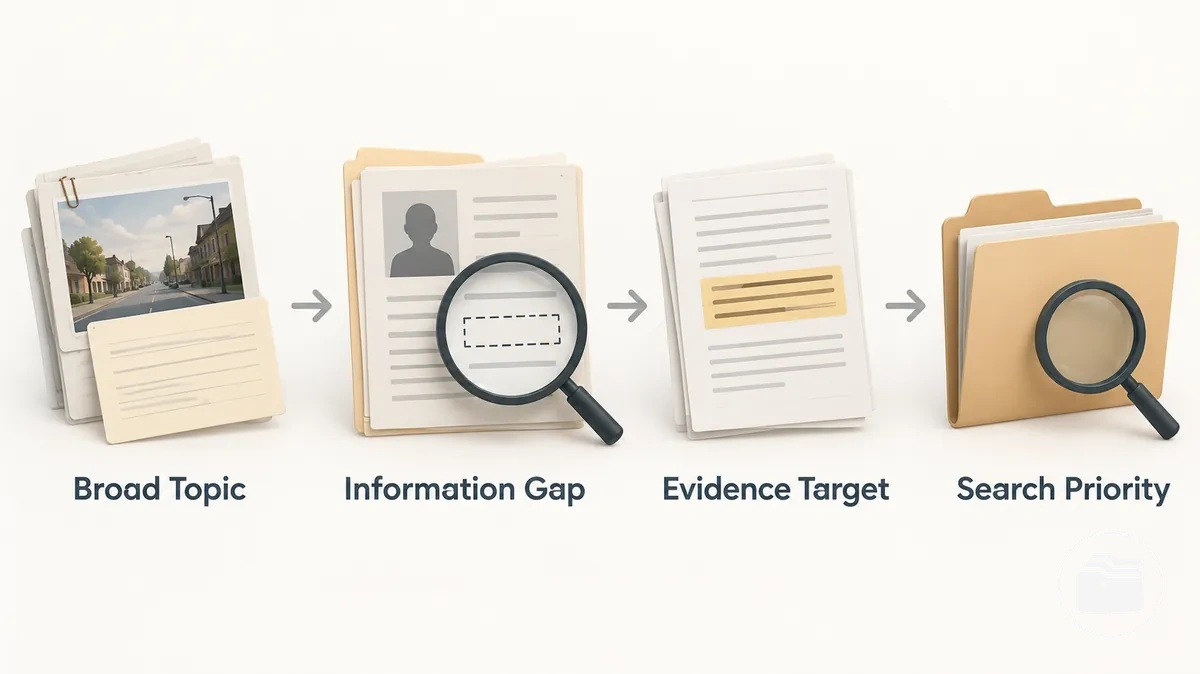
The diagram distinguishes the broad topic from the information gap and evidence target, while the numbered sequence defines the planning decisions.
Using that sequence prevents broad searching before the information gap is specific enough to guide the search.
- Define the goal: state the specific research question rather than the general case topic.
- Identify the information gap: specify the event, person, claim, or document for which information is missing.
- Select the evidence target: name the material that could answer the research question without treating that target as verified evidence.
- Set the search priority: check whether the target is specific enough to search using the known details; if it remains ambiguous, narrow the research question before searching.
For example, an unfocused question such as “What happened after the incident?” can be narrowed to “What official action was recorded immediately after the event?” The information gap is the recorded official action, and the evidence target becomes a document or contemporaneous record describing that action.
That target gives the search a specific priority without expanding into the entire case topic.
List the Events, People and Claims That Need Sources
Inventory the specific events, people, and claims that still lack source support so each unsupported factual point becomes a separate source gap.
Record what needs documentation without deciding whether the underlying statement is true or false.
The image organizes these three object types by the information each one still needs, making the different documentation needs easier to distinguish before searching.

- Events
- Date or time of an event needs source support when the timing is undocumented, creating a source gap for a dated record or contemporaneous document.
- Location needs support when the place is uncertain, creating a source gap for material that identifies where the event occurred.
- Participants need support when involvement is unclear, creating a source gap for a document that names or records the people present.
- Official action needs support when a response or decision is asserted without documentation, creating a source gap for the relevant official record.
- People
- A person's name needs support when identity or spelling is uncertain, creating a source gap for a record that identifies the person.
- A stated role needs support when the person's relationship to an event is undocumented, creating a source gap for material recording that role.
- An attributed statement needs support when its origin is missing, creating a source gap for a transcript, recording, document, or other attributable source.
- Claims
- A factual claim needs support when no underlying document has been located, creating a source gap for material addressing that specific assertion.
- An attributed claim needs support when the named source is unclear, creating a source gap for material that establishes the attribution.
- A claim referring to an official action or finding needs support when the relevant record is absent, creating a source gap for the document containing that information.
For example, a fictional event entry might have separate source gaps for its date, location, participants, and any recorded official action rather than treating the event as one unsupported item.
Separating those factual points shows exactly which missing evidence or document each part requires.
An identified source gap marks a documentation need; it does not make the unsupported item a verified fact.
Record Names, Dates, Locations and Case Identifiers
Names, dates, locations, jurisdictions, and case identifiers reduce ambiguity by narrowing which person, event, agency, or record a search should retrieve.
A full name can distinguish one person from others with similar names, while an alternate name, alias, or spelling variant can broaden retrieval when the recorded form is uncertain.
Dates and locations further constrain the search by linking the research subject to a particular time, place, or jurisdiction.
The annotated example shows where these identifiers can appear in a fictional research note and how uncertain values can be marked without treating them as established facts.
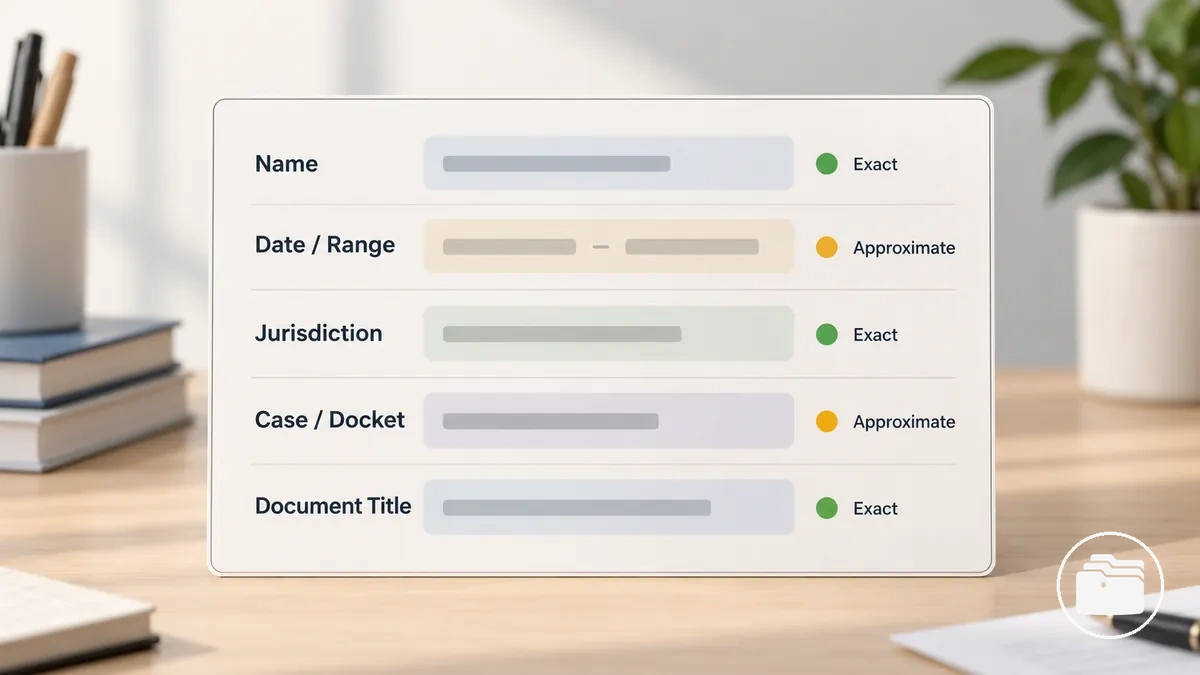
An identifier should be recorded with its state as well as its value: exact when the detail is established in the available material, approximate when only a range or partial value is known, alternate when more than one form may apply, and unknown when no usable value has been found.
A case number is a reference assigned within a relevant case or record system, while a docket number is typically a court reference used to distinguish a particular proceeding or file.
A distinctive document title can also narrow retrieval when the title or a close variant is known.
The table connects each identifier type to its usable state and search implication; uncertain identifiers remain search conditions to refine, not facts to assert.
| Identifier type | Usable value or state | Search implication |
|---|---|---|
| Name | Full name, alternate name, alias, or spelling variant | Use the most specific supported form for direct lookup; test controlled variants when the recorded form is uncertain. |
| Date | Exact date, approximate date, or bounded date range | An exact date narrows retrieval directly; an approximate date requires searching a defined surrounding period. |
| Location / jurisdiction | Specific place, known jurisdiction, or broader location when the exact jurisdiction is unknown | Limits retrieval to records, archives, courts, or institutions associated with the relevant place or jurisdiction. |
| Agency | Known agency name or candidate agency when responsibility is uncertain | Directs retrieval toward the organisation that may hold or reference the relevant record while preserving uncertainty about responsibility. |
| Case / docket number | Exact reference number, partial reference, or unknown | An exact number may support direct lookup within the system that assigned it; a partial number requires supporting names, dates, or jurisdiction details. |
| Document title | Exact title, distinctive phrase, or approximate title | Supports title-based retrieval and controlled phrase variation without treating an approximate title as official wording. |
Match Each Research Question to the Kind of Evidence It Requires
The research question should determine the evidence type sought because different questions point to different source classes.
A case-specific question usually requires material tied to the particular event, person, proceeding, or statement, while a contextual question may require aggregate data rather than a case document.
Define the evidence target before searching so the source class matches the factual point being investigated.
The image illustrates the distinction between case-specific and contextual evidence needs without ranking source reliability.
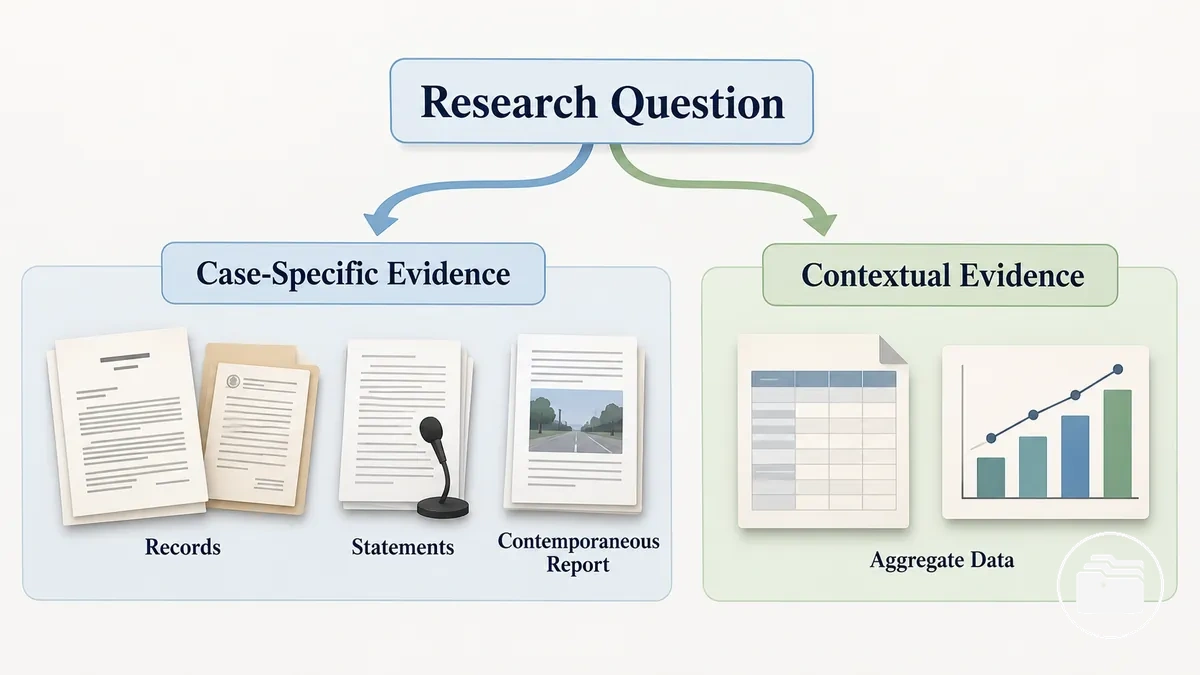
A question about charges points to a court record, filing, or other official record that states the charges in the relevant proceeding.
A chronology question points to dated records or contemporaneous reporting that can establish when an event was recorded as occurring, while a quoted statement points to an interview, transcript, recording, or document containing the attributed words.
Broader statistical context instead points to a dataset, agency statistics, or other aggregate data suited to population-level patterns rather than the facts of one case.
The table maps each research question to its evidence target, likely source class, and an important limitation without treating any source class as reliable by default.
| Research question | Evidence sought | Likely source class | Important limitation |
|---|---|---|---|
| What charges were recorded in the case? | A record stating the charges associated with the relevant proceeding | Court record, filing, or other official record | The record reflects the charge information documented for that proceeding and does not by itself establish the truth of the underlying allegation. |
| When did a particular event occur? | A dated record or contemporaneous account tied to the event | Official record, contemporaneous reporting, or other dated source material | Different records may use different dates for occurrence, reporting, filing, or publication, so the date attribute must match the research question. |
| What exactly was said or attributed to a person? | The quoted statement in its recorded context | Interview, transcript, recording, or document containing the statement | A secondary quotation may omit wording or context, so the material sought should preserve the attribution and surrounding statement where available. |
| How was an event described at the time? | Contemporaneous reporting or records created near the relevant period | News archive, dated publication, or contemporaneous record | Contemporaneous reporting documents what was reported at that time; it does not automatically establish that every reported detail was correct. |
| How common is a broader crime pattern? | Aggregate counts, rates, or other statistical context relevant to the defined population and period | Dataset, agency statistics, or aggregate data publication | Aggregate data provides contextual patterns and should not be used as evidence that a particular event or individual case occurred in the same way. |
If a research question could point to several evidence types, narrow the question by specifying whether the need is case-specific or contextual and what factual attribute must be answered.
That refinement turns an ambiguous question into a defined evidence target while keeping evidence selection separate from later reliability evaluation.
Build a Search Path from Known Details to Original Sources
A search path should move from stable known details toward progressively more direct source material.
Begin with a case-specific search anchor such as a name, date, jurisdiction, or known identifier, then use each located source to identify the next retrieval clue; the image demonstrates how one fictional source exposes a more specific identifier for the next search action.
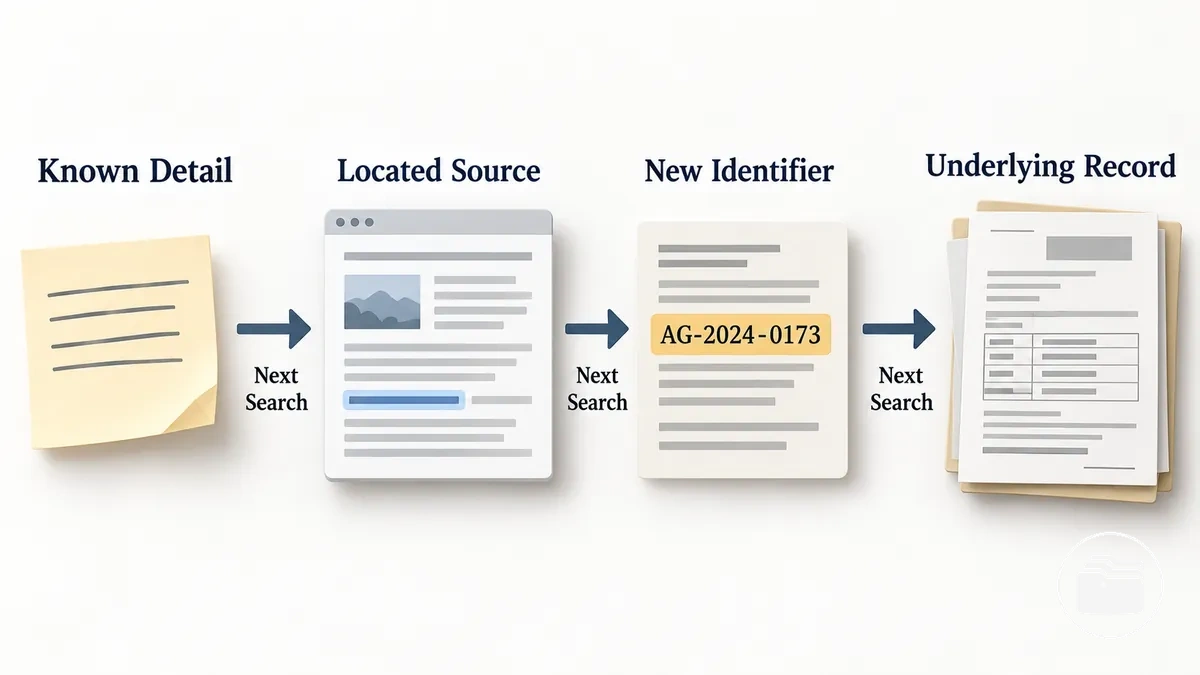
- Start with stable known details: choose the strongest available name, date, jurisdiction, case identifier, or document title as the first search anchor.
- Locate an initial relevant source: find material that clearly relates to the same case or research object through lawful public or authorised-access channels.
- Extract retrieval clues: note any citation, document reference, byline, agency name, court reference, record title, or other identifier that appears in the located source.
- Search the new identifier: use the newly discovered detail to make the next query narrower and move the retrieval path toward the material being referenced. Confirm only that the identifier actually appears in the located source; this does not verify the underlying claim.
- Follow the trail to its stopping point: repeat the locate-and-extract process until an underlying record or first-hand material is found, or until no further traceable reference can be retrieved through available lawful channels.
For example, a fictional article may cite a court filing using a docket-like identifier; searching that identifier may lead to a record index that supplies the title of the underlying filing.
Each located source therefore contributes a new search anchor rather than serving as a reason to broaden the search again.
This controlled progression keeps the citation trail connected to provenance clues while leaving reliability assessment and claim verification for a later stage.
A source trail may stop before an original source is available because records may be undigitised, restricted, missing, or inaccessible in the relevant jurisdiction.
When the trail ends, record the most direct material located and the unresolved document reference or identifier rather than assuming that a more original source does not exist.
Use Case-Specific Names, Dates and Identifiers as Search Anchors
Focused searches should combine the most stable case-specific search anchor with one or two narrowing details.
Start with a name, date, location, jurisdiction, agency, or case number that is already supported by the available material, then refine the query one variable at a time.
Exact identifiers can be searched directly, while approximate or alternate values should be represented with controlled query variation.
This approach keeps each refinement traceable to a known detail rather than disconnecting the search from the case.
- Start with the strongest name: search a supported full name or alternate name by itself to establish the initial retrieval set and observe which results relate to the correct context.
- Add a date: combine the name with an exact year or supported date when known; if the date is approximate, test a small number of nearby date variations rather than treating one date as established.
- Add location or jurisdiction: refine the same query with the relevant city, region, court jurisdiction, or other supported location when similar names or events remain mixed together.
- Add the agency: include a known agency name when the material sought is associated with that organisation, keeping the other search anchors unchanged so the effect of the new narrowing detail is clear.
- Use a case number when available: combine the supported case number with the relevant name, agency, or jurisdiction to target records connected to that identifier without assuming that a matching result confirms identity.
An exact name or case number supports a more specific query, while an approximate date, alternate name, spelling variant, or uncertain jurisdiction requires deliberate variation.
When a value is unknown, leave it out rather than inventing a search term; when it is approximate, vary only that uncertain element while holding the stronger search anchors stable.
Search matches remain retrieval candidates until the underlying material establishes their relevance.
Avoid changing several identifiers at once, because doing so makes it harder to determine which refinement improved or distorted the query.
Use One Located Source to Discover Related Material
A located source can supply embedded source clues for the next search without establishing whether the underlying claim is true.
- Located source
Use the candidate material as a discovery node rather than as proof of the underlying claim.
- Embedded clue
Extract a citation, document title, quoted official or interview subject, byline and date, court identifier, named report, filing, interview, publication, or collection name.
- Related material
Use that clue to target the referenced document, earlier reporting, court record, interview, agency or office, archive, catalogue, repository, or other directly related material.
These clues may be incomplete or repeated from another source, so use them as retrieval clues rather than as verification of the claim they accompany.
Choose Search Channels That Match the Material You Need
The right search channel depends on the evidence type needed, jurisdiction, time period, expected record holder, digitisation status, and access conditions.
A court database may fit a recent case-specific filing, while an archive or repository may be more appropriate for older material that is not fully digitised.
Channel choice should therefore follow the characteristics of the material rather than the visibility, cost, or popularity of a platform.
The criteria below organize the main conditions that determine whether a search venue fits the research need.
- Evidence type: identify whether the target is a court filing, agency record, news report, archival item, dataset, transcript, or another material type, because different source channels are built around different record categories.
- Jurisdiction: determine which court, agency, government portal, archive, or other institution is associated with the relevant place or legal authority, because coverage commonly follows jurisdictional boundaries.
- Time period: match the search venue to the period involved; recent material may appear in current databases, while historical material may require an archive, catalogue, or older repository.
- Record holder: identify the organisation expected to create, maintain, or catalogue the material, since the record holder often determines the most direct access route.
- Digitisation: check whether material from the relevant period has been digitised; incomplete digitisation may require catalogue searches, archival finding aids, or offline access rather than a full-text database.
- Access conditions: account for public access, registration, authorised institutional access, onsite consultation, or other lawful restrictions that may affect whether the material can be retrieved through that channel.
- Research need: distinguish case-specific retrieval from contextual research, because a channel containing individual records may not provide the aggregate data needed for broader statistical context.
These variables change channel fit without creating a universal hierarchy of databases or repositories.
If a known agency is the record holder and its material is digitised, that agency's public record system or government portal may provide the relevant access route; if the material predates its digital coverage, an archive or catalogue may be more appropriate.
Jurisdiction can narrow the available source channel to a particular court or government body, while access conditions may require a different lawful route even when the expected record holder is known.
A highly visible or paid database does not inherently fit a research need better if it lacks the required evidence type, period, jurisdiction, or record collection.
Case-specific research usually calls for channels that may contain records tied to a particular proceeding, event, person, agency, or identifier.
Contextual research instead may require statistical databases, agency aggregate data, or other sources designed to describe broader patterns across a defined population and time period.
Selecting between these channel types depends on whether the research need is an individual record or statistical context, not on treating one category as generally superior.
News Sites and Newspaper Archives
News sites and newspaper archives can surface contemporaneous reporting, historical coverage, interviews, updates, and references to underlying records connected to a case.
Current-site search may work for recent reporting, while a newspaper archive may be needed for older coverage that is no longer prominent or fully searchable on a publication's live website.
A later retrospective article may summarize earlier events or reporting, but it should not be treated as contemporaneous reporting merely because it describes historical material.
The fields below help narrow archival retrieval without assuming that every publication or edition is equally accessible.
- Name: search a supported person, organisation, agency, or case-related name, including a known alternate spelling when relevant.
- Date range: limit the search to the period surrounding the event or reporting window, especially when the archive contains many unrelated mentions.
- Location: add the city, region, court location, or other relevant place to separate similarly named events or people.
- Publication: restrict the search to a known newspaper, outlet, or publication when earlier reporting is expected from a particular source.
- Distinctive event terms: add one or two specific event descriptions, agency names, or document terms that remain closely tied to the case rather than broad topic words.
Publication date, dateline, byline, quoted participants, agency names, and a referenced document can provide retrieval clues for locating earlier coverage or more direct material.
For example, if a generic incident is known to have occurred in one location during a defined date range, combining that location with the date range and a distinctive event term can reduce unrelated archive results.
Retrieval can still be limited by OCR errors, missing editions, incomplete digitisation, paywalls, or archives that index metadata without exposing full text.
These limitations affect what can be found through a particular news archive, not the factual status or quality of the reporting itself.
Court, Police and Government Record Portals
Official record portals are searched most effectively by identifying the correct jurisdiction, record holder, record type, and case identifier before choosing an access route.
The relevant jurisdiction usually determines which court, police body, or government agency may hold the material, while the record type determines which part of that system should be searched.
A court record system may contain filings, dockets, opinions, or case entries, while a government agency portal may contain press releases, reports, or other public record material.
The criteria below organize the routing decisions needed before searching an official portal.
- Jurisdiction: identify the country, state, province, territory, local authority, or court jurisdiction responsible for the relevant matter, because the same record type may be held in different systems.
- Record holder: determine whether the likely holder is a court, police service, government agency, department, archive, or another official body.
- Record type: specify whether the target is a docket, filing, opinion, charge record, press release, report, case entry, or another official document so the correct section of the system can be selected.
- Identifier: use a supported case number, docket number, party name, date, agency name, or other identifier that the relevant official portal accepts for retrieval.
- Access route: check whether the material is available through public search, registration, a paid request, an onsite system, an authorised-access service, or another lawful route provided by the record holder.
Availability varies by jurisdiction, record type, digitisation, access restrictions, fees, and the policies of the court, police body, or government agency holding the record.
A public record may be searchable online in one jurisdiction but require a formal request or onsite access in another, and some records may be restricted, incomplete, undigitised, or unavailable to the general public.
Case numbers and docket numbers often narrow retrieval when they are known, while party names, dates, or agency names may be needed when an exact identifier is unavailable.
Locating an official record documents what the relevant body recorded or published; it does not by itself determine how every statement in that record should be interpreted or corroborated.
Library, Archival and Primary-Source Databases
Libraries, archives, and primary-source databases are useful when relevant material is historical, organised within a collection, described in a catalogue, or poorly surfaced by ordinary web search.
These discovery systems may index manuscripts, newspapers, oral histories, transcripts, photographs, government material, and other collection-based sources even when the underlying item is not openly searchable on the wider web.
A repository may provide a catalogue, finding aid, digitised collection, or primary-source database as the route into its holdings.
The list below groups the main discovery aids and metadata that can point from a collection-level description toward a more specific source target.
- Catalogue: identifies individual items or collections and may provide a title, creator, date, subject terms, format, repository, and other details that can become new search anchors.
- Finding aid: describes the structure and contents of an archival collection and may identify series, folders, creators, dates, collection titles, or accession information needed to narrow a request.
- Digitised collection or primary-source database: may provide searchable descriptions, transcripts, page images, or digital copies of selected underlying items when those materials have been digitised.
- Newspaper database: indexes historical newspaper material and can surface articles by publication, date, name, location, or subject term when ordinary web search does not expose the archived issue.
- Oral history or transcript collection: may catalogue interviews, recordings, or transcripts by interviewee, interviewer, date, project, collection title, or repository.
- Manuscript and archival description: can point to letters, files, reports, photographs, or other materials through collection names, creators, dates, folder descriptions, accession information, and repository identifiers.
A catalogue record or finding-aid description points to material but is not necessarily the primary item itself; its function may be to describe where the underlying source sits within a collection.
Collection title, creator, date, repository, accession information, and subject terms can then be reused as more specific search anchors or as details in a document request.
For example, a case-neutral collection description that names a creator, repository, date range, and accession reference may lead to a particular folder description and then to a digitised item or a request for that document.
Access still depends on whether the relevant material has been digitised and on the repository's access conditions, so a discoverable description does not imply that the underlying item is remotely available.
Use the descriptive record to refine the source target while keeping the catalogue or finding aid distinct from the item it describes.
Trace Secondary Coverage Back to Original Sources
Secondary coverage can be traced backward by extracting its attribution and following each cited source or named source toward the most direct available material.
This process maps source provenance rather than judging credibility: identify what source the coverage attributes a claim to, then follow that source chain one step at a time.
Compare publication date and document date where available so the chronology of reporting and underlying records remains clear.
The goal is to reach an original source, primary source, or other direct material when the trail supports that classification, not merely the earliest item that can be found.
- Identify the specific claim: isolate the statement in the secondary coverage whose provenance needs to be traced so later steps remain tied to one attribution chain.
- Extract the attribution: record the citation, named source, document title, agency, interview, report, court filing, or earlier publication that the coverage says the claim derives from.
- Locate the attributed material: search for the cited source or named source using its title, organisation, identifier, quotation, publication date, document date, or other available retrieval clue.
- Compare dates and source relationships: determine whether the located item predates the secondary coverage and whether it reports first-hand information or attributes the same claim to another source. A chronological predecessor is a useful provenance clue, but its earlier date alone does not make it a primary source.
- Continue or stop the trace: follow any further attribution toward more direct material until the source chain reaches a first-hand or underlying source appropriate to the claim, or until no additional cited or named source can be located through available lawful channels.
Likewise, a publication date records when an article appeared, while a document date may identify when the underlying record was created; those dates serve different roles in provenance.
Tracing therefore establishes how material derives from earlier sources without treating a successfully reconstructed source chain as verification of the underlying claim.
For example, a fictional secondary article may attribute a procedural update to an agency release.
The release may name a court proceeding and cite a filing, allowing the filing to become the next source target.
If the filing directly records the procedural action relevant to the claim, it may be the most direct available material for that point; if it cites another document instead, the provenance trail can continue.
The example shows how attribution moves the search from secondary coverage toward underlying material without assigning a credibility score.
Follow Citations, Links and Named Documents to Their Source
Citations, links, document titles, and bibliographic details should be converted into exact retrieval fields before broad searching.
Useful citation details include the author or agency, exact title, date, publication, case number, archive name, document type, and any identifier tied to the referenced item.
The more complete these fields are, the more precisely a cited source or record holder can be searched.
A live hyperlink is only one access route; the underlying source may still be retrievable from its citation elements when a link no longer resolves.
- Capture the citation elements: record the available author, agency, title, date, publication, case number, archive name, document type, and identifier exactly as they appear.
- Identify the record holder: determine which publisher, court, government agency, archive, repository, or other record holder is associated with the referenced item.
- Search the exact reference: use the exact title, case number, document identifier, or distinctive combination of author or agency, publication, and date before substituting broader keywords.
- Broaden only when direct lookup fails: reconstruct a partial citation by retaining the strongest known fields and varying only incomplete elements, such as a shortened title, uncertain date, publication name, or document type.
An incomplete reference should be treated as a set of retrieval clues rather than as the source itself.
For example, a partial citation containing an agency name, an abbreviated document title, a year, and an archive name can first be searched using that exact combination; if no direct match appears, the title can be shortened while the agency and archive name remain fixed.
A copied citation may contain an error or omit a field, so the located item should supply the authoritative title, date, publication, case number, or other bibliographic detail when available.
A dead link therefore narrows one access route but does not establish that the referenced material is unavailable elsewhere.
Separate Original Reporting from Repeated Coverage
Original reporting contributes first-hand reporting work or newly obtained material, while repeated coverage mainly relies on reporting that already exists.
Reporting provenance should be distinguished through observable signals in the individual article rather than publication prestige alone.
Signals can include a first-hand interview, an obtained document, direct observation, explicit attribution, syndicated text, and publication timing.
The comparison below organizes those signals by what they suggest about the source trail and what they can reveal for further discovery.
| Signal | Original reporting | Repeated coverage | Discovery implication |
|---|---|---|---|
| First-hand interview | The article reports an interview conducted by its named reporter or publication and presents material obtained directly from the interview subject. | The article repeats interview material while attributing the quotation or account to another outlet, reporter, transcript, or previously published source. | The interview attribution can identify the outlet or material to follow when reconstructing the source trail. |
| Obtained document or direct observation | The report states that its journalists obtained a document, examined records, attended an event, or made a direct observation relevant to the story. | The report describes the same document or observation through another publication's reporting rather than indicating independent acquisition or observation. | The named document, record, reporter, or earlier report becomes a target for locating more direct material. |
| Explicit attribution | The article may still cite other material, but it also identifies reporting work or information gathered independently for the article. | The article explicitly attributes central information to another outlet, agency report, interview, or previously published account. | Attribution identifies an earlier source that can be followed without assuming the current article originated the information. |
| Syndicated text or close repetition | Independently reported material normally identifies its own reporting contribution rather than presenting another publisher's text as its reporting work. | Syndicated text, credited wire copy, or closely repeated wording can indicate that the article derives from material produced elsewhere. | The syndication credit or named originating publication can point toward the earlier version of the coverage. |
| Publication timing | An earlier publication time may support a provenance inference when combined with independent reporting signals such as interviews, obtained records, or direct observations. | A later article may repeat, rewrite, or syndicate earlier coverage, but timing alone does not establish that relationship. | Compare timing with attribution and reporting signals; the earliest timestamp by itself does not establish originality. |
These signals can overlap, so a single article may contain independently reported material alongside repeated coverage from other sources.
Repeated coverage can still have discovery value when its attribution reveals the original outlet, an underlying document, or another useful point in the source trail.
For example, a later article may repeat details from an earlier report but name the agency document that the earlier outlet obtained; that reference can direct the researcher toward both the earlier reporting and the document itself.
Publication timing helps reconstruct chronology, but it should be interpreted together with reporting signals rather than treated as proof that the earliest item is original reporting.
Locate the Record, Interview or First-Hand Account Behind a Claim
The underlying first-hand material behind a secondary claim is located by identifying its source type, likely holder or repository, retrieval details, and access condition.
Determine whether the claim points to a record, interview, testimony, transcript, audio, video, letter, diary, or another underlying item, then identify the organisation or collection most likely to hold it.
Names, document titles, dates, case numbers, interview participants, collection references, and other identifiers make the lookup more precise.
The criteria below organize discovery routes to first-hand material rather than judging whether that material is accurate.
- Court or agency record: identify the relevant court, government agency, or official repository, then search with a case number, docket number, document title, party name, filing date, or other supported identifier; the access condition may involve public search, authorised access, a formal request, or another lawful route.
- Interview or testimony: identify the publisher, broadcaster, court, hearing body, archive, or repository that created or preserved the interview or testimony, then use the participant name, interviewer, hearing name, date, programme, or proceeding as retrieval details.
- Transcript, audio or video: trace the recording to the organisation, broadcaster, court, archive, or collection responsible for the underlying media, using a title, speaker, event, date, episode, proceeding, or recording identifier where available; access may depend on whether the material was published, deposited, digitised, or restricted.
- Letter or diary: look for the archive, library, estate collection, institutional repository, or digitised collection that catalogues the material, using the creator, recipient, date, collection name, folder reference, or accession identifier to narrow the search.
- Named archival item: when secondary coverage cites a manuscript, statement, report, photograph, or other first-hand source, trace its title or description to the named repository or collection and use the catalogue or finding-aid identifiers to locate the underlying item through the repository's lawful access route.
For example, if a secondary article quotes a named interview, the interview title, participant, publisher, and date can be used to locate the original publication, transcript, audio, or video held by the publisher or repository.
If a claim instead names a court document, its case number, document title, or filing date can be traced to the relevant court or repository record where lawful access is available.
When the underlying item is restricted or not publicly available, record the identifying details and access condition rather than attempting to obtain it through private contact or unauthorised means.
Recover Sources That Are Missing or Hard to Access
A missing or inaccessible source can reflect several different retrieval problems, so identify the obstacle before changing the search method.
The same source-access problem may result from a dead link, changed URL, incomplete citation, paywall, non-digitised holding, jurisdiction error, archive gap, or access restriction.
Start by checking what is directly observable, such as the URL state, citation fields, named record holder, repository entry, or access message.
The diagnostic table separates likely reasons from the check and next search direction without assuming that one symptom has one certain cause.
| Symptom | Likely reason | Check | Next search direction |
|---|---|---|---|
| Dead link or changed URL | The page may have moved, the site structure may have changed, or the original page may no longer be served at that address. | Check the page title, publisher or agency domain, citation details, document title, and whether another current URL refers to the same item. | Search the exact title or identifier on the record holder's current site, then check a lawful public web archive or archived page where available. |
| Incomplete citation | The reference may omit an author, agency, title, publication, date, case number, or other retrieval field needed for an exact match. | Compare every available citation element with surrounding text, footnotes, bibliographic details, and named organisations to identify which fields are missing or uncertain. | Search using the strongest known fields together, then broaden one uncertain field at a time while keeping supported identifiers fixed. |
| Paywall | The source may exist but full access may require a subscription, institutional entitlement, purchase, or another authorised access route. | Check whether the publisher exposes the title, author, date, abstract, citation, or access options without requiring full-text access. | Use a lawful subscription, library or institutional access route, or search the citation details for an authorised version or repository record. |
| Non-digitised holding | The repository may catalogue the material without providing a digital copy, or the relevant collection may never have been digitised. | Check the catalogue, finding aid, collection description, accession information, and any statement about physical or digital availability. | Use the repository's stated request route, onsite-access procedure, or other lawful access method while preserving the catalogue identifiers for the item. |
| Jurisdiction error | The search may be directed to the wrong court, government agency, police body, archive, or record system for the relevant place or proceeding. | Check the location, jurisdiction, agency name, court level, case number format, and record type against the details already supported by the source trail. | Redirect the search to the court, agency, or record system associated with the supported jurisdiction and reuse the strongest identifiers there. |
| Archive gap | The archive may have incomplete coverage for the relevant publication, date range, edition, collection, or record series. | Check the archive's stated coverage, available dates or editions, catalogue notes, and whether neighbouring material from the same period is present. | Search another lawful archive, repository, collection catalogue, or record holder that may preserve the missing period or edition. |
| Access restriction | The material may be restricted because of authentication requirements, privacy controls, sealed-record status, repository rules, or another explicit access condition. | Check the record holder's access notice and whether the restriction applies to the entire source, a particular file, or a defined category of users. | Follow the stated lawful access procedure if eligible; otherwise record the source identifier, holder, and restriction as an unresolved access limitation. |
The corrective direction should address the diagnosed retrieval failure rather than simply making the search broader.
When a URL changes, preserve the title, publisher, date, and identifiers while looking for the source at its current location; when a citation is incomplete, reconstruct the missing fields from supported context before widening the query.
For a non-digitised holding or archive gap, the next step may be a catalogue, repository, alternative archive, or official request route rather than another ordinary web search.
A paywall, authentication requirement, or other access restriction should be handled through lawful access options or documented as a limitation, not by attempting to evade the control.
A jurisdiction error instead suggests correcting the court, agency, or record system before repeating the same identifiers.
An unavailable source may be temporarily inaccessible, permanently restricted, misidentified, absent from the searched archive, or never digitised, so retrieval failure does not by itself establish that the source was deleted or never existed.
If lawful checks do not extend the search further, record the last confirmed citation, repository or record holder, identifying details, and access condition so the unresolved source remains traceable.
Search with Alternate Names, Dates and Jurisdictions
When an exact search produces no useful result, vary one uncertain identifier at a time so the effect of each change remains interpretable.
Keep the strongest supported details fixed while testing an alternate name, spelling variant, initials, date range, jurisdiction, or other plausible variant.
This controlled process distinguishes a useful refinement from a result caused by changing several variables at once.
The sequence below moves from likely name variation toward broader date and jurisdiction alternatives.
- Test the name: keep the known date and jurisdiction unchanged while re-running the search with one plausible alias, former or maiden name, initials, or spelling variant. Compare the result with the original search before testing another name form.
- Test the date: restore the strongest supported name, then replace an uncertain exact date with an approximate date or bounded date range around the relevant event. Keep the location and other identifiers unchanged so any difference in results can be attributed to the date variation.
- Test the local jurisdiction: keep the supported name and date information fixed while varying the city, county, court level, or responsible agency when the original jurisdiction may be wrong or incomplete. A result appearing only after this change suggests that the earlier jurisdiction was a possible source of the retrieval failure, not that the result is automatically the correct person or case.
- Test broader or historical place forms: if the earlier variations fail, re-run the search with a supported historical place name, former jurisdiction label, or broader geographic form while preserving the other stable identifiers. Treat any resulting approximate match as a candidate that still requires matching details before identity or case connection is accepted.
An approximate match should guide refinement rather than confirm identity.
For example, a fictional search for a person under one surname in the wrong county may return nothing, while changing only the county or testing a documented alternate surname may surface a candidate record.
That result shows which identifier may have blocked retrieval, but the name, date, jurisdiction, court level, agency, and other available details still need to align before the record is treated as relevant.
This one-variable-at-a-time method keeps failed-search troubleshooting traceable without turning broad variation into indiscriminate searching.
Use Archive Descriptions and Document Metadata to Continue the Search
Archive descriptions and document metadata can provide the identifiers needed to continue a stalled search even when the full item is unavailable.
Descriptive metadata may identify where material sits within a repository or collection and supply fields that narrow the next source target.
Use explicit identifiers and collection relationships to move from a metadata clue to the relevant repository, collection, and possible access route.
The list organizes high-value metadata fields by how each one can narrow the next search.
- Collection title and creator: identify the named collection and person, organisation, or body associated with it, which can narrow a repository search to the relevant group of records.
- Date range: compare the described period with the event or document being sought so unrelated parts of a collection can be excluded from the immediate search target.
- Repository: identifies the archive, library, court, agency, or other institution associated with the described material and therefore the place to check for a catalogue, finding aid, or stated access route.
- Accession number or catalogue number: provides a collection- or item-level identifier that can be searched or supplied to the repository to distinguish the described material from similarly titled records.
- Box and folder reference: narrows a larger archival collection to a particular physical or described subdivision and may enable a more precise catalogue search or document request.
- Docket identifier or other document identifier: narrows court, agency, or record-system searches to the referenced proceeding or item when that identifier is supported by the description.
- Format and related collection notes: indicate whether the described material is, for example, correspondence, a transcript, audio, video, or another record format and may point to related series, folders, or finding-aid entries that refine the retrieval path.
For example, a finding aid may describe a relevant series and supply a collection title, repository, accession number, box, and folder reference even though the underlying item is not digitised.
Those identifiers can be combined to locate a narrower catalogue record or used through the repository's stated access route to identify the specific source target.
A catalogue description may also expose a docket identifier or related collection note that enables a more precise follow-up search.
Descriptive metadata describes or locates material; it does not prove the contents of an unseen document or guarantee that the item is available online.
Decide When Source Discovery Is Sufficient to Begin Verification
Source discovery is sufficient to begin verification when the main factual questions have a traceable source path, provenance details are recorded, and any unresolved gap is explicit.
Verification readiness depends on whether the discovered material can be handed forward in a documented and traceable form, not on whether the claims have already been confirmed.
The amount of source coverage needed can vary with case complexity, access conditions, and the importance of the unanswered factual question.
Use the checklist to judge traceability and coverage before moving from discovery into verification.
- Major factual questions have a traceable source path: each important factual question should point to at least one identifiable source, citation, document reference, repository, record holder, or other retrieval path that can be examined during verification.
- Key identifiers are stable enough to continue: names, dates, jurisdictions, agencies, case identifiers, or document titles needed to distinguish the relevant people, events, and records should be sufficiently resolved for the next phase to proceed without relying on unsupported assumptions.
- Provenance is recorded: note where each candidate source came from and preserve useful citation detail, such as author or agency, title, publication or repository, date, identifier, and the relationship between secondary material and any underlying source record.
- An original source or first-hand target has been identified where available: when secondary coverage points to an underlying record, interview, transcript, filing, or other first-hand target, record that target and the available retrieval route even if access has not yet been obtained.
- Candidate material covers the main research areas: source coverage should be broad enough that the principal events, people, claims, and documents identified for research are represented by traceable material rather than by unsupported narrative alone.
- Every unresolved gap is flagged: record missing documents, inaccessible sources, uncertain identifiers, unlocated original material, and other limitations so verification can distinguish known source coverage from questions that still require further discovery.
An unresolved gap does not automatically prevent the hand-off to verification.
If the gap is documented and the remaining factual questions still have enough traceable material to examine, verification can begin while the limitation remains explicit.
Further source discovery is required when a major factual question has no identifiable source path, when provenance is too incomplete to identify what material is being relied on, or when an unresolved identity or jurisdiction issue prevents the candidate sources from being tied to the correct research object.
The decision is therefore conditional: gaps may remain, but they must be visible enough to guide the next phase rather than being mistaken for completed source coverage.