
Common Accuracy Mistakes in True Crime Research
The most common mistakes that reduce accuracy in true crime research are treating repeated retellings as independent corroboration, altering source meaning in quotations or paraphrases, overstating inference or forensic findings, fixing uncertain dates or event order, and resolving conflicts without sufficient support. A reliable correction rule is to preserve provenance, wording, evidence strength, chronology, and unresolved uncertainty so each claim is stated only as strongly as its supporting material allows.
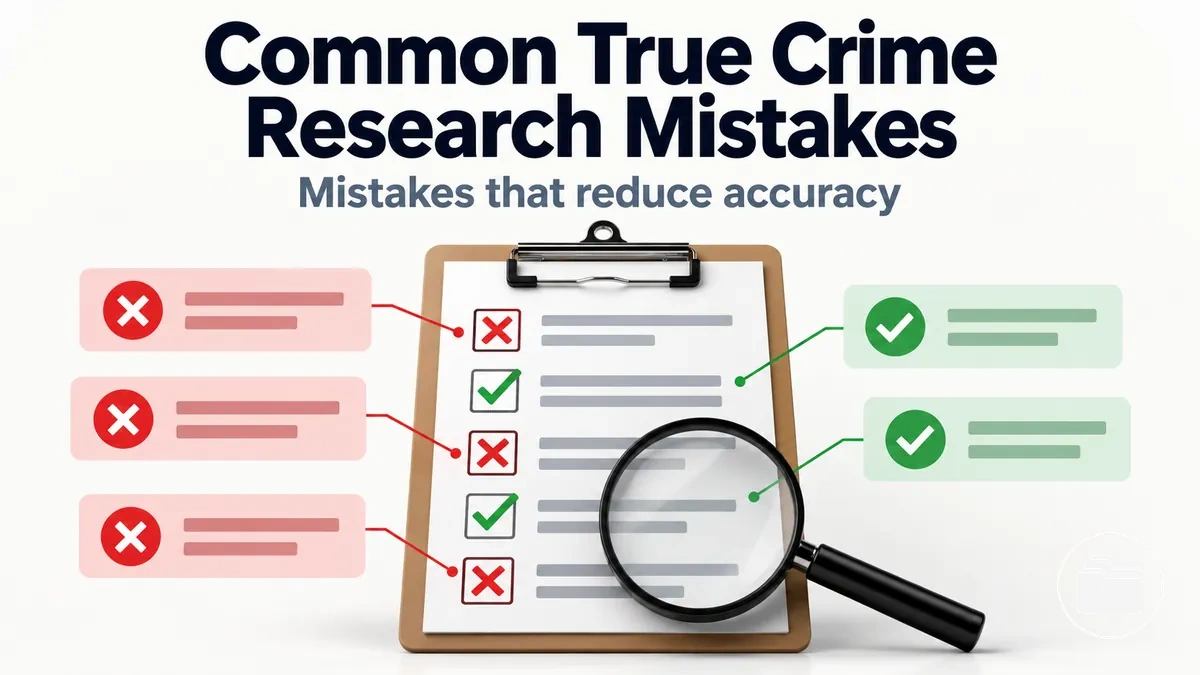
Claim accuracy decision path
Use these checks before treating a case claim as settled. Each step tests a different part of the research record: where the claim came from, what the source actually says, how strong the support is, how precise the chronology is, and whether conflicting evidence remains.
- Trace the claim.Identify the supporting source and the specific passage, record, or statement. If the cited material cannot be matched to the claim, mark the support as unsupported or unresolved rather than assuming it.
- Check source independence.Separate independent corroboration from derivative repetition. Several publications that share one origin do not create several independent evidentiary origins.
- Preserve source meaning.Compare quotation, paraphrase, attribution, context, and qualifiers with the source. Correct observable mismatches rather than carrying stronger wording forward.
- Match certainty and chronology to support.Keep inference labelled as inference, retain method limitations, and state dates or times only at the precision the source supports.
- Keep material conflicts visible.When competing accounts remain compatible with the available evidence, record the disagreement as unresolved until stronger differentiating evidence justifies reconciliation.
What the review state means
- Supported
- The source path is traceable and supports the claim at the wording, certainty, and precision being used.
- Needs correction
- An observable mismatch in wording, attribution, factual detail, or chronology can be corrected from the supporting material.
- Unresolved
- The current record does not justify choosing one version or level of certainty; the limitation stays visible.
A claim is ready to present as supported only when its wording, certainty, precision, and conflict status do not exceed what its source basis can sustain.
Accuracy checking depends on keeping documented information, inference, uncertainty, and unresolved conflict distinct. A warning sign is a reason to recheck a claim; it is not proof that the claim is false.
Table of Contents
Accuracy Warning Signs in True Crime Research
Accuracy warning signs in true crime research identify information that warrants a recheck, but they do not by themselves establish that a claim is wrong.
A signal may reflect weak support, altered wording, an unresolved chronology conflict, or an interpretation that exceeds the available evidence.
The image below labels examples of these diagnostic signals so they can be recognised without treating them as confirmed errors.
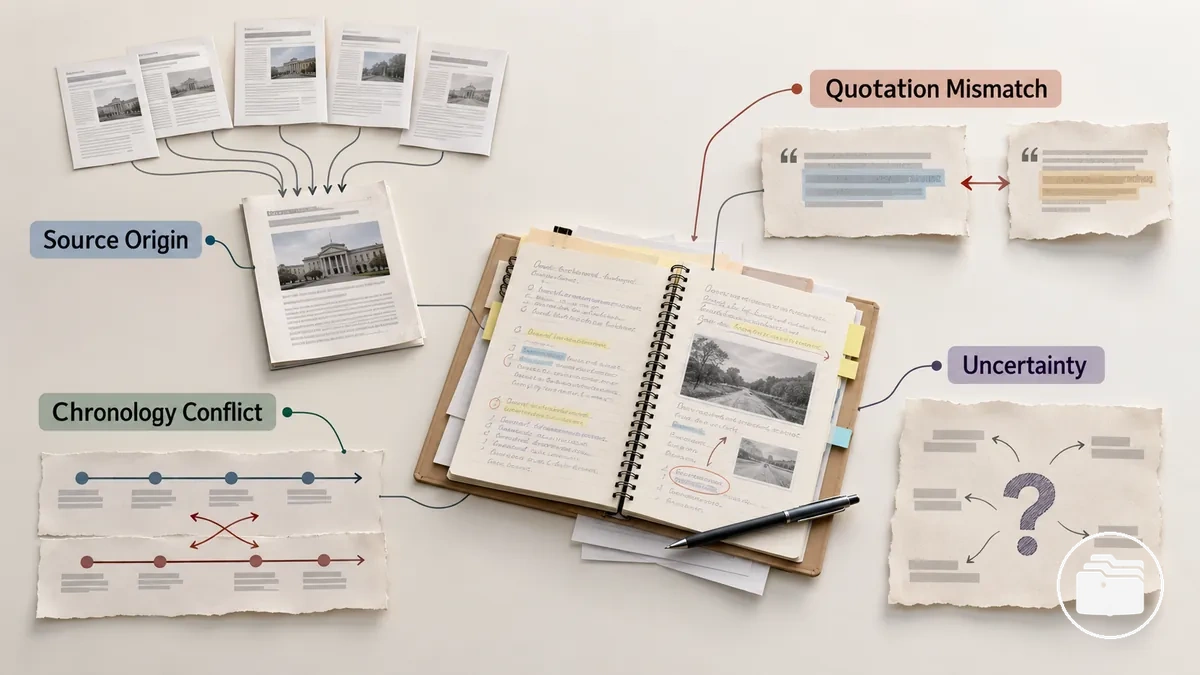
The warning signs differ in what they imply: some concern where information originated, some concern whether wording still matches its source, and others concern whether a conclusion accounts for conflicting or contrary evidence.
The indicators below separate a reason to recheck from the evidence needed before treating the issue as a confirmed error.
- Unsupported certainty: a conclusion stated as settled despite qualified, incomplete, disputed, or inferential support is a warning sign; it becomes a confirmed accuracy problem only if comparison with the cited evidence shows that the conclusion claims more certainty than the evidence supports.
- One source origin: several accounts tracing to the same initial source or repeated retelling warrant rechecking source independence; the problem is confirmed when the apparently separate accounts can be shown to derive from the same origin rather than provide independent support.
- Quotation mismatch: wording that cannot be matched confidently to the attributed source raises an accuracy concern; a quotation error is confirmed when the original wording, attribution, or surrounding context demonstrates a material mismatch.
- Unexplained chronology conflict: incompatible dates or event order indicate that the chronology requires review; a specific chronology error is established only when the relevant evidence supports one sequence or shows that a recorded date or order is inaccurate.
- Contrary evidence omitted from a conclusion: an interpretation that leaves material contrary evidence or an alternative explanation unaddressed warrants rechecking the conclusion; stronger criticism is justified when the omitted evidence materially limits or contradicts what the conclusion claims.
A warning sign and a confirmed error are therefore different evidentiary states.
When the available material permits several explanations, the appropriate classification is unresolved uncertainty rather than confirmation.
Evidence-based checking is required before an accuracy concern is treated as an established research error.
Source-Handling Mistakes That Distort Case Information
Source handling controls whether the provenance and wording of case information remain traceable to the material that supports them.
When derivative reporting is treated as independent support, or when quotation, paraphrase, attribution, or qualifiers change during retelling, the information can appear more certain or more specific than the original source warrants.
The image traces how provenance and wording can change as information moves from an original source through repeated retellings without implying that the original source is automatically accurate.
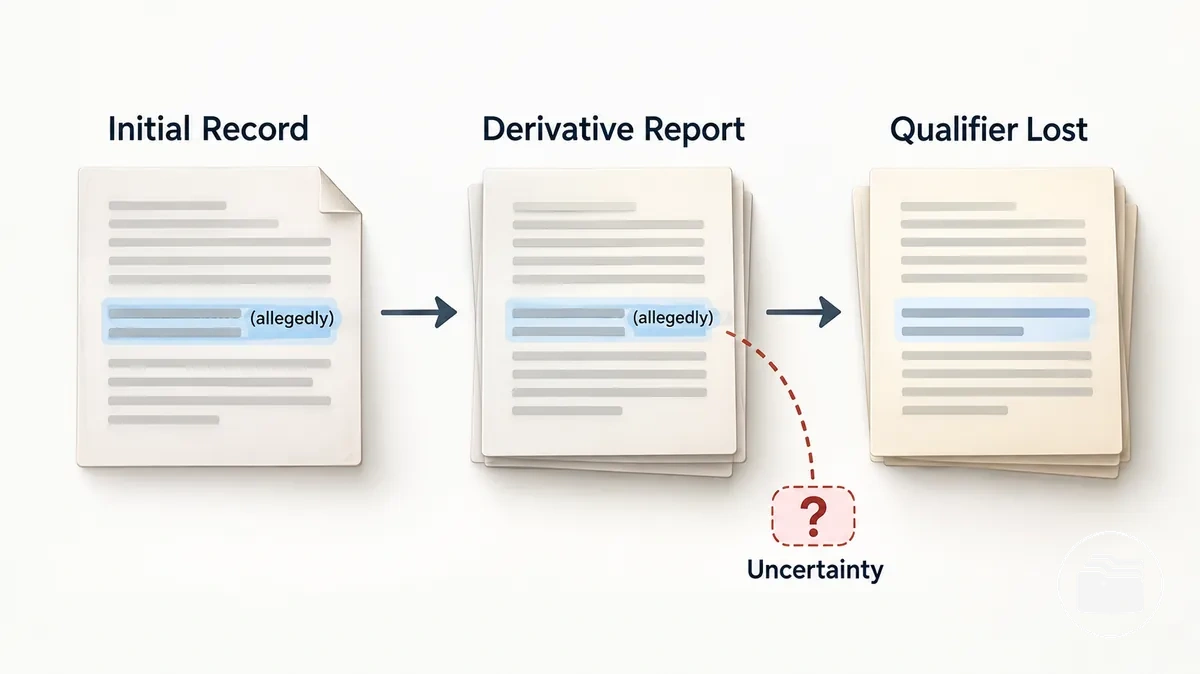
Provenance errors concern where a claim originated and whether apparently separate reports are genuinely independent.
Source independence is weakened when multiple publications derive from the same origin, while unknown provenance leaves the independence state unresolved rather than establishing corroboration.
Recognition therefore depends on tracing reports back far enough to distinguish an original source from derivative reporting or circular citation.
Wording errors concern whether the meaning carried forward still matches the source.
Quotation fidelity can be weakened by omitted context, a paraphrase can add an inference the original wording did not contain, and incorrect attribution or missing qualifiers can change who said something or how certain the statement was.
The following grouped errors distinguish provenance problems from wording and attribution problems while keeping each corrective direction limited to the specific distortion.
- Derivative repetition treated as independent support: repeated reports can make a claim look multiply supported even when they share one origin. Identical wording, the same attribution, or a citation chain leading to one account is a recognition cue; the corrective direction is to record the shared provenance rather than count each retelling as independent support.
- Unclear or missing provenance: case information becomes difficult to evaluate when its source origin cannot be established. A claim appearing without a traceable record or with references that stop at another derivative report should retain an unresolved provenance state until its origin can be identified.
- Quotation fidelity lost: a quotation may distort source meaning when wording is shortened, detached from context, or presented without a qualifier that changes its scope. Comparing the quoted wording with the original source and retaining material qualifiers keeps the quotation tied to what was actually stated.
- Paraphrase extends beyond the source: a restatement can increase apparent certainty when an inference is rewritten as though the source stated it directly. A useful recognition cue is a stronger predicate or more definite conclusion in the paraphrase than in the source; correction requires separating the source-supported statement from the added inference.
- Attribution or qualifiers are altered: assigning a statement to the wrong person, document, or reporting layer can change its evidentiary meaning, while dropping words that express uncertainty can make the same information appear more definite. Checking attribution and retaining material qualifiers preserves both source identity and the level of certainty conveyed.
For example, suppose an original record states that an event “may have occurred before midnight,” a later report paraphrases it as “the event occurred before midnight,” and subsequent articles repeat the later wording.
The repeated retellings have not created new independent support; they have carried forward a dropped qualifier that makes the case information appear more certain.
The corrective principle is to preserve provenance, wording, attribution, and uncertainty as information moves from one source to another.
Relying on One Source or Repeated Retellings
Several publications do not provide independent corroboration when they all trace to one source origin.
Source independence depends on whether separate accounts derive their support independently, not on how many times the same claim has been published.
Repeated retellings can therefore create an appearance of multiple support while leaving the underlying evidentiary basis unchanged.
Recognition cues include identical or near-identical wording, circular citation, and several reports that ultimately trace back to the same initial account.
These cues do not show that the claim is false; they indicate that publication count may overstate the amount of independent support.
The image illustrates how several reports can share one underlying source while appearing separate at publication level.
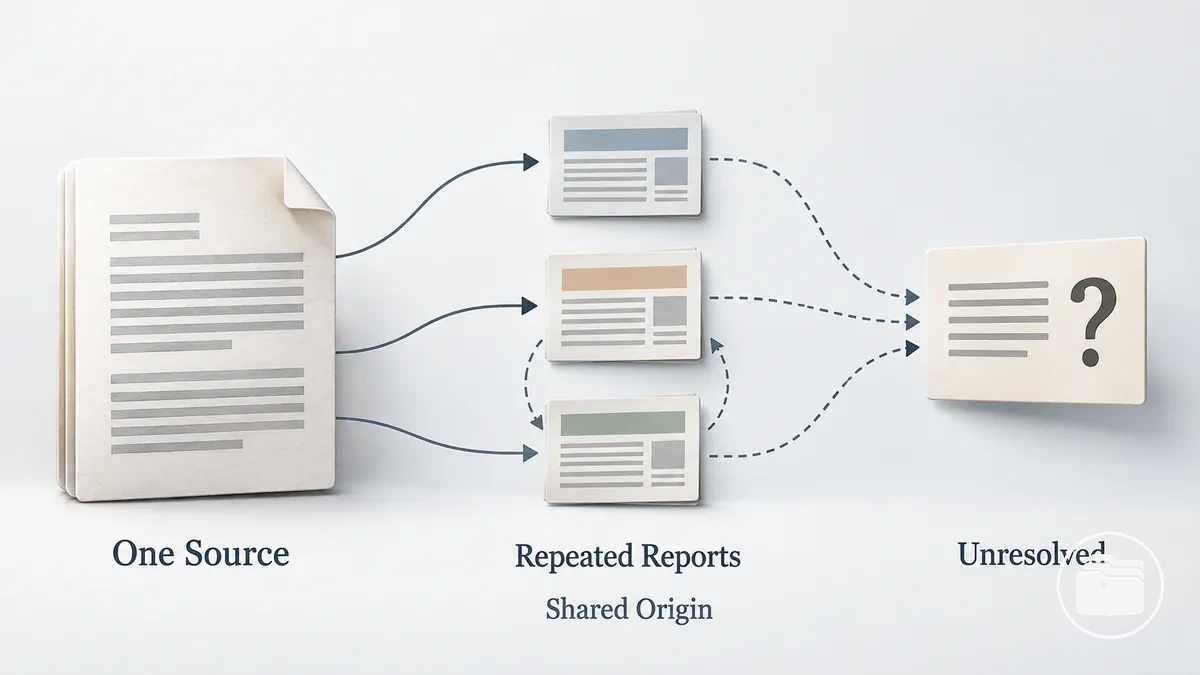
- Independent corroboration: separate sources independently support the same claim from distinct evidentiary origins. This provides stronger support for the claim because the accounts do not merely derive from one another.
- Derivative repetition: several publications repeat information that traces to the same source origin. The publication count increases, but the independence state does not, so confidence should not be increased simply because the claim appears in several places.
- Unresolved single-source support: a claim currently rests on one identifiable source without independent corroboration. Its support remains limited to that source, but single-source status does not necessarily mean the claim is false.
Source independence is therefore evaluated by evidentiary origin rather than publication quantity.
When repeated reports share an origin or a single-source claim has not been independently supported, the appropriate conclusion is that corroboration remains unresolved rather than that repetition itself confirms or disproves the claim.
Misquoting or Paraphrasing Beyond the Original Meaning
Quotation and paraphrase fidelity depends on preserving the original wording's context, attribution, qualifiers, and uncertainty.
A quotation can alter evidentiary meaning when selective wording omits a qualification, while a paraphrase can overstate what the source establishes by adding inference or greater certainty.
When relevant context is incomplete, the missing meaning should remain uncertain rather than be supplied through interpretation.
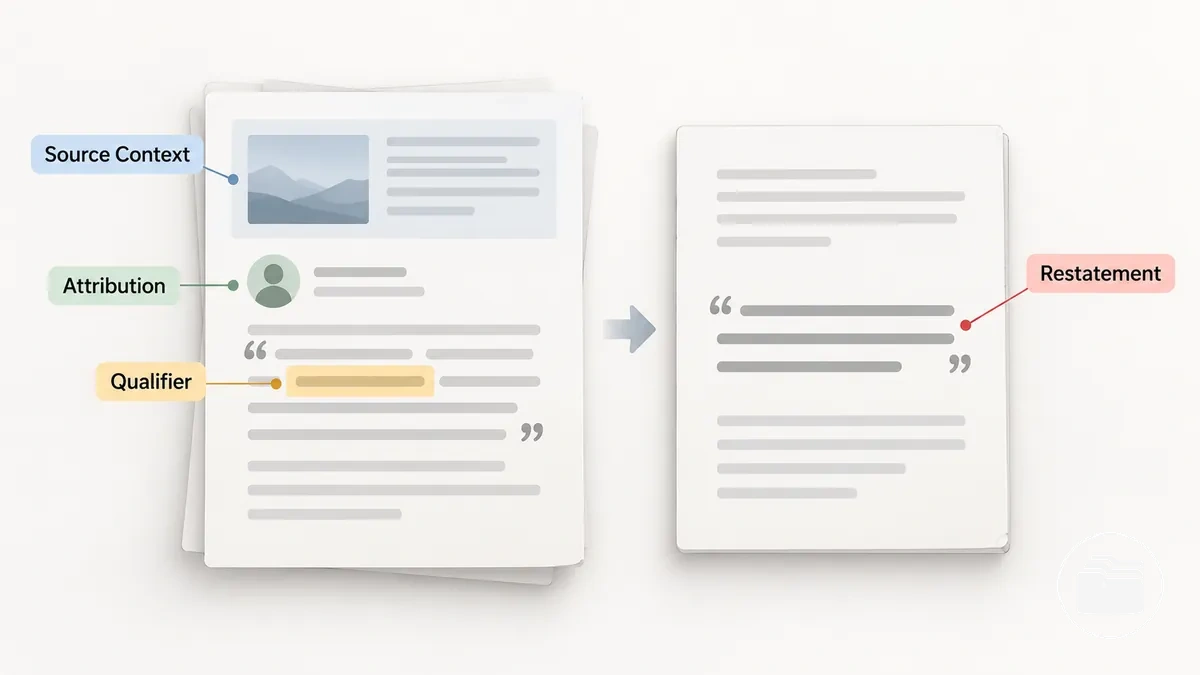
A missing qualifier can turn a conditional statement into an apparently definite one, and selective quotation can make wording appear stronger when surrounding context is absent.
Incorrect attribution can change who appears to support a statement, while an overextended paraphrase may present the writer's inference as though it appeared in the source.
Key distinction: preserve the qualifier
The hypothetical contrast below shows how uncertainty can disappear during rewriting even when most of the original words remain.
Illustrative original wording
“The witness may have left before 10 p.m.”
The qualifier may leaves the timing uncertain and limits what the statement establishes.
Overextended paraphrase
“The witness left before 10 p.m.”
The restatement removes the qualifier and converts an uncertain possibility into a definite assertion.
Fidelity rule: preserve source meaning, material context, attribution, and expressed uncertainty rather than supplying certainty through paraphrase.
Interpretation Mistakes That Create False Certainty
Interpretation of evidence creates false certainty when the strength of a conclusion exceeds the evidence state that supports it.
Documented material may support a limited observation, permit an inference, or leave competing explanations unresolved, while the interpretation can mistakenly present one of those states as conclusive.
The image separates what the evidence shows from the inference and conclusion added during interpretation, including limitations and an alternative path that remains possible.
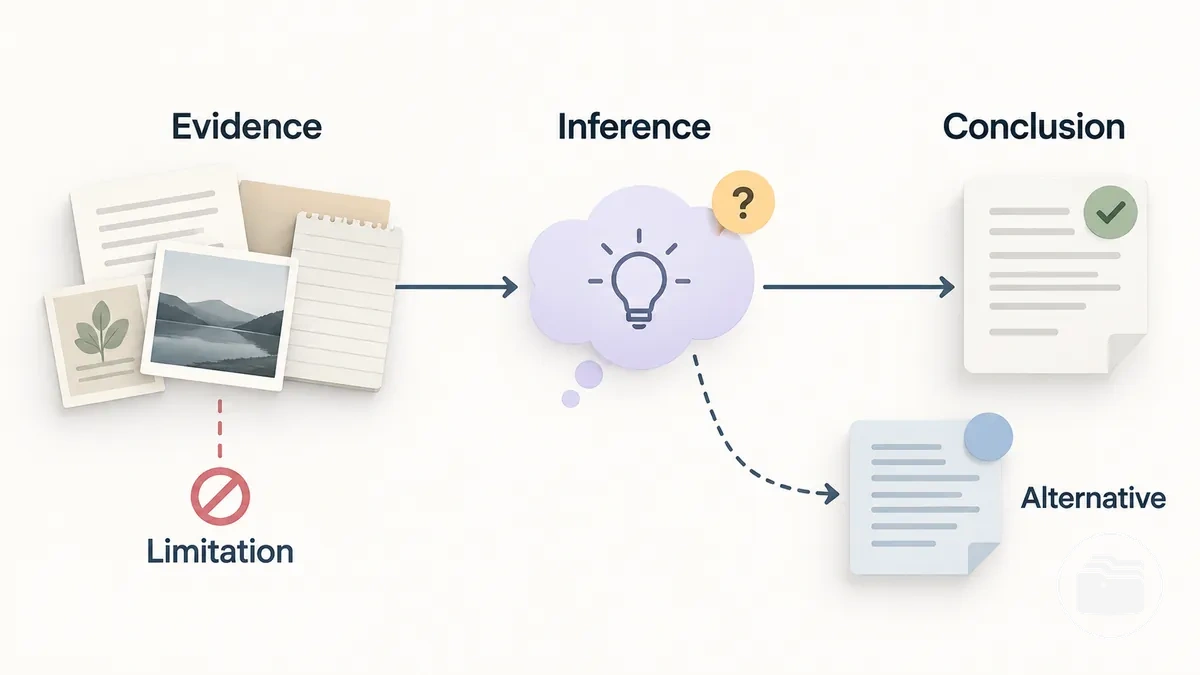
Conclusion strength should remain proportional to evidentiary support: direct support can justify what the evidence actually establishes, while an inference requires its inferential status and relevant limitation to remain explicit.
The following criteria test whether interpretation has moved beyond that support by examining direct evidence, added inference, alternative explanations, limitations, and the certainty expressed in the conclusion.
- Direct support: identify what the evidence state directly supports before extending the conclusion. A conclusion exceeds support when it states a fact or relationship that the underlying material does not itself establish.
- Inference: distinguish what the evidence documents from what the interpretation adds. An inference may be reasonable under the available conditions, but presenting it as documented fact creates greater certainty than the evidence permits.
- Alternative explanations: consider whether another explanation remains compatible with the same evidence. Ignoring a plausible alternative can make one interpretation appear uniquely supported when the evidence does not rule the alternative out.
- Limitations and selective evidence: retain conditions, contrary evidence, missing information, and technical limitations that constrain the conclusion. Selecting only supporting material while omitting relevant limitations can make the evidentiary basis appear more conclusive than it is.
- Confidence language: match wording to the level of support. Terms such as supports, suggests, or permits an inference communicate different evidence states, whereas stronger language should be reserved for conclusions that the evidence can actually sustain.
Premature commitment to one theory can narrow interpretation before contrary evidence or an alternative explanation has been adequately considered.
Selective evidence use can reinforce that commitment by foregrounding supporting material while relevant limitations remain unaddressed, and technical claims can become overstated when the conditions or limitations attached to a method, measurement, or expert finding are omitted.
For example, if documented evidence shows that a person was present near a location at a particular time, a supportable conclusion is that the evidence places the person nearby under the recorded conditions.
Concluding from that fact alone that the person necessarily performed a particular act adds an inference that the evidence state does not establish and may ignore alternative explanations.
The appropriate certainty is therefore the strongest conclusion supported by the evidence, not the strongest interpretation that can be constructed from it.
Confirmation Bias, Anchoring, and Ignoring Disconfirming Evidence
Compare the reasoning failures
Confirmation bias and anchoring can both shape interpretation under prior assumptions, but they describe different failures. Beginning with a hypothesis is not itself an accuracy error; the problem arises when the starting point changes how later evidence is selected, scrutinised, or revised.
Confirmation bias
Favouring information that supports a preferred theory, or giving supporting evidence more weight than contrary evidence.
Recognition cue: disconfirming material receives less scrutiny, is rationalised away, or is treated as exceptional without equivalent justification.
Anchoring
Relying too heavily on an initial assumption or salient detail when later evidence is considered.
Recognition cue: the first interpretation continues to dominate even when later evidence supports revision or a competing explanation.
Example: if a researcher treats every supporting detail as confirmation while dismissing conflicting timing evidence without equivalent scrutiny, the same record may still support an alternative explanation. The relevant accuracy test is whether the preferred theory remains supportable after contrary evidence and competing explanations receive comparable scrutiny.
Treating Forensic Evidence as Conclusive or Infallible
Separate the evidentiary layers
Forensic evidence is not automatically conclusive. What a finding supports depends on the method, its capability, the conditions under which it was produced, relevant limitations, and the interpretation applied to it.
- Layer 1 Laboratory or analytical finding Records what the method found under the stated conditions.
- Layer 2 Expert interpretation Explains what the finding may mean within the method's capabilities, assumptions, uncertainty, and limitations.
- Layer 3 Case-level inference Connects the technical finding to broader factual questions that the method may not resolve by itself and may require other evidence.
Confidence should follow the layer actually supported. Because forensic methods differ in capability, uncertainty, assumptions, and possible error sources, the criteria below test whether interpretation remains proportional to the technical evidence.
- Method capability: identify the question the method is capable of addressing before extending its finding to a broader proposition. A case inference exceeds support when it depends on information the method does not itself determine.
- Finding and interpretation: distinguish the reported analytical finding from the expert interpretation applied to it. An interpretation may explain what the result supports or is consistent with, but it should not be presented as though every broader implication were contained in the laboratory result itself.
- Limitation and uncertainty: retain relevant conditions, assumptions, uncertainty, and known interpretive limits when describing the finding. If those constraints remain material, confidence in the conclusion should reflect them rather than imply greater precision or certainty.
- Case-level implication: ask whether the forensic evidence independently establishes the broader factual claim or only contributes to it alongside other information. Technical evidence can strengthen or challenge a proposition without necessarily resolving every competing explanation or factual question.
For example, a generic forensic method might produce a finding that is consistent with a particular proposition under stated conditions while still leaving other propositions unresolved.
A supportable interpretation would describe that relationship and its limitation; a stronger claim that the finding alone establishes the entire case-level conclusion would go beyond what the method has shown.
The appropriate confidence is therefore tied to the method, finding, limitation, and expert interpretation actually available.
Timeline Mistakes That Distort Event Order
Chronology errors can change how events in a true crime timeline appear to relate because event order depends on both the time claim and its source basis.
A timestamp supported only as an approximate time should not carry the same confidence as a precisely documented time claim.
When uncertainty is lost, events can appear closer together, farther apart, or differently ordered than the available evidence supports, which can alter apparent opportunity or causal interpretation without establishing either.
Timestamp precision should remain tied to the evidence behind it.
A record may provide a precise timestamp, another source may describe an approximate time, and a later account may report only a general sequence; those different source bases support different confidence states.
Reporting conventions or time zones can also matter when records use different temporal references, but the effect on chronology remains uncertain until the relevant convention or offset is established rather than assumed.
Sequence conflicts become more consequential when later retellings silently standardise uncertain dates or times into a single chronology.
The error classes below show how uncertainty in a time claim can change apparent event order while leaving the underlying source basis weaker or more conflicted than the finished timeline suggests.
- Unverified timestamp: a precise-looking time lacks a traceable source basis. Treating it as established can place an event at a definite position in the sequence even though its confidence remains unresolved.
- Approximate time treated as exact: wording that supports only an approximate period is converted into a precise timestamp. The added precision can make surrounding events appear more tightly ordered than the evidence supports.
- Inconsistent reporting convention: records use different time zones, date conventions, or temporal references without the difference being resolved. Combining them as though they use the same convention can shift the apparent chronology.
- Sequence conflict: two sources support incompatible event order or timing. Selecting one sequence without retaining the conflict can create greater confidence in the timeline than the available evidence permits.
- Uncertainty standardised during retelling: a later account converts an uncertain date, approximate time, or disputed sequence into a single definite entry. Repetition of that standardised version can obscure the earlier uncertainty without resolving it.
For example, suppose one source places an event only approximately before another event, while a later retelling assigns it a precise position afterward.
That single shift could change the apparent opportunity, sequence, or relationship between surrounding events even though the source basis never established that precision.
Chronology accuracy therefore requires uncertainty and sequence conflict to remain visible until dedicated timeline work can determine whether the event order is actually supported.
Treating Unverified Dates or Times as Fixed Anchors
An unverified or approximate date or time should not be treated as a fixed anchor beyond the precision supported by its source.
A timestamp can guide chronology only to the extent that its evidentiary basis supports the stated precision and confidence.
Treating a weakly supported temporal reference as exact can propagate error into the apparent order and relationship of later events.
Uncertainty does not make the underlying event unusable; it limits how precisely that event can anchor downstream chronology.
Time-status labels help keep the precision of a time claim aligned with its source support.
The categories below distinguish stronger support from increasingly uncertain states and show the implication each state has for using a timestamp as an anchor.
- Confirmed: the date or time is verified by sufficiently specific supporting evidence for the precision being stated. It can serve as an anchor at that supported level of precision without implying more detail than the source establishes.
- Approximate: the source supports only an approximate time or period. The event can still be placed broadly within the chronology, but nearby events should not be ordered as though the timestamp were exact.
- Reported: a source reports a particular date or time, but the time claim has not been independently verified at the same level of precision. It should remain identified as reported rather than automatically functioning as a fixed chronological anchor.
- Inferred: the timing is derived from surrounding evidence rather than stated directly by a source. The inference can help organise chronology, but its confidence depends on the assumptions and evidence used to derive it.
- Conflicting: available sources support incompatible dates, times, or temporal positions. The anchor remains uncertain until the conflict is resolved or represented explicitly, so downstream event order should not depend on one version as though it were settled.
For example, suppose a source places an event at approximately late evening, but a later timeline assigns it a precise timestamp and uses that point to position several subsequent events.
Those downstream relationships may then appear more exact than the original source support permits.
Marking the initial time as approximate rather than fixed keeps the chronology usable while preventing false precision from propagating through later conclusions.
Ignoring Conflicts in the Sequence of Events
A sequence conflict should remain visible when conflicting accounts agree that events occurred but disagree about their order, timing, or dependency.
Treating one event sequence as settled can change how later events are interpreted even though the source support does not resolve the disagreement.
A cleaner chronology is not stronger evidence if it is produced by silently discarding an unresolved alternative.
Reconciliation is justified only when stronger evidence supports a particular relationship between the competing sequence claims.
Two sources can support the same set of events while supporting different relationships between them.
One source may place Event A before Event B, while another places Event B first, or the accounts may disagree about whether one event depended on another having already occurred.
The relevant issue is therefore not only whether each event has source support, but where the exact point of disagreement lies and whether the available evidence leaves that order, timing, or dependency unresolved.
In a hypothetical conflict, one account may support A → B → C while another supports A → C → B, with both supporting the occurrence of all three events.
The comparison separates each competing sequence, its supporting source basis, the point of conflict, and its current status without selecting a preferred version before stronger evidence permits reconciliation.
| Competing sequence | Supporting source | Point of disagreement | Current status |
|---|---|---|---|
| A → B → C | Hypothetical source 1 | B occurs before C | Unresolved alternative |
| A → C → B | Hypothetical source 2 | C occurs before B | Unresolved alternative |
How to Audit True Crime Research for Accuracy
An accuracy audit checks whether important claims can be traced to supporting evidence, whether factual details remain correct, whether conflicting evidence is visible, and whether interpretation has been stated more strongly than the record supports.
The audit should recheck source relationships, quotations, names, dates, and chronology rather than assume that previously recorded information is reliable.
Its purpose is to identify accuracy weaknesses and unresolved findings, not to certify research as error-free.
Apply the audit to claims that materially affect the case account, especially claims that influence identity, timing, event order, attribution, or interpretation.
Each checklist item targets a distinct failure point in the research record, and completing every check reduces avoidable errors without guaranteeing that no error remains.
- Claim traceability: trace each important claim to the document, record, statement, or other evidence that supports it. Mark the finding as traceable, unsupported, or unresolved when the claimed support cannot be established.
- Source independence: compare apparently separate sources to determine whether they provide independent support or repeat information from the same origin. Record shared provenance when multiple accounts derive from one underlying source rather than treating repetition as separate corroboration.
- Quotation fidelity: compare quoted or paraphrased wording with the supporting source, including material context, attribution, and qualifiers. Mark any mismatch where the research record changes the original meaning, speaker, or level of certainty.
- Factual details: recheck names, dates, locations, identifiers, and other concrete details against their supporting evidence. Record discrepancies or unsupported precision instead of silently selecting one version.
- Chronology: compare each important timestamp and event-order claim with its source basis, including whether the time is precise, approximate, reported, inferred, or conflicting. Mark chronology as unresolved where the evidence does not support one event sequence with sufficient confidence.
- Conflicting evidence: identify material evidence that contradicts or limits a current claim and check whether it has been represented with equivalent scrutiny. Record unresolved conflicts explicitly rather than treating omitted contrary evidence as resolved.
- Interpretation versus established information: separate what the evidence directly establishes from inference, interpretation, or an alternative explanation. Mark conclusions for revision when their certainty exceeds the support available in the research record.
Record each audit finding with the criterion checked, the evidence examined, and a status such as supported, corrected, or unresolved, preserving uncertainty where the review does not justify reconciliation.
Those findings can then guide later corrections without turning the audit into a complete research workflow.
File organisation and record-management decisions remain a separate implementation task from determining whether the underlying research is accurate.
Trace Important Claims Back to Their Supporting Sources
An important factual claim should be traceable to identifiable supporting material that actually supports the wording used.
Claim traceability requires a clear path from the claim to a supporting source and then to the relevant source passage or record.
A citation that cannot be matched to the stated detail leaves the support unresolved, while a source that supports only part of the wording provides partial support rather than support for the entire claim.
The confidence attached to the claim should reflect that support strength.
Traceability establishes provenance, not independent corroboration.
A traceable claim has an identifiable source trail, whereas a corroborated claim requires genuinely independent support beyond that trail; several derivative reports sharing one origin do not become independent merely because each can be cited.
The checklist below tests provenance and evidentiary fit between each claim and its cited material rather than treating traceability as confirmation.
- Identify the supporting source: confirm that each important claim names or records an identifiable supporting source. If no source can be located, mark the claim as unsupported or unresolved rather than allowing a missing citation to imply support.
- Locate the source passage or record: trace the claim to the specific passage, entry, statement, or record that is supposed to support it. If the cited material cannot be matched to the relevant detail, the source trail is incomplete even when the source itself exists.
- Compare wording with support strength: check whether the source supports the whole claim, only part of it, or a weaker formulation. For example, if a hypothetical source records that an event occurred but says nothing about why it occurred, it supports the event but not the stronger causal conclusion attached to it; that stronger wording requires separate support or lower confidence.
- Check provenance of derivative reports: determine whether a report contains independently obtained information or merely repeats material from an earlier source. Record the shared origin when a derivative report traces back to the same underlying material instead of treating each retelling as separate support.
- Detect circular sourcing: follow citations far enough to see whether sources ultimately cite one another or return to the same origin. Circular sourcing can make a claim appear multiply supported while leaving its independent evidentiary basis unchanged.
- Match confidence to the source fit: classify the result according to what the supporting material actually permits, such as supported, partially supported, unsupported, or unresolved. A traceable source trail can justify provenance, but stronger confidence requires support that matches the full wording of the claim.
Recheck Quotations, Names, Dates, and Event Order
Recorded quotations, names, dates, times, and event order should be rechecked against the original source or the strongest available source before they are treated as settled factual details.
Each recorded value should be compared with the source value so that any discrepancy is identified rather than carried forward through later summaries.
Small transcription or chronology errors can affect source matching, identity, and the apparent relationship between events.
Where the source itself is approximate or conflicting, preserve that limitation instead of converting it into unsupported precision.
Handle each discrepancy according to what the source comparison actually resolves: correct a clear mismatch, retain the recorded value when it matches, or add an uncertainty note when the evidence does not establish one value.
For example, a hypothetical record that misspells a name or shifts a date by one day could be matched to the wrong source entry or placed incorrectly in the chronology, so the correction should come from the source rather than assumption.
The checklist below keeps each factual-detail check tied to its source value, discrepancy state, and required action.
- Quotation: compare the recorded quotation with the wording in the original source, including material qualifiers and attribution. Correct an observable mismatch; if wording or context cannot be resolved, retain an uncertainty note rather than silently standardising the quotation.
- Name: match each recorded personal or place name to the spelling and identity shown by the strongest available source. If the recorded name differs, determine whether the difference is a clear transcription error, a documented variant, or an unresolved discrepancy before making a correction.
- Date: compare the recorded date with the source date and preserve the source's stated precision. Correct a definite mismatch, but mark the date as uncertain when available sources are approximate or conflicting instead of selecting one value by assumption.
- Time: recheck the recorded time against the source value, including whether it is precise, approximate, reported, or otherwise qualified. A discrepancy should lead to a correction only when the source resolves it; otherwise add an uncertainty note that preserves the supported level of precision.
- Event order: compare the recorded sequence with the source-supported order of events. If the source places events differently or leaves their relative order unresolved, correct the sequence where support is clear or mark the event order as uncertain rather than forcing consistency.
- Uncertainty qualifiers: verify that words or notes expressing approximation, conflict, or limited precision remain attached to the relevant factual detail. If a later record has dropped that qualification, restore the supported uncertainty instead of presenting the value as more exact than the source permits.
Mark Unresolved Conflicts Instead of Forcing Certainty
A conflict should remain unresolved when the available evidence does not justify choosing one competing claim as established fact. Keep each version connected to its supporting evidence, the point of disagreement, and the differentiating evidence that could change the status.
Repetition, narrative simplicity, or preference for one account does not resolve uncertainty; stronger evidence is required before the status changes.
- Unresolved
- Competing claims retain relevant support, but the current differentiating evidence does not justify selecting one version.
- Unsupported
- The claim lacks sufficient evidentiary support for the assertion being made, even if the opposite has not been established.
- Disproved
- Sufficiently strong contrary evidence establishes that the claim cannot be sustained under the relevant conditions. Unresolved or unsupported does not automatically mean disproved.
When conflicting dates, witness accounts, quotations, source descriptions, or interpretations cannot be distinguished with the current record, preserve each relevant version and record what stronger evidence would be needed to recheck the disagreement.
The next informational decision is whether a specific source, document, comparison, or other differentiating criterion could change the current status.
If no such evidence is available, the appropriate finding remains an explicitly marked unresolved conflict rather than a forced resolution.