
How to Research a True Crime Case
Research a true crime case by defining a bounded question, collecting only lawfully accessible, traceable sources, linking each important claim to its source, checking material claims against independent evidence where possible, and building a working chronology that preserves uncertainty. The goal is a traceable working account, not a definitive narrative: claims should be no stronger than their evidence, and conflicting, missing, derivative, or inaccessible material should remain qualified or unresolved. Pause when further reasonable searching produces repetition rather than material change, and reopen only the affected part if credible new evidence appears.
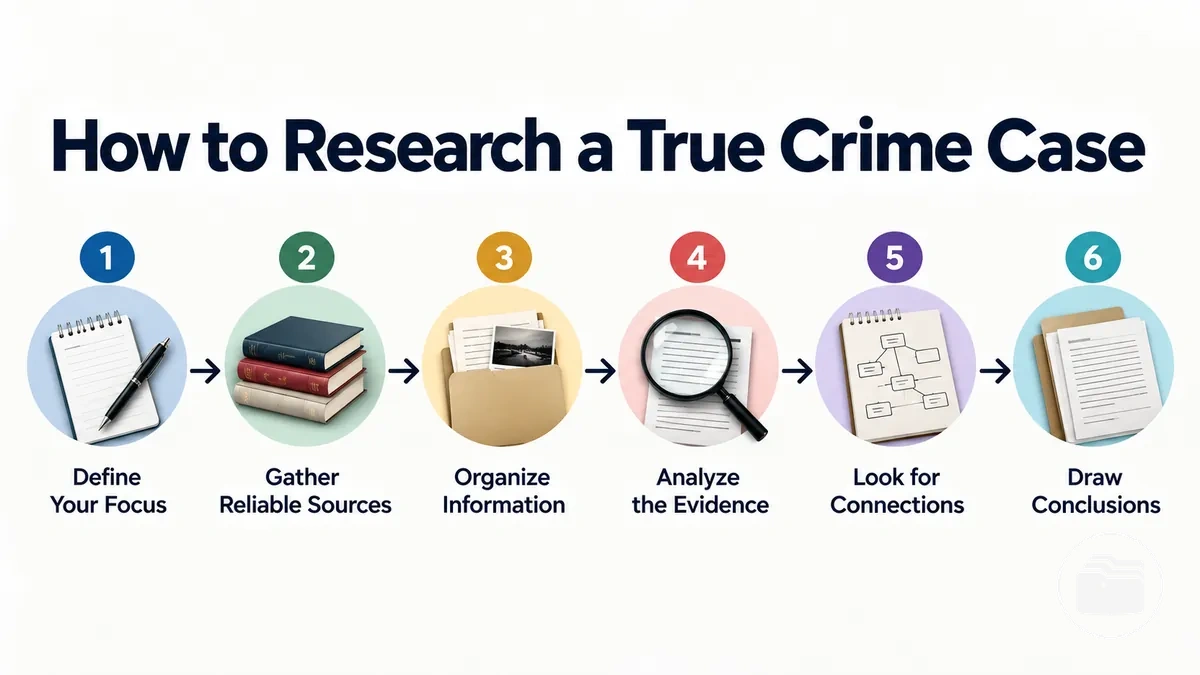
True crime case research control model
Use these four checkpoints to decide what should happen next. Each checkpoint has a concrete output; move forward when that output exists, and return only to the affected checkpoint when evidence creates a specific gap or conflict.
- Define the boundary
The case identity, relevant time period, included people or events, exclusions, and one answerable research question are explicit.
Output: A bounded question with a clear evidence need.
- Build traceability
Sources are lawfully accessible, relevant to the question, identifiable by origin, and recorded together with the claim or note they support.
Output: Source-linked notes with visible gaps and provenance.
- Evaluate the evidence
Claim wording matches the source, corroboration is genuinely independent where possible, conflicts remain visible, and chronology precision does not exceed the evidence.
Output: Supported, contradicted, provisional, or unresolved claim states plus a qualified chronology.
- Decide whether to continue
Reassess only material gaps or conflicts, change scope only when new evidence changes the boundary, and pause when further reasonable searching no longer changes the working account.
Output: A sufficiently supported working account with explicit uncertainty and a reversible stopping point.
Decision rule: do not convert missing information into a conclusion. If evidence cannot resolve a material point, keep the point qualified or unresolved and state what would be needed to change that status.
Keep the research boundary within public information and other material available through lawful access. Preserve enough source context to trace important information back to its origin and connect it to the claim it supports.
When sources conflict, keep the conflict visible until the evidence supports a justified interpretation. When important records are unavailable, the uncertainty limits the working account rather than supplying evidence for a missing conclusion.
Before collecting material broadly, define the case boundary and the specific research question the available material needs to address.
Table of Contents
Define the Case Scope and Research Questions
Case scope and research questions set the boundary of a true crime research task before source collection begins.
The research goal states what the work is intended to clarify, while the scope defines which case, time period, people, events, and unknowns belong within that goal.
A clear case boundary also identifies what the research will deliberately exclude so collection does not expand beyond the questions being asked.
Define the case identity precisely enough to distinguish the subject from related cases or events, then set the time period that the research question actually requires.
Include people and events only when their relationship to the research goal is explicit, and record known information limits that may constrain what can be answered.
These boundaries provide inclusion and exclusion criteria rather than assuming every available detail belongs in the research.
The diagram visualises how the research goal, case boundary, time limits, included subjects, and research questions form one bounded plan.

Each criterion below limits what the research must answer and distinguishes relevant material from information outside the defined scope.
Turn the remaining unknowns into a specific research question linked to the defined case boundary, then check whether accessible information could reasonably address that question before broader collection begins.
- Case identity: In scope are the identified case and directly relevant circumstances; out of scope are separate cases that do not help answer the defined research question.
- Time period: In scope is the period needed to examine the selected events or claims; out of scope are earlier or later periods with no stated relevance to the research goal.
- People: In scope are people whose documented roles or relationships matter to the core question; out of scope are peripheral individuals without a defined connection to that question.
- Events: In scope are events needed to address the specified unknowns; out of scope are related but non-essential events that would broaden the research without changing the answer sought.
- Information limits: In scope are questions that can be examined through lawfully accessible information; unresolved matters that depend on unavailable or inaccessible material should remain identified as limits rather than treated as established conclusions.
Confirm the Case Has Enough Accessible Information to Research
A case is sufficiently researchable when accessible information is traceable, relevant to the defined research question, and capable of supporting or challenging the important claims under review.
Source availability alone is not enough: usable material must also provide date coverage and context sufficient to address the question being asked.
Researchability therefore remains conditional on what the available evidence can actually address.
Assess the case by moving from basic availability toward answerability: check whether sources can be accessed, traced to their origin, matched to the relevant time period, connected to identifiable claims, and compared with independent material where that material exists.
These checks estimate whether responsible research can proceed; they do not establish that any claim is true merely because material is available.
The illustration shows the difference between having accessible sources and having sufficient coverage to address a research question while still making information gaps visible.

- Source availability: Check whether accessible information directly relates to the defined research question rather than merely mentioning the case.
- Traceability: Check whether important information can be traced to an identifiable source, record, publication, or other documented origin; untraceable material should not carry the same evidential weight as material with a recoverable origin.
- Date coverage: Check whether the available material covers the period needed to examine the relevant events or claims; missing periods should remain explicit information gaps.
- Identifiable claims: Check whether the material contains specific claims that can be examined rather than only broad summaries, repeated assertions, or unsupported commentary.
- Independent material: Check whether important points can be examined against material that is not simply repeating the same originating claim; where independent material is unavailable, that limitation should remain explicit.
- Researchability decision: Treat the case as researchable now when accessible, traceable material can address the defined questions; researchable with a narrower scope when only part of those questions can be supported; or not sufficiently researchable yet when the central question cannot be meaningfully examined with the available material.
For example, a case may remain researchable but incomplete when usable material addresses the main events while leaving one period or claim unresolved; the research can proceed with that gap stated explicitly.
If the central question depends on material that is unavailable or cannot be traced, narrow the question or pause rather than treat the absence of records as evidence for a conclusion.
Separate Case Research From Criminal Investigation Tasks
Documentary case research and an official criminal investigation may concern the same case, but they differ in purpose, lawful access, authority, and permitted actions.
Documentary research reviews public information and other lawfully accessible sources to assess what the available record can support.
It does not give a researcher official authority to handle physical evidence, direct investigative activity, or access restricted records without authorisation.
The comparison below distinguishes the shared dimensions of purpose, access, authority, actions, and limits.

| Dimension | Documentary case research | Official criminal investigation |
|---|---|---|
| Purpose | Examine documented information, claims, sources, and uncertainties. | Perform authorised investigative functions concerning a suspected or reported offence. |
| Evidence access | Uses public information and other material available through lawful access. | May involve evidence or records available through official authority and applicable legal procedures. |
| Authority | Has no official investigative authority merely because the case is being researched. | Authority depends on the responsible agency, role, jurisdiction, and applicable law. |
| Actions | Reviews, compares, documents, and evaluates source-based information. | May include authorised handling of physical evidence, official interviews, and other investigative actions. |
| Limits | Stops where information is inaccessible, restricted, or outside the documentary research boundary. | Operates within the legal powers, procedures, and restrictions that apply to the investigating authority. |
The practical research boundary is reached when answering a question would require restricted access, official authority, physical evidence handling, or control of an active criminal investigation.
Those limits should remain explicit rather than being treated as barriers that documentary research can bypass.
True crime case research should therefore remain a lawful, source-based process focused on what accessible documentation can establish, qualify, or leave unresolved.
Turn the Case Into Answerable Research Questions
An answerable research question turns broad curiosity into a defined unknown that evidence can support, contradict, or leave unresolved.
Each question should identify a specific claim, event, identity, relationship, conflict, or unresolved gap rather than assume an explanation in advance.
The possible answer state should remain conditional on what the available evidence can establish.
A useful research question asks about one bounded issue and makes its evidence need clear enough to evaluate.
Chronology questions require dated records or other time-linked material; identity and relationship questions require documentation that connects the relevant people, entities, or events; conflict questions require traceable versions of the competing claims.
If the available material supports one answer, contradicts it, or cannot resolve it, record that state rather than forcing a conclusion.
The illustration shows how a broad prompt can be refined into evidence-addressable questions with supported, contradicted, or unresolved answer states.
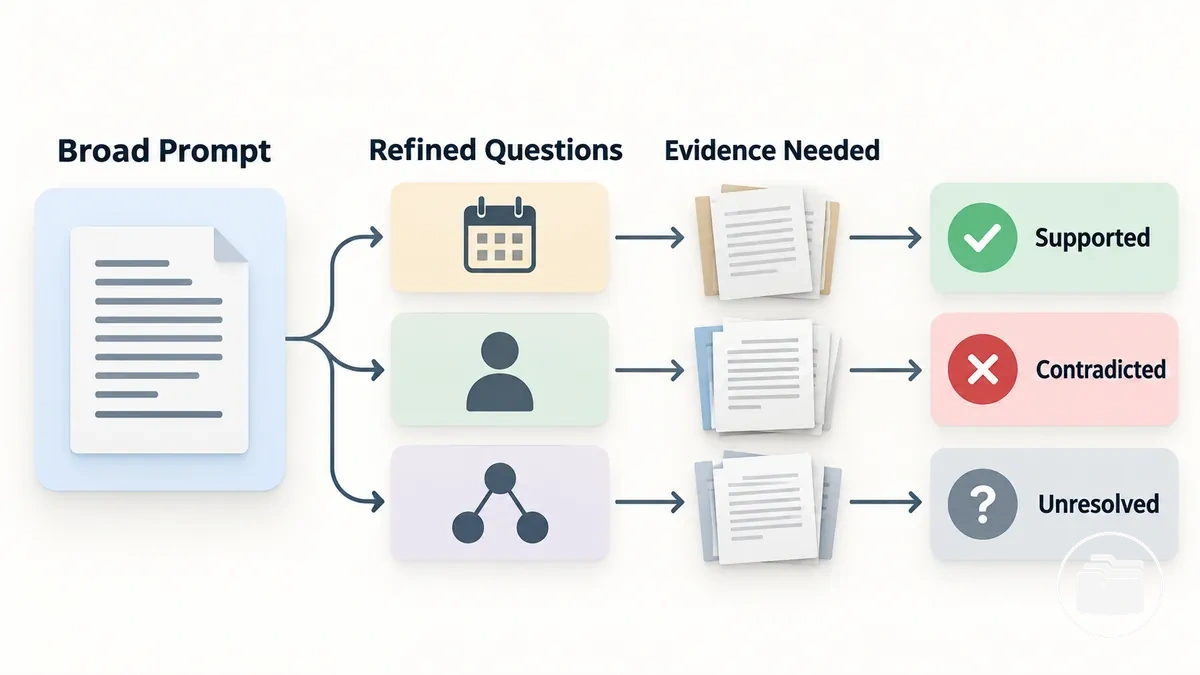
The patterns below connect common question functions to the evidence needed to address them.
Each pattern keeps the question tied to a defined claim or unknown rather than expanding into speculation.
- Chronology: Ask when a defined event occurred or how documented events relate in time; the answer requires date-linked evidence and may remain unresolved where the relevant period is not adequately documented.
- Identity: Ask which person, organisation, place, or item a specific record identifies; the answer requires traceable material connecting that identity to the claim rather than inference from similarity or repetition.
- Relationship: Ask what documented relationship exists between two relevant people, events, or entities; the evidence must show the connection directly enough for the relationship to be supported, contradicted, or left uncertain.
- Source conflict: Ask why two traceable accounts differ on a defined factual point; answering requires comparing what each source actually claims and may result in one account being better supported or the conflict remaining unresolved.
- Unresolved gap: Ask what specific fact remains unknown and what evidence would be necessary to address it; if that evidence is unavailable, the gap remains unresolved rather than becoming a factual conclusion.
A vague prompt such as “What really happened?” can be reframed as the answerable question “What sequence of documented events is supported for the defined time period, and which points remain unresolved?” Once the question is specific enough to identify its evidence need and possible answer states, select one core question as the starting point for source collection.
Follow a Repeatable Case Research Workflow
A case research workflow should be ordered enough to guide documentary research while remaining iterative when evidence changes what must be checked.
Each stage produces information for the next stage, from the research question through source collection, documentation, claim checking, chronology, gap review, and completion assessment.
Iteration should occur when new evidence, an unresolved conflict, or an information gap creates a defined reason to return to an earlier stage.
Move forward when the current stage has produced the input needed by the next stage rather than simply because material has been collected.
The sequence below organises source-based documentary research and its completion checks without extending into official investigation procedures.
The accompanying visual clarifies the stage order and the limited feedback loops created by evidence gaps or conflicts.
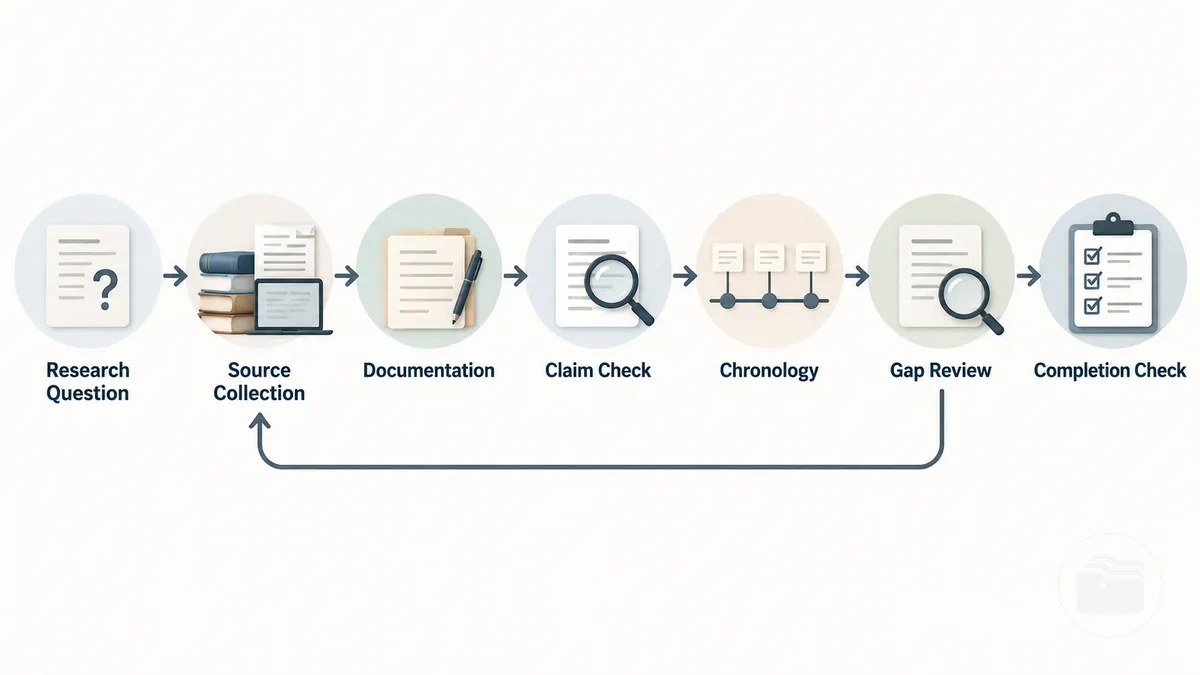
Workflow sequence
- Define the research question: Select the bounded question the research needs to address so collection remains relevant. Continue when the question identifies a specific claim, event, relationship, or unresolved fact that evidence can meaningfully address.
- Begin source collection: Gather material relevant to the research question so the working record contains information capable of addressing it. Continue when the collected sources provide relevant material for structured documentation while any obvious coverage gaps remain recorded.
- Document the material: Record each source, its relevant information, and the claim or event it relates to so later checks remain traceable. Continue when important statements can be connected back to their documented source rather than relying on memory or detached notes.
- Perform claim checking: Compare important claims with the available material and note whether corroboration supports them, contradicts them, or leaves their status unresolved. Continue when each material claim has a recorded evidence status or an explicit reason it cannot yet be assessed.
- Integrate the chronology: Place sufficiently supported events into their relevant temporal order so relationships among documented events can be examined without turning uncertain dates into established facts. Continue when known sequence information and unresolved timing questions are clearly distinguished.
- Conduct a gap review: Identify missing information, conflicting accounts, weakly supported claims, or chronology gaps that could materially affect the research question. Continue when each significant gap has either a defined reason for further research or an explicit limitation that can remain unresolved.
- Make a completion assessment: Assess whether the documented evidence now addresses the research question to the extent the accessible material permits. Complete the research cycle when the principal claims, conflicts, chronology issues, and remaining limitations are explicit; otherwise, return to the stage connected to the unresolved need.
Iteration is justified when the gap review or completion assessment identifies a specific missing source need, unresolved claim, chronology conflict, or new evidence that changes an earlier conclusion.
Return only to the relevant stage, update the affected documentation and checks, and reassess completion rather than restarting the entire workflow without an evidence-based reason.
Find Sources for One Research Question at a Time
Begin each source search with one defined research question so collection stays tied to a specific evidence need rather than expanding into merely related material.
The question should indicate what claim, event, identity, relationship, or gap the source must help address.
The sequence below moves from a likely source class to a candidate source, then checks relevance and traceability before usable information is captured.
- Identify a likely source class: Ask what kind of record could contain evidence relevant to the research question, such as contemporary reporting, public records, interviews, photographs, transcripts, or later analysis. Treat the source class as question-dependent rather than universally sufficient.
- Locate a candidate source: Find a specific research source within that class whose subject and date fit the claim or event being examined. Keep the candidate only when its content could reasonably contribute to the defined question.
- Check relevance: Assess how directly the candidate source addresses the claim instead of relying on a general connection to the case. Prefer material that contains information capable of supporting, contradicting, qualifying, or leaving the question unresolved.
- Check access and traceability: Confirm that the material is available through lawful access and that its origin, creator, publication, record, or preserving institution can be identified later. If the source cannot be traced reliably, record that limitation before relying on its contents.
- Capture usable information: Record the relevant statement, date, source identity, and connection to the research question so the information can be checked again during later documentation and claim review. Stop collecting from that candidate when the useful information has been captured or when further material no longer addresses the defined evidence need.
Source relevance depends on the research question, the claim being examined, the required date fit, and whether the material can be accessed and traced later.
A source may be closely related to the case yet still be unsuitable for the current question if it lacks the needed time period, information, or identifiable origin.
Select complementary source classes when necessary, but keep the search within the source-selection boundary rather than expanding into an exhaustive source catalogue.
Record Sources, Claims, Notes, and Unresolved Gaps as You Research
Record source context when information is found so each later claim or note can be traced, checked, and revised without reconstructing its provenance from memory.
The research record should keep the source identity connected to the information taken from it and label the current status of that information.
Any unresolved gap should remain visible as a follow-up need rather than being absorbed into an apparently settled note.
Capture only the detail needed to identify the source, understand what was recorded, locate it again, and distinguish supported information from uncertainty.
The exact amount of citation detail may vary with the material, but provenance depends on retaining enough information to recover the source and reconnect it to the recorded claim.
The fields below preserve that relationship from source to recorded information, status, and later research action.
Research record fields
- Source identity
- Record the identifiable source, creator, publisher, institution, record, or other origin needed to distinguish where the information came from.
- Claim or note
- Capture the specific statement, observation, quotation, summary, or research note relevant to the case without merging it with unsupported inference.
- Date
- Record the publication, creation, event, or access date that is relevant to interpreting or locating the information, and label the date type when ambiguity is possible.
- Status
- Label the recorded claim or note according to its current research state, such as supported by a traceable source, contradicted by another source, uncertain, or not yet checked.
- Citation detail
- Preserve the page, section, timestamp, record identifier, archive location, or other location detail needed to return to the relevant passage or item later.
- Unresolved gap and follow-up
- Flag what remains unknown, conflicting, or incomplete and record the later action needed to revisit it, such as locating another source or checking a disputed detail.
Verify Important Claims Before Treating Them as Established
An important claim should remain provisional until its support has been checked against the source and, where possible, independent corroboration.
Verification asks whether the source actually supports the claim as stated and whether other evidence provides genuinely independent support.
A claim should not be treated as established while material support, independence, or unresolved conflict remains uncertain.
Check source identity first so the supporting material can be traced, then compare the recorded claim with what the source actually says to preserve fidelity.
Assess whether corroboration comes from an independent origin rather than from multiple publications repeating the same underlying account.
Compare the available sources for consistency while noting differences in wording, dates, scope, or context that could affect interpretation.
Any material conflict that cannot yet be resolved should remain part of the claim status rather than being hidden by a stronger label.
Verification gate
- Source identity: Confirm that the source can be identified and traced well enough to examine the material supporting the claim.
- Claim fidelity: Check that the recorded claim matches the meaning and scope of the source rather than overstating, narrowing, or changing what the material supports.
- Independence: Determine whether additional support originates independently or merely repeats information derived from the same underlying source.
- Consistency: Compare independent supporting material for agreement on the specific point being evaluated, while preserving relevant differences or qualifications.
- Unresolved conflict: Record material contradictions, missing support, or uncertainty that prevents the claim from moving from provisional to established status.
A claim supported directly by an identifiable source and separately corroborated by independent material has a different evidence state from a claim repeated across several derivative sources that all trace back to one unsupported assertion.
Repetition alone does not change claim status; the claim should remain provisional whenever its source support, independence, consistency, or unresolved conflict does not justify treating it as established.
Add Established Events to the Working Chronology
A researched event is ready for the working chronology when its identity is clear, its temporal position is supported as precisely as the evidence allows, and its factual status is recorded.
The chronology entry should connect the event to at least one traceable source while preserving any uncertainty about its date, time range, or occurrence; the inclusion checks below keep that temporal context and evidence status attached to each event.
Chronology entry fields
- Event identity
- Record what happened in terms specific enough to distinguish the event from related actions, reports, or later interpretations.
- Date or time range
- Record an exact date only when the source supports that precision; otherwise use an approximate date or bounded time range that reflects the available evidence.
- Supporting source
- Identify the source that supports the event and its temporal placement so the entry can be traced and checked later.
- Factual status
- Mark whether the event is supported by traceable evidence, remains provisional, or is disputed rather than presenting every chronology entry as equally established.
- Known uncertainty
- Preserve conflicts or missing temporal detail explicitly, including disagreement between sources about when an event occurred or whether a proposed sequence is supported.
An exact date can be recorded directly when the supporting source establishes it, while an approximate date should remain labelled as approximate and a disputed date should retain the competing temporal claims.
Source support and factual status therefore determine how confidently an event can be placed, while uncertainty limits the precision of the chronology entry rather than being converted into a definite sequence.
Once the event has been entered with those qualifications, deeper chronology reconstruction and conflict resolution remain separate tasks.
Reassess the Research as Gaps and Conflicts Emerge
A research gap or conflict signals that the workflow needs targeted reassessment rather than an automatic conclusion about which source or claim is wrong.
Identify the current problem state before choosing the next action, because missing support, contradiction, scope problems, documentation weakness, and an unanswered question require different checks.
The purpose of reassessment is to return to the specific research task that can address the unresolved issue instead of restarting the entire case.
Missing evidence means a material claim or event lacks enough supporting information for its current status, while conflicting evidence means relevant sources support incompatible accounts that require comparison rather than immediate rejection of either source.
A scope mismatch occurs when the available material does not address the defined research question, whereas weak documentation occurs when source identity, claim context, or prior research notes are insufficiently recorded to evaluate what was found.
An unanswered question remains unresolved when the information needed to resolve it is unavailable, inaccessible, or not established by material that can be checked.
The diagnostic flow below matches each problem state to a check and corrective direction.
Problem → check → corrective direction
Missing evidence
The gap may reflect incomplete source coverage for a material claim. Check: Identify exactly which fact or evidence relationship lacks support. Corrective direction: Run a targeted search for material capable of addressing that specific gap.
Conflicting evidence
The contradiction may reflect different source origins, dates, scopes, interpretations, or genuinely unresolved accounts. Check: Compare what each source actually states, its relationship to the disputed point, and whether apparently separate accounts are independent. Corrective direction: Reassess the affected claim and preserve the conflict when the available evidence does not resolve it.
Scope mismatch
The material may be relevant to the case but not capable of answering the current research question. Check: Compare the question boundary with the information the available sources can actually address. Corrective direction: Refocus the source search or narrow the question when the evidence boundary does not support the original scope.
Documentation weakness
The problem may result from incomplete provenance, detached notes, or an unclear connection between a source and a recorded claim. Check: Review the source identity, citation detail, claim wording, date, and recorded status. Corrective direction: Repair the documentation before relying on the affected information in later research.
Unanswered question
The unresolved issue may depend on evidence that has not been found or is not available through the accessible record. Check: Determine what specific information would be required to answer the question and whether accessible sources could reasonably supply it. Corrective direction: Keep the question unresolved, narrow it where appropriate, or stop pursuing it when the evidence needed to answer it cannot be obtained.
For example, if two traceable sources give different dates for the same event, the conflict sends the research back to the affected source, claim, and chronology checks rather than requiring every earlier task to be repeated.
The corrective direction should match the diagnosed problem state, and only the affected documentation, source search, claim status, or chronology entry needs reassessment.
Targeted re-entry keeps unresolved issues visible while allowing unaffected parts of the research to remain intact.
Return to Questions With Weak, Missing, or Conflicting Support
An unstable question or claim should be returned to the specific evidence problem preventing a reliable status rather than sent through the entire research process again.
First identify whether the problem is weak support, missing support, or conflicting support, because each state points to a different check.
The recheck should remain limited to the evidence relationship that is uncertain.
Targeted rechecking may involve source independence, missing primary context, a date inconsistency, an attribution mismatch, or an unresolved contradiction when those issues affect the current question.
Each evidence state requires a different targeted recheck before the claim status can change.
If the available evidence still cannot support a stronger conclusion after the relevant check, preserve the claim or question as unresolved rather than assuming that additional searching will necessarily increase certainty.
Evidence state → targeted recheck
Weak support
When a claim has some support but that support is indirect, derivative, or insufficiently independent, check source independence and whether genuinely separate corroboration supports the same specific claim. Strengthen the claim status only if the recheck adds relevant independent support; otherwise keep the qualification or unresolved status.
Missing support
When a material part of the question lacks a supporting source or necessary primary context, identify exactly what evidence is absent and run a targeted search for that gap. If the required support remains unavailable, record the missing support explicitly and leave the affected claim unresolved.
Conflicting support
When sources disagree, check for a date inconsistency, quotation or attribution mismatch, differences in source context, or an unresolved contradiction before changing either claim. Revise the status only when the conflict can be accounted for by the available evidence; otherwise retain the conflicting support as an unresolved condition.
Change the Scope Only When New Information Justifies It
A scope change is justified only when new evidence materially affects the research question, case boundary, or relevance of information previously treated as outside the case.
Newly discovered detail that is merely interesting should not automatically expand the research scope.
Any decision to expand, narrow, or retain the boundary should continue to serve the original research purpose.
Changing research scope affects what must be collected, checked, documented, and reassessed, so the boundary impact should be identified before more material is added.
Valid triggers include a newly identified participant, a corrected time range, a newly established event, or a dependency showing that one research question cannot be addressed without another.
Use the criteria below to connect each new information state to a specific scope decision and its downstream research consequence.
- Newly identified participant: Expand the case boundary when new evidence establishes that a previously excluded person or entity has a material relationship to the research question; otherwise retain the existing scope.
- Corrected time range: Expand or narrow the temporal boundary when reliable information shows that the relevant event sequence begins earlier, ends later, or occupies a different period than previously defined, then reassess only the material affected by that revised range.
- Newly established event: Expand the scope when a supported event materially changes what must be explained or which evidence is relevant; retain the existing boundary when the event adds context without changing the research question.
- Dependency between questions: Expand the scope when answering the current research question requires resolving another directly connected question; keep unrelated questions outside the boundary even when they concern the same case.
- Changed relevance of excluded information: Reconsider previously excluded material when new evidence creates a direct relationship between that material and the defined research purpose; otherwise retain its out-of-scope status.
Justified expansion follows a demonstrated boundary impact, whereas topic drift follows material because it is interesting without showing how it changes the research question or case boundary.
Document the reason for each decision to expand, narrow, or retain scope so later research reflects the revised boundary without using scope change as a substitute for resolving weak evidence.
Check Whether the Case Research Is Complete Enough
Case research is complete enough when the working account sufficiently answers the defined research questions and no unresolved evidence gap is likely to materially change that account.
Completion is therefore a sufficiency judgment against the stated questions, supporting evidence, and known limitations rather than a claim that every fact about the case has been found.
The judgment remains conditional because materially new evidence can require the research to be reopened.
Assess the working account as a whole rather than using a fixed research duration or source count.
Core answers should have traceable support, material conflicts should be reconciled or clearly flagged, uncertainty should remain explicit, and the chronology should distinguish supported events from unresolved timing.
The completion checklist below tests whether those conditions are met without treating uncertainty itself as failure.
Completion criteria
- Core questions: Check whether each central research question has an evidence-supported answer, a qualified answer, or an explicit unresolved status rather than being left implicitly incomplete.
- Traceable sourcing: Check whether the material claims that shape the working account can be traced to identifiable sources and the relevant supporting information.
- Conflicts: Check whether important contradictions have been reconciled where the evidence permits or clearly flagged when the available material does not support a resolution.
- Uncertainty: Check whether missing information, disputed details, approximate dates, and other limitations remain explicit instead of being converted into stronger conclusions.
- Chronology: Check whether the supported events form a coherent working chronology and whether disputed or uncertain temporal relationships are clearly qualified.
- Material unresolved gaps: Check whether any remaining gap could materially alter an important answer, event relationship, or interpretation; if so, the research may not yet meet the required level of sufficiency.
A case can therefore be complete enough for the stated research purpose while still containing documented uncertainty or questions that the accessible evidence cannot resolve.
If a high-impact gap remains capable of materially changing the working account, continue the relevant research rather than declaring closure.
If materially new evidence appears later, reassess the affected conclusions and revise the completion judgment accordingly.
Confirm the Main Research Questions Have Supported Answers
Every main research question needs an answer state whose wording strength matches the available evidence.
An answer may be supported, contradicted, or unresolved depending on its supporting sources, conflict state, and overall evidence strength.
Completion depends on these question-level states rather than on how many notes or sources have been collected.
A supported answer has evidence that directly supports the stated conclusion at the strength claimed, while a contradicted answer has relevant evidence that conflicts with the proposed conclusion strongly enough to change its status.
An unresolved question lacks sufficient support for a reliable answer or retains material conflict that the available evidence cannot resolve.
Apply the same checks to each main research question so its answer state and completion implication remain explicit.
- Answer state: Record whether the current answer is supported, contradicted, or unresolved, and avoid strengthening tentative inference merely to give the question a definite result.
- Supporting sources: Check whether the sources attached to the answer actually provide evidence at the strength implied by its wording; if support remains incomplete, qualify the answer state accordingly.
- Conflict: Identify whether relevant sources conflict with the current answer or with one another, and retain an unresolved state when that conflict prevents a sufficiently supported conclusion.
- Completion implication: Treat the question as sufficiently addressed when its answer state accurately reflects the available evidence strength, including an explicit unresolved outcome when the evidence does not support a stronger answer.
Make Remaining Uncertainties Explicit
Remaining uncertainty should be named explicitly rather than hidden by wording that makes the working account appear more certain than the evidence allows.
Recording what is missing, disputed, approximate, or inaccessible preserves the boundary between information the evidence establishes and what remains unknown.
Uncertainty record
- Uncertainty type
- Identify whether the uncertainty results from missing information, disputed evidence, an approximate date or detail, inaccessible material, or another clearly defined evidence limitation.
- Affected claim or event
- Record the specific claim, event, relationship, or chronology point whose status is limited by the uncertainty rather than applying a vague qualification to the entire case.
- Reason for uncertainty
- State why the affected claim cannot currently receive a stronger status, such as unavailable records, conflicting accounts, insufficient date precision, or material that cannot be accessed.
- Evidence checked
- Record the relevant evidence checked so the uncertainty reflects the actual research boundary rather than an assumption that information is absent.
- Material effect
- State whether the uncertainty could materially affect the broader working account, requires a qualified interpretation, or can remain unresolved without changing the principal supported conclusions.
A missing source leaves the affected claim unsupported, disputed material requires the conflict to remain visible, approximate information limits precision, and inaccessible evidence cannot be treated as though its contents were known.
The material effect depends on whether resolving that uncertainty could change an important answer, event relationship, or interpretation in the working account.
Prefer a qualified statement such as “the available evidence does not establish the exact date” over an unsupported definitive statement that supplies a date merely to remove the gap.
Stop When Further Research No Longer Changes the Working Account
Research can pause when further reasonable searching produces diminishing information gain and no feasible unresolved gap remains that is likely to cause a material change to the supported answers, chronology, or major uncertainty profile within the defined scope.
This stopping rule reflects diminishing returns in relevant information, not proof that the case is objectively complete.
Additional research warrants continuing when it yields new support that materially changes an answer, event relationship, or important uncertainty.
An unresolved gap also supports continued work when feasible evidence remains available and could materially affect the working account.
Use the criteria below to distinguish when new information yield supports continuing, when repetition supports a pause, and when later evidence may justify reopening the research.
Continue, pause, or reopen
- Continue for material change: Continue when additional research is producing new information or new support that changes a supported answer, chronology point, or major uncertainty relevant to the research question.
- Continue for a feasible unresolved gap: Continue when a high-impact unresolved gap remains and there is identifiable, feasible evidence that could address it; pause if no reasonable next evidence source is presently available.
- Pause when novelty falls away: Pause when further reasonable searching mainly produces repetition or derivative material that does not change the evidence state, interpretation, chronology, or uncertainty profile.
- Pause without claiming finality: Treat the pause as a practical stopping criterion based on current information yield and material impact, not as evidence that nothing else exists or that the account cannot change.
- Reopen when new evidence appears: Reopen the affected part of the research when credible new material could materially change an existing answer, resolve an unresolved gap, alter the chronology, or change the significance of recorded uncertainty.
For example, locating a genuinely new record that could resolve a major chronology gap supports continuing, while finding several derivative accounts that repeat evidence already assessed may support a pause.
The stopping decision remains reversible, and credible new evidence may justify reopening the affected research later.