
Building a True Crime Case Timeline
Build a true crime case timeline by defining the case period first and then recording each supported event with four linked fields: event description, date or time range, source citation or identifier, and uncertainty or conflict status. Place each event only as precisely as the evidence allows—use fixed dates when supported, preserve bounded or relative positions when timing is uncertain, and keep competing dates separate until the evidence supports a narrower conclusion. Treat the result as a research chronology of case events rather than a generic court-procedure schedule, and recheck affected sequence relationships whenever evidence changes.
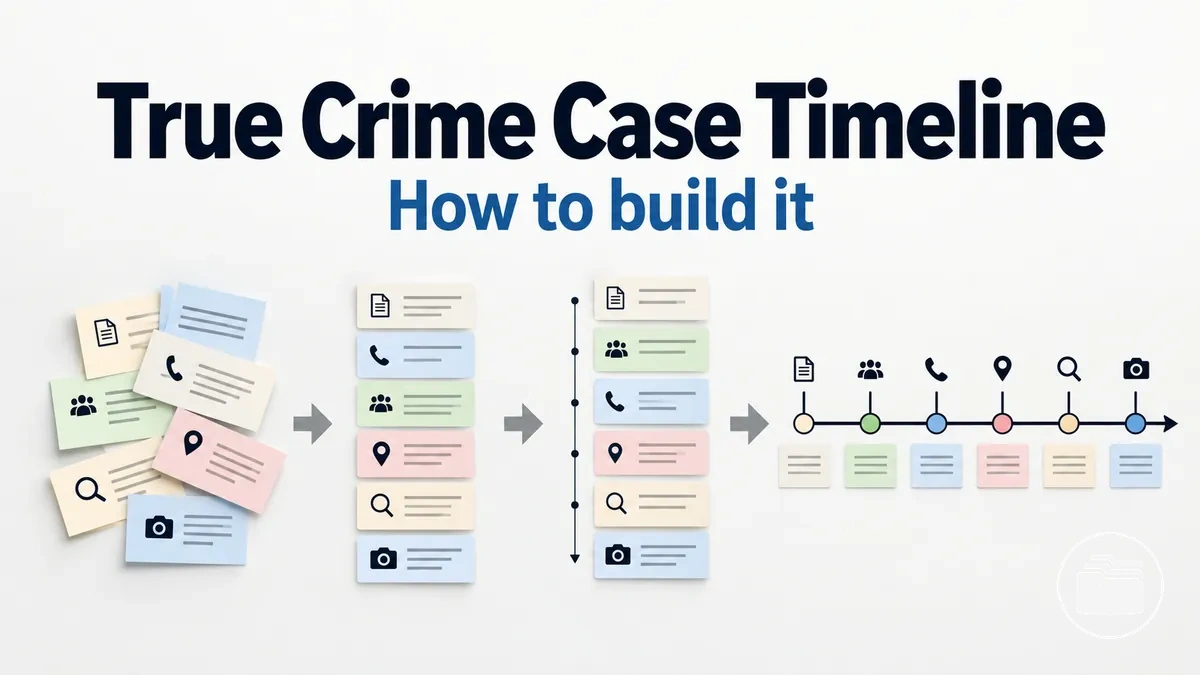
Case timeline build model
Use the same event record throughout the chronology, then move each entry through placement, conflict handling, sequence checking, and revision without increasing its temporal precision beyond the evidence.
- Event
- What occurred, described narrowly enough to distinguish the event from surrounding entries.
- Time
- The supported fixed date, approximate period, bounded range, or relative before/after position.
- Source
- The citation or identifier that lets the event claim and temporal claim be checked again.
- Status
- Whether placement is fixed, approximate, bounded, disputed, reconstructed, or otherwise unresolved.
Article-wide workflow
- Scope. Define the research purpose, start and end boundaries, and inclusion criteria.
- Record. Capture the same event, time, source, and status fields for every included entry.
- Place. Use supported fixed dates as anchors; keep approximate, bounded, and relative-time entries provisional where necessary.
- Resolve carefully. Compare competing dates with the same temporal criteria and retain supported alternatives when the evidence does not distinguish between them.
- Check and revise. Test gaps, sequence errors, duplicates, and contradictions, then recheck affected neighbours whenever new evidence changes an entry.
Sequence is not causation. A chronology can establish supported temporal order without proving that one event caused another.
Table of Contents
Define the Timeline Scope and Entry Structure
Define the timeline scope before placing individual events.
The scope should follow the chronology's research purpose, the case period it needs to cover, event relevance, and the entry fields needed to record a date or time range, source support, and uncertainty state consistently.
An event belongs inside the chronology boundary when it helps answer the timeline's research purpose or materially affects the temporal sequence being examined; background that does neither can remain outside it.
The boundary can use exact dates when the evidence supports them or broader time limits when the available evidence supports only an approximate period.
Once an event is included, the entry structure should record the event, its date or time range, source support, and uncertainty state using consistent labels.

Consistency means applying the same inclusion rules and entry fields to comparable events throughout the chronology.
A sample event should fit the chosen boundary and be recordable with the same date or time-range, source-support, and uncertainty fields used elsewhere.
The four planning steps below test those decisions before full chronology construction begins.
- Define the purpose and case period. State the chronological question the timeline is intended to address, then set start and end boundaries that contain the events needed for that purpose.
- Set inclusion criteria. Include events that are relevant to the chronology and have identifiable source support; exclude peripheral details that do not affect the sequence or its interpretation.
- Set required entry fields. Use a repeatable entry structure for the event description, date or time range, source support, and uncertainty state so records remain consistent.
- Test consistency on sample events. Apply the same inclusion rules and entry fields to several representative events; if comparable events are treated differently without an evidence-based reason, refine the scope before chronology construction.
Timeline planning has a narrower purpose than wider case research: fix the chronology boundary and entry structure before individual events are placed.
Set the Chronology Boundaries and Level of Detail
Set each chronology boundary from the research question and the earliest relevant event and latest relevant event needed to interpret the sequence, rather than from an arbitrary date cutoff.
The case period can use exact endpoints when the evidence supports them or broader temporal limits when the available evidence supports only an approximate period.
A bounded chronology makes the inclusion limits visible: start and end points constrain the case period, while peripheral events remain outside the sequence.
The level of detail for each included event should reflect event relevance, temporal precision, evidentiary support, and whether the information changes chronological understanding.
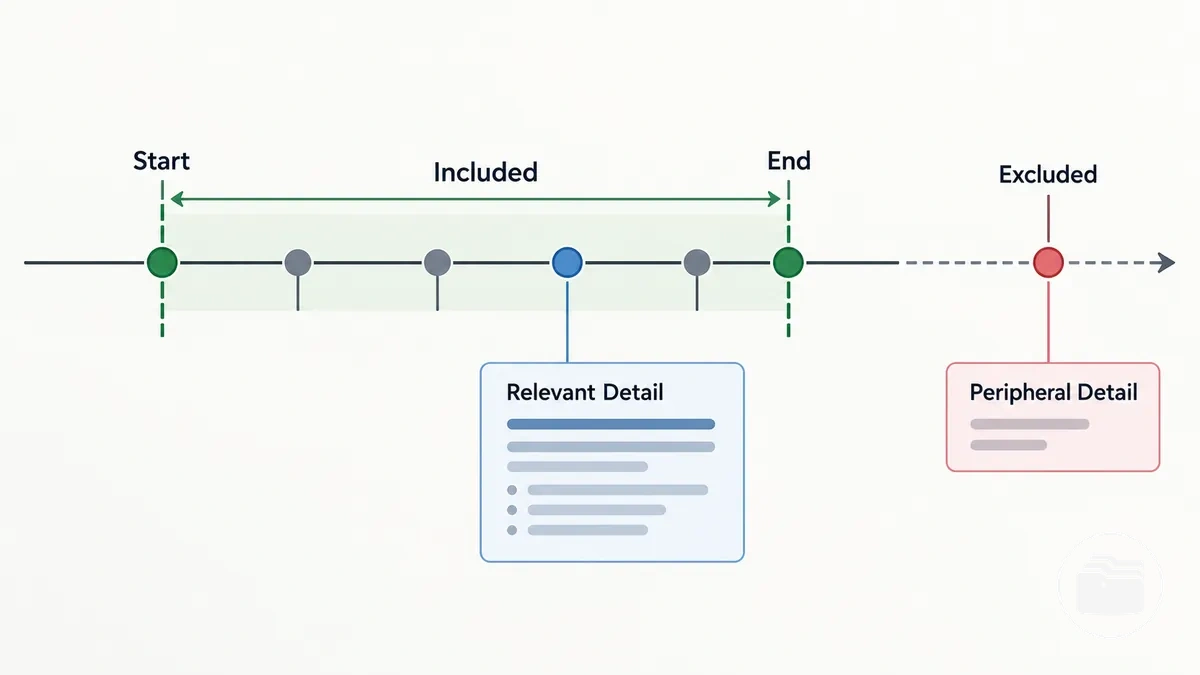
- Chronological relevance: Include an event when it helps establish, connect, or interpret the sequence; omit background that does not affect temporal understanding.
- Temporal precision: Record the date or period only as precisely as the available evidence permits, keeping an approximate period approximate when an exact date is unsupported.
- Evidentiary support: Keep detail that can be traced to supporting evidence and qualify information when the source record is incomplete or conflicting.
- Effect on sequence: Add detail when it changes the event's temporal position or the interpretation of surrounding events; narrative detail that leaves the sequence unchanged can remain outside the chronology.
For an older case with incomplete historical records, the earliest or latest supported point may define the practical boundary even when the wider case period is less certain.
Detail is justified when it changes chronological understanding, not merely because more background is available.
Record the Essential Fields for Each Timeline Event
A timeline entry is a structured event record that preserves the event description, date or bounded time range, source reference, and uncertainty status or conflict status needed to interpret it in the chronology.
An optional temporal note belongs only when it explains how the event relates to surrounding events or affects the sequence.
Use the same entry field labels across the timeline so comparable events can be checked and revised without changing what each field means.
Record a source citation or source identifier closely enough to the event for the supporting evidence to remain traceable.
When timing or evidence is uncertain or conflicting, record that state explicitly rather than converting it into a definitive claim.
The following fields standardize the information needed to evaluate each event and its chronological purpose.
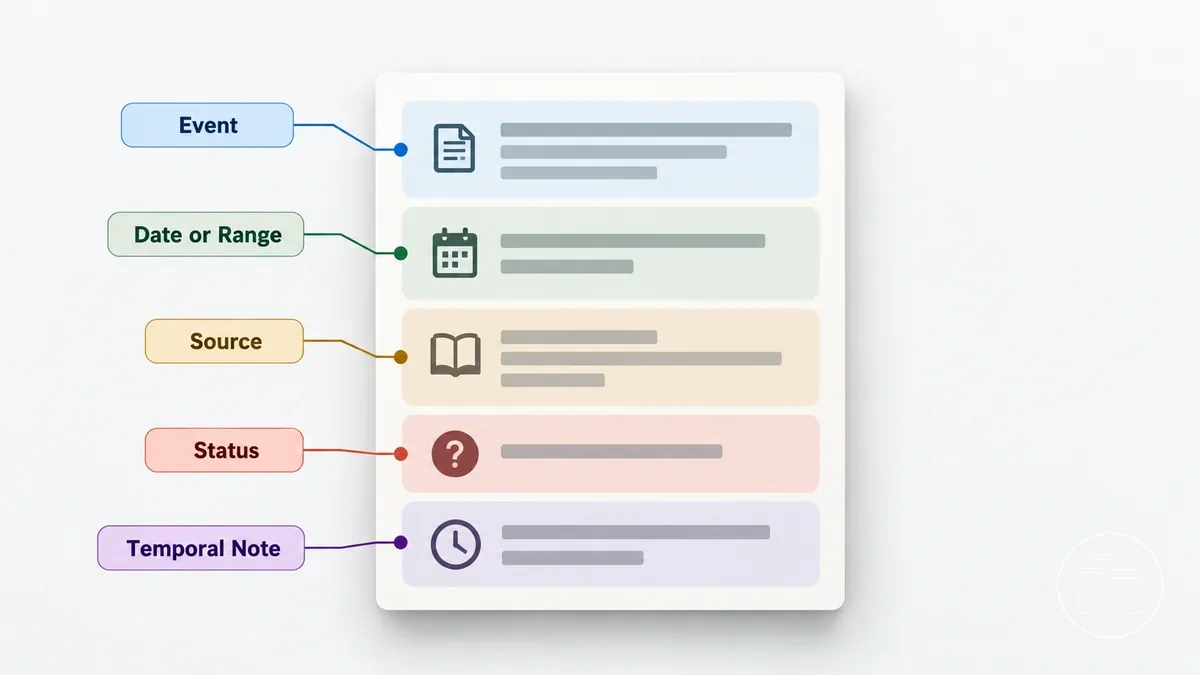
| Field | What to record | Chronological purpose |
|---|---|---|
| Event description | A concise description of what occurred. | Identifies the event being positioned in the chronology. |
| Date or time range | The supported date, approximate period, or bounded time range. | Places the event at the level of temporal precision supported by the available evidence. |
| Source citation or identifier | The citation, record reference, or other source identifier supporting the entry. | Preserves traceability so the event and its temporal information can be checked later. |
| Uncertainty or conflict status | Whether the timing or event information is supported, approximate, disputed, reconstructed, or affected by conflicting sources. | Distinguishes settled placement from entries that may require revision or qualified interpretation. |
| Optional temporal note | A short note only when context is needed to explain the event's temporal significance or relationship to nearby events. | Clarifies sequence without adding unrelated narrative detail. |
For example, a synthetic entry might describe an event, record only a bounded time range when no exact date is supported, identify the supporting record, and mark the timing as uncertain.
These chronology fields are narrower than broader case-file metadata because each one serves event interpretation, traceability, or temporal revision.
Build the Chronology from Source-Backed Events
Build the chronology from source-backed events by ordering them according to the strongest temporal information their evidence provides.
Events with a supported date can take a firmer temporal position, while events supported only by a time range or relative-time statement should retain an appropriate confidence state and, where necessary, a provisional placement.
The process below separates evidence from unsupported inference by moving each supported event through temporal normalization, placement, and sequence review.
Each step includes a check before the chronology advances.
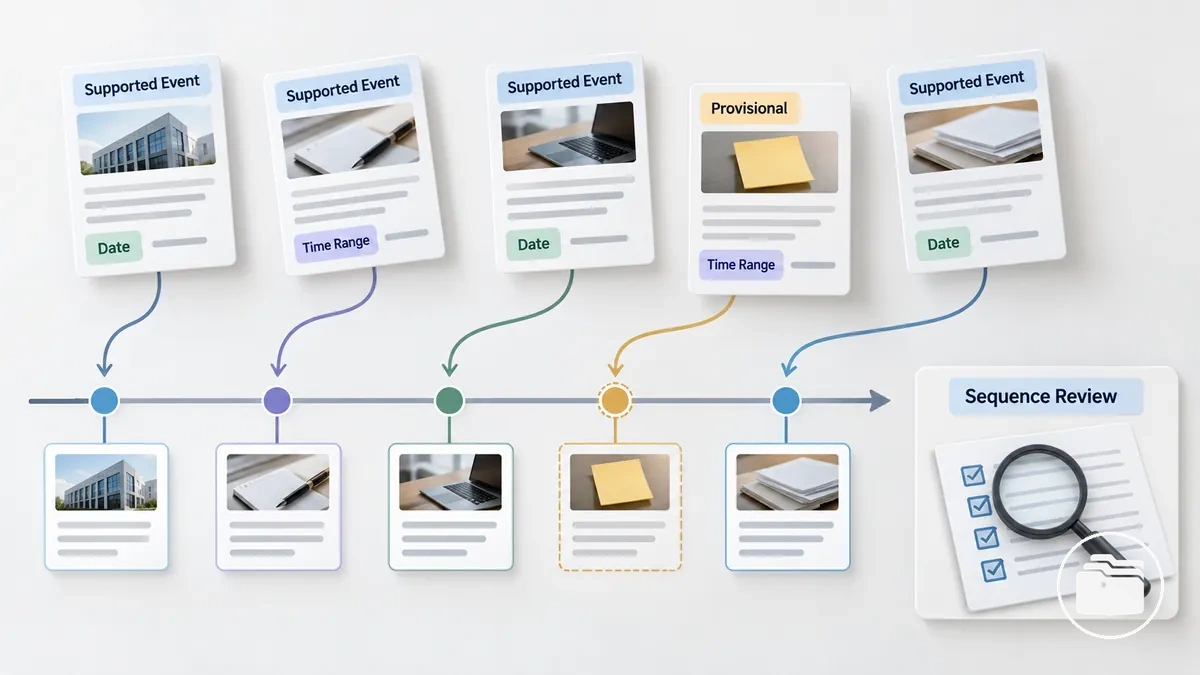
- Select events with support. Start with each source-backed event that has identifiable evidence for the event itself or its temporal information. Check that the record has enough support to enter the chronology before attempting to place it.
- Normalize dates and relative-time statements. Express each supported date, time range, or relative temporal statement in a consistent form while retaining the precision provided by the evidence. Check that normalization has not converted an approximate or bounded statement into a more precise claim.
- Place fixed events. Position events whose temporal information supports a specific point in the chronological order. Check that each position follows the recorded date rather than an inferred relationship with another event.
- Position approximate or bounded events provisionally. Place an event within the supported time range or relative position without presenting the placement as settled when the evidence leaves uncertainty. Check that its provisional placement and confidence state remain visible.
- Review the sequence and confidence states. Read the chronology in order and compare each temporal position with its supporting evidence. Verify that fixed and provisional events are distinguishable and that the resulting sequence does not imply greater temporal certainty than the evidence supports.
Provisional placement preserves a useful event order without turning unresolved timing into a fixed fact.
A confidence state should reflect whether the temporal position is directly supported, bounded by a time range, or still uncertain within the sequence.
During sequence review, revise the order when stronger temporal information changes an event's supported position.
The final check is whether every placement can still be traced from evidence to temporal position without treating chronological order as proof that one event caused another.
Place Fixed-Date Events as Chronological Anchors
A fixed-date event can function as a chronological anchor when its specific date is sufficiently supported by the available evidence. Support may come from one well-provenanced record that directly documents the date or from multiple consistent sources; source count alone does not establish accuracy.
Once supported, the anchor event gives the chronology a stable temporal position against which neighbouring events can be placed.
The chronological anchor constrains surrounding order by separating events that evidence places before it from those placed after it.
A neighbouring event does not need its own exact date to be constrained by the anchor if its supported temporal relation establishes that it preceded or followed the fixed date.
This relationship establishes sequence, not causality, and an approximate event should remain within its supported range or relative position.
The anchor therefore limits the permitted order around its temporal position.
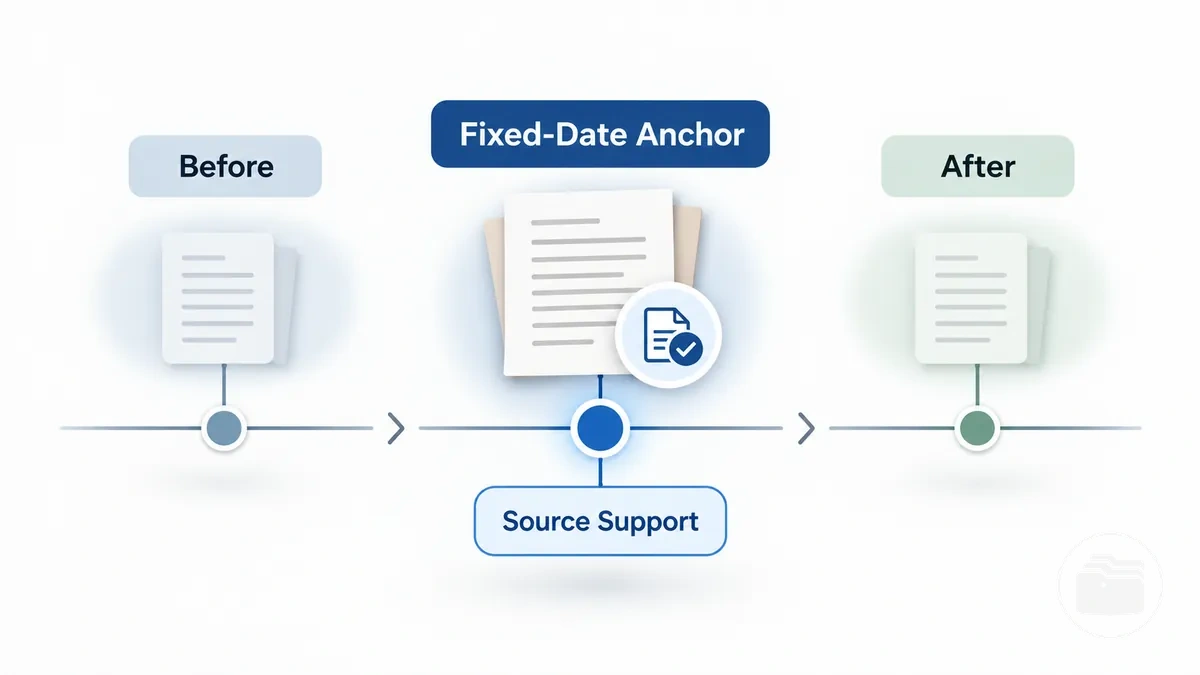
- Confirm the supported date. Check that the event's fixed date is supported strongly enough by the available evidence to serve as an anchor rather than relying on an unsupported or approximate date claim.
- Place the anchor event. Record the event at its supported temporal position in the chronology and retain the evidence that supports that date.
- Constrain neighbouring events. Use supported before-and-after relationships to position neighbouring events around the anchor, keeping any event with unresolved timing within its supported range or relative position.
Add Approximate or Bounded Events Without False Precision
Represent an approximate or bounded event at the level of precision supported by its temporal evidence rather than converting it into an exact date.
If the evidence establishes only a date range, relative timing, or a broader approximate date, keep that uncertainty state explicit when placing the event in the sequence.
Temporal evidence determines the supported representation and the resulting placement constraint.
The states below distinguish what can be placed approximately, bounded between limits, ordered before or after another event, or left unresolved within known boundaries.
Their order does not imply a difference in confidence.
- Approximate date: Represent the event around the supported period without assigning an unsupported exact day or timestamp. Its sequence position remains approximate to the same degree as the evidence.
- Bounded range: Place the event within the earliest and latest limits supported by the evidence. The event may move within that bounded range unless further temporal evidence narrows its placement constraint.
- Before or after: When the evidence establishes only relative timing, record that the event precedes or follows the relevant event without inventing a date between them. The before or after relation constrains chronological order while leaving the exact temporal position unresolved.
- Unresolved within boundaries: If the evidence limits an event to a known interval but cannot support a narrower position, keep its provisional placement within those boundaries and retain the uncertainty state. Its exact position in the local sequence remains unsettled.
An exact date occupies one supported temporal point, whereas an approximate date or bounded event occupies only the period or relative position the evidence can justify.
Preserving that distinction keeps the sequence useful without making uncertain timing appear more precise than its support allows.
Attach a Source Citation to Each Timeline Event
Attach a source citation to every event claim and temporal claim so each timeline entry remains traceable to the supporting evidence used to describe or place it.
The citation should identify the supporting source closely enough that the evidence can be located again without implying that the source establishes more than it actually supports.
The citation elements below preserve traceability without prescribing a particular citation style.
- Source identifier: Record the document, record, publication, interview, or other source reference needed to distinguish the supporting evidence from other material.
- Locator or source date: Include a page, section, record reference, timestamp, publication date, or comparable locator when available and useful for finding the supporting passage or record again.
- Supported claim: Identify the specific event claim or temporal claim the source supports so the citation's scope remains explicit.
- Disagreement note: When multiple sources materially disagree, record the differing support or uncertainty rather than allowing one citation to obscure the disagreement.
Keep recoverable citation information with the claim it supports rather than separating dates or event statements from their evidence trail.
A source identifier should distinguish the relevant record, while an available locator or source date can narrow where the supporting information appears.
When multiple sources support the same event, retain each materially relevant source and record any disagreement that affects the event claim or temporal claim.
This keeps the timeline auditable by preserving both traceability and the scope of what each source actually supports.
Handle Conflicting or Uncertain Timeline Dates
A conflicting date exists when sources disagree about the timing of the same event, while an uncertain date exists when the available evidence does not support one precise temporal position.
Source disagreement requires the competing claims to be checked against their supporting evidence; temporal uncertainty requires the chronology to retain only the date, range, or relative position the evidence can support.
Use a short diagnostic sequence to keep the chronology usable without manufacturing certainty.
The purpose is to distinguish the conflict type, inspect its evidentiary support, retain each supported alternative, and determine whether the event can be placed firmly or must remain provisional.
- Identify the problem state. Determine whether the issue is a conflicting date caused by source disagreement or an uncertain date caused by incomplete temporal evidence.
- Inspect the supporting evidence. Check what each source actually supports about the event's timing without treating one discrepancy as evidence that the entire source is unreliable.
- Retain supported possibilities. Keep only dates, ranges, or relative positions that remain supported by the evidence; do not force competing claims into one date for neatness.
- Set the placement status. Mark the event as resolved only when the evidence supports one temporal position; otherwise retain provisional placement and an explicit uncertainty status.
Provisional placement allows an unresolved event to remain useful in the sequence without presenting one competing date as settled.
If several supported alternatives remain possible, keep the event within the temporal limits those alternatives permit and preserve its uncertainty status until stronger evidence changes the placement.
For example, if one source supports an event on one date while another supports a nearby date and neither claim can be preferred from the available evidence, the chronology should retain the unresolved timing rather than manufacture a definitive resolution.
The sequence can remain provisional until the date conflict is supported more narrowly.
Compare Sources Behind Competing Dates
Compare each source only in relation to the disputed temporal claim, not as a judgment of the source's overall quality.
For a competing date, examine the same criteria across every account: proximity to event, whether the date is a direct statement or a repeated account, temporal specificity, consistency with other dated evidence, and any explicit uncertainty.
The table below uses two generic source accounts to show how the same temporal criteria can be applied consistently.
The observations affect confidence in each date claim without treating source prestige as evidence that one account is automatically correct.
| Source | Date claim | Basis and proximity | Consistency with dated evidence | Uncertainty / confidence implication |
|---|---|---|---|---|
| Source account A | States one competing date directly. | Direct statement with closer proximity to event; determine whether the account reports the date from its own record or derives it from another source. | Compare the claimed date with other dated evidence and note whether those records align or conflict. | Closer proximity and a direct basis may support greater confidence when the claim also remains consistent with other evidence, but explicit uncertainty should remain attached to the claim. |
| Source account B | States a different competing date. | Determine whether the date is a direct statement or a repeated account and how far the source is removed from the event. | Compare the alternative date against the same corroborating dated evidence rather than applying different standards. | A repeated account, lower temporal specificity, inconsistency, or explicit uncertainty may reduce confidence in the date claim, but none of these conditions alone establishes that the alternative is incorrect. |
Interpret the comparison by separating observable source attributes from the confidence implication they support.
Greater proximity to event, a direct statement, higher temporal specificity, and consistency with other dated evidence can strengthen a temporal claim, while a repeated account or explicit uncertainty may justify more qualified treatment.
If the evidence does not discriminate between the competing dates after the same criteria are applied, the result should remain unresolved rather than manufacturing a preferred date.
Preserve Unresolved Date Alternatives and Their Uncertainty
When the evidence supports more than one date, time range, or temporal position, preserve each supported alternative and the uncertainty that separates them.
- Alternative record
- Keep each supported date or time range separate, with its supporting evidence and the reason it remains unresolved. Do not average competing dates or silently select one.
- Placement constraint
- A supported range can constrain where an event may fall without establishing one exact point; an alternative date affects before-and-after relationships only conditionally.
- Sequence consequence
- If alternatives permit different sequence positions, keep the order provisional and qualified rather than implying that one possibility has greater support without evidence.
- Resolution condition
- Narrow the timing only when stronger evidence supports a narrower temporal conclusion; until then, retain the event's unresolved status.
Practical boundary: unresolved alternatives can constrain the chronology without becoming one invented midpoint or one falsely settled date.
Check the Timeline for Gaps, Sequence Errors, and Contradictions
A timeline consistency check tests the completed chronology for gaps, sequence errors, duplicate events, and contradictions that may weaken temporal consistency or evidentiary support.
A signal identifies something that requires checking, but a gap or contradiction does not by itself establish why the inconsistency exists.
A gap is a missing interval in which the evidence does not account for part of the chronology, but it does not prove that an event is missing.
A sequence error occurs when the recorded chronological order conflicts with supported dates or event relationships.
A duplicate event records the same event more than once without a justified distinction, while a contradiction exists when supported temporal claims cannot both hold under the same interpretation.
The checklist separates these states by the check needed to interpret them and the appropriate corrective direction.
- Gap check: Signal: an interval between neighbouring events has little or no recorded evidence. Interpretation: the interval may be an ordinary evidence gap, an intentionally broad date range, or a missing chronology entry. Check the supporting records and boundary conditions; if no additional event is supported, preserve the gap rather than inventing one, but add or adjust an entry when evidence justifies it.
- Sequence error check: Signal: an event appears before another event that the available dates or supported relationships require it to follow, or after one it must precede. Interpretation: the chronology may contain an ordering error even when each event has evidentiary support. Check the dates and before-or-after relationships; if the current order conflicts with them, correct the placement and then recheck the surrounding sequence.
- Duplicate event check: Signal: two entries describe the same event with no supported reason for separate treatment. Interpretation: the chronology may duplicate one event rather than document two distinct occurrences. Check the event description, temporal information, and supporting evidence; merge or distinguish the entries according to what the evidence supports.
- Contradiction check: Signal: two supported date claims or event relationships cannot both fit the chronology as currently stated. Interpretation: the inconsistency may reflect conflicting evidence, different event definitions, or unresolved timing rather than deception. Check the exact claims and their evidentiary support; revise an unsupported statement where possible or preserve the contradiction and uncertainty when the evidence does not resolve it.
Interpret each failed check according to the evidence rather than assuming a cause from the signal alone.
A corrective direction should restore the chronology only to the level of temporal precision and support the evidence permits, whether that means changing an order, removing a duplicate, adding a supported event, or retaining an unresolved inconsistency.
After any correction, recheck the affected sequence so the revised placement does not create a new temporal inconsistency elsewhere.
Update the Timeline as New Evidence Changes the Chronology
Revise a timeline when new evidence adds an event, changes a date, narrows a range, or alters an uncertainty state, but preserve the current entry as the previous state before making the change.
A timeline update is complete only after the proposed revision is recorded and every affected sequence relationship has been rechecked against the updated chronology.
Use the same update cycle for each timeline revision so a revised date or narrowed range does not silently replace the earlier record.
The cycle connects the current entry, new evidence, proposed revision, uncertainty review, sequence recheck, and recorded change while limiting adjustments to relationships actually affected by the evidence.
- Identify the affected entry. Record the current entry, including its existing date or range, uncertainty or confidence state, and relevant neighbouring event relationships. Completion check: the previous state remains recoverable before any revision is applied.
- Record the new evidence. Attach the evidence that introduces a new event or supports a changed temporal value. Completion check: the evidence can be traced to the specific part of the chronology it may affect.
- State the proposed revision. Specify whether the change adds an event, produces a revised date, narrows a range, or changes another temporal condition. Completion check: the proposed revision is distinguishable from both the current entry and the evidence used to support it.
- Reassess uncertainty or confidence. Review whether the new evidence narrows, preserves, or leaves unresolved the entry's uncertainty state rather than removing uncertainty automatically. Completion check: the revised entry expresses only the temporal precision and confidence state supported by the combined evidence.
- Recheck neighbouring sequence relationships. Test whether the proposed revision changes the entry's permitted order relative to each affected neighbouring event. Completion check: any chronological effect is applied where supported, while unrelated entries remain unchanged.
- Record the revision. Document the previous state, the revised state, the supporting evidence, the uncertainty review, and any resulting sequence change. Completion check: the recorded change explains why the chronology was revised and preserves a traceable revision history.
A changed event may alter the position or interpretation of a neighbouring event when the revised temporal value changes their supported order, but it does not automatically affect the rest of the chronology.
If a narrowed range leaves the same before-and-after relationships intact, those neighbouring placements can remain unchanged while the entry itself becomes more precise.
If the sequence recheck reveals a dependent change, record that effect as part of the same revision rather than changing the date in isolation.
The updated chronology should remain evidence-traceable and internally consistent while staying open to later revision if stronger evidence appears.