Academic and Library Sources for True Crime Research
Academic and library sources strengthen true crime research by providing scholarly interpretation, research methods, preserved materials, and discovery pathways. Use them to explain, locate, or contextualise evidence, but do not treat scholarly or institutional status as proof of a case-specific fact; the source still has to support the particular claim and fit the research question.
Research-function guide
Match the question to the evidence function
Start with the claim you need to answer. The useful source type changes with the required evidence, and each source has a boundary on what it can reasonably establish.
Case-specific fact
Start with
Records or other evidence that directly document the event, statement, action, decision, or record at issue.
Academic/library role
Provide context, interpretation, discovery, or access unless the holding itself contains the direct record.
Boundary
Scholarly prestige or library custody does not substitute for direct support of the fact.
Scholarly interpretation
Start with
Relevant journal articles, scholarly books, theses, dissertations, or institutional research.
Use it for
Theory, methods, terminology, prior research, and disciplinary interpretation.
Boundary
Population, jurisdiction, method, time period, and scope must still fit the question.
Historical or archival context
Start with
Special collections, archives, catalogues, finding aids, historical records, and contemporary publications.
Use it for
Preserved material, provenance, institutional history, period context, and discovery.
Boundary
Holdings can be incomplete or restricted; absence from one collection is not proof that an item never existed.
Population or statistical context
Start with
Relevant population-level research or appropriate aggregate data sources.
Use it for
Patterns, comparisons, prevalence, trends, or outcomes across groups and periods.
Boundary
Aggregate findings do not by themselves establish what happened in one individual case.
Decision rule: choose the source by the evidence the question requires, then test its scope, methods, provenance, and limitations before using it to support a claim.
This page focuses on finding, understanding, and evaluating academic and library sources for true crime research while keeping context and interpretation distinct from evidence that directly establishes a disputed case fact.
Table of Contents⌄
What Academic and Library Sources Contribute to True Crime Research
Academic and library sources contribute scholarly context, established concepts, research methods, historical preservation, and discovery pathways that complement case-specific evidence.
Scholarly literature can explain theories, terminology, methods, and prior research, while library collections can preserve research material and organise access through catalogues, databases, and other discovery systems.
For true crime research, these functions help frame a case question, locate relevant material, and understand how a claim fits within a broader body of knowledge.
The usefulness of each contribution depends on the source, the research question, and its relationship to the particular case.
Different disciplines contribute different forms of context: criminology can frame questions about crime and criminal justice, while law can clarify legal concepts, procedures, and institutional context relevant to a research question; psychology, history, or media studies may provide other interpretive perspectives when those disciplines are relevant.
Library collections perform a different institutional role by preserving holdings and creating discovery pathways that help researchers locate scholarly or historical material across formats.
Within the wider True Crime Research process, these functions support interpretation and source discovery rather than replacing case-specific evidence.
The illustration separates contextual, methodological, and discovery contributions without treating them as a hierarchy.
Academic status alone does not make a claim correct, and a library holding is not necessarily scholarly; the evidentiary contribution of a source depends on what it is, how it was produced, and which claim it can support.
Academic and library sources are therefore most useful when their contribution is matched to the research question before the specific material type is selected for closer examination.
Types of Academic and Library Materials for Case Research
Academic and library materials differ by source form, typical content, access conditions, and the research function they can serve in case research.
Some source types primarily support scholarly interpretation through published research, synthesis, or extended academic analysis, while others primarily support discovery or access to preserved holdings.
The illustration groups these material families by recognisable form and research function rather than ranking their reliability or importance.
Journal articles: Primarily useful for scholarly interpretation and methodology, journal articles can report research methods and findings, review prior literature, and provide references for further investigation. Access and peer-review status depend on the individual publication and should not be assumed from the journal format alone.
Scholarly books: Academic monographs and edited volumes typically provide sustained analysis, synthesis, or disciplinary context across a broader subject than a single article. Their research value depends on the book's scope, authorship, publication context, and relationship to the case question.
Theses and dissertations: These materials can provide detailed literature reviews, methods, original analysis, and extensive reference lists for specialised scholarly interpretation. Their scope, review process, institutional requirements, and availability can differ between works.
Institutional research: Universities and research institutions may produce reports, working papers, research publications, or other materials addressing a defined subject or project. These can add specialised findings or context, while publication processes, coverage, and access conditions differ between institutions and documents.
Repositories and catalogues: Primarily useful for discovery, institutional repositories and library catalogues organise records for articles, theses, books, reports, and other holdings; some repositories also provide access to full digital materials. Inclusion identifies availability or location rather than the evidentiary strength of the item itself.
Special collections: Primarily useful for preserved holdings and discovery, library special collections can contain manuscripts, correspondence, photographs, ephemera, institutional records, and other distinctive materials whose provenance may affect interpretation. Finding aids support discovery, while collection scope, digitisation, onsite requirements, or access restrictions can limit what a researcher can examine.
The most useful material type depends on the research question: scholarly interpretation may require journal articles, scholarly books, theses, dissertations, or institutional research, whereas discovery of preserved or institutionally organised material may depend more heavily on repositories, catalogues, and special collections.
Access conditions and source scope should therefore be considered alongside the information each material type can contribute to case research.
Peer-Reviewed Journal Articles and Scholarly Books
Peer-reviewed journal articles and scholarly books share a scholarly context but typically serve different research functions: journal articles often report focused research, methods, findings, and references, while academic monographs and edited volumes can develop theory or provide broader literature synthesis and disciplinary interpretation.
Peer review is an editorial evaluation process applied to a particular scholarly work; it does not mean that every item appearing in a scholarly journal has undergone the same review.
The illustration highlights these publication-form differences and their typical research functions without ranking one format above the other.
Authorship, references, methods, and publication context help show how a scholarly work was produced and what kind of evidence or interpretation it can contribute.
Clark College Library notes that scholarly journals may contain peer-reviewed articles alongside material such as letters, book reviews, and shorter review articles, so journal placement alone does not establish the review status of a specific item.
Scholarly books may provide greater space for synthesis and extended treatment of a criminological, legal, psychological, historical, or media topic, while a journal article may provide a more focused account of a particular study or argument.
Neither peer review nor scholarly publication makes every conclusion definitive, and contextual scholarship should not be treated as primary evidence for a specific case fact unless the work itself directly supports that fact.
Library Special Collections and Archival Holdings
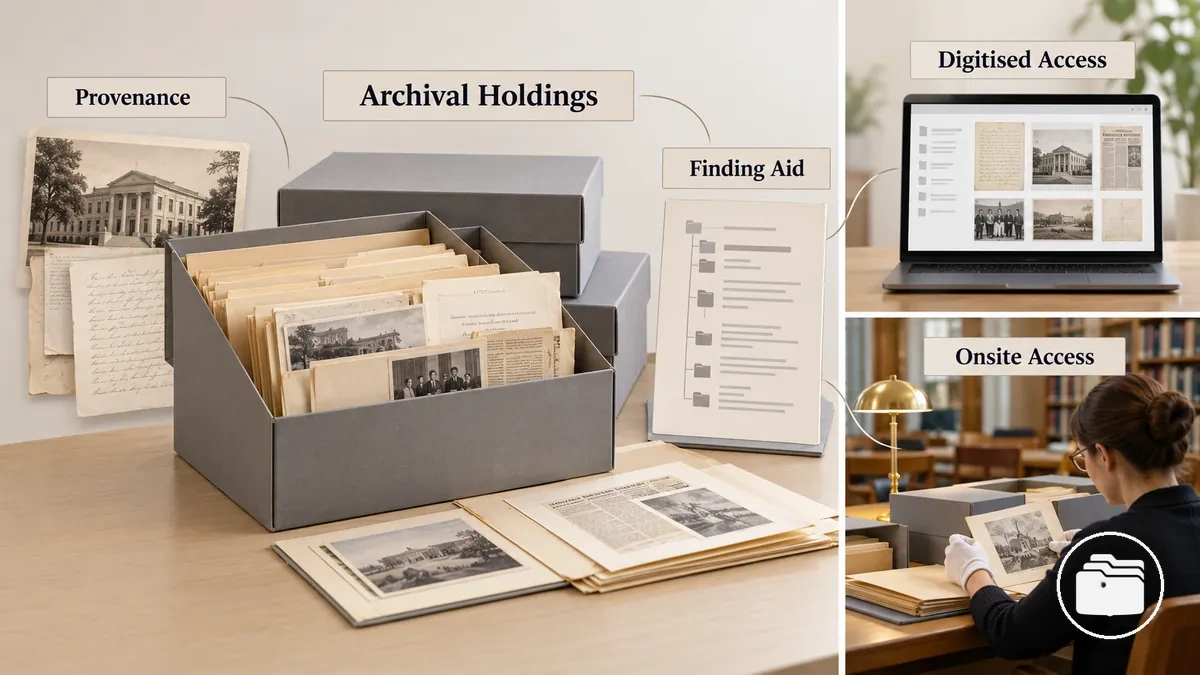
Library special collections and archival holdings preserve unique or hard-to-find materials whose research value depends on provenance, custody, collection scope, and relationship to the question being investigated.
Holdings can include correspondence, photographs, newspaper clippings, ephemera, institutional records, rare publications, and other preserved materials that provide historical or organisational context.
Provenance matters because knowing where an item came from and how it entered a collection helps a researcher interpret what the material represents and what claims it can reasonably support.
Finding aids and catalogue descriptions can identify collection contents, arrangement, dates, creators, or access conditions, but the level of description varies by institution and collection.
Some holdings are digitised for remote access, while other materials remain available only onsite because they have not been digitised, require supervised handling, or are subject to restrictions.
Collection scope can also be incomplete, so the absence of an item from a particular archive does not by itself show that the item never existed.
The illustration shows preservation and access context around archival holdings rather than implying evidentiary certainty.
For case research, a library archive may preserve photographs, correspondence, newspapers, ephemera, or institutional records, but the evidentiary meaning of each item still depends on its provenance, content, custody, and connection to the case.
Preserved material can be valuable without being complete, unrestricted, or self-interpreting; researching an older case may therefore require combining archival holdings with other case-specific records and sources.
Academic and Popular Sources Serve Different Research Functions
Academic sources and popular sources can both contribute to case research, but they typically serve different research functions and should not be reduced to a reliable-versus-unreliable binary.
Academic sources often emphasise scholarly communication, theory, methods, references, and disciplinary interpretation, while popular publications may emphasise timely reporting, general-audience explanation, commentary, or public discourse.
The usefulness of either source class depends on its authorship, audience, editorial process, evidence, citations, purpose, timeliness, and relationship to the specific research question.
SUNY Canton’s Library Research E-Textbook distinguishes scholarly and popular publications using recurring characteristics such as author background, intended audience, editorial accountability, references, and publication purpose.
The comparison and illustration use those shared dimensions to clarify differences in evidence presentation, audience, and research use without assigning either source class a reliability score.
Criterion
Academic Sources
Popular Sources
Research Implication
Authorship
Often written by scholars, researchers, or subject specialists whose credentials and institutional affiliations are identified.
Often written by journalists, staff writers, commentators, or other general-audience authors; subject expertise varies by publication and author.
Check the author's expertise and role rather than treating publication type alone as evidence of authority.
Audience
Typically addresses scholars, researchers, students, or specialist readers and may use disciplinary terminology.
Typically addresses a general audience and tends to explain topics in more accessible language.
Audience affects depth, terminology, and the amount of background explanation a source is likely to provide.
Editorial process
Scholarly journal articles may undergo peer review, while scholarly books and other academic works follow editorial processes appropriate to their publication form.
Popular publications are commonly reviewed by editors rather than academic peer reviewers, although editorial practices differ between outlets.
Verify the editorial process of the specific item when that process matters to the research question.
Evidence and citations
Often presents references, methods, prior research, or other evidence that allows claims to be traced within a scholarly literature.
May summarise, quote, or link to evidence, but formal citation and methodological detail are often less extensive and vary by publication.
Academic material can support evidence tracing and methodological interpretation, while popular material can provide leads that require verification against underlying sources.
Purpose
Typically serves scholarly communication, research analysis, theory development, literature synthesis, or disciplinary interpretation.
May serve reporting, explanation, commentary, entertainment, or discussion of issues for a general audience.
Match the source's purpose to the research task before deciding how much weight its claims should carry.
Timeliness
Publication can take longer when research, review, revision, and academic production processes are involved.
News and other popular publications may report events or public reactions soon after they occur.
Popular sources may be useful for contemporary framing, while academic sources may provide deeper research context after scholarly analysis develops.
Typical research use
Often useful for theory, methods, literature synthesis, disciplinary context, and interpretation of broader crime-related questions.
Often useful for research leads, contemporary reporting, public discourse, and understanding how events were presented to general audiences.
Neither research function automatically establishes a disputed case claim; the source must directly support the particular claim being examined.
Academic sources are often more suited to theory, methods, and research context when their scope and evidence address the question being investigated.
Popular sources may be especially useful for leads, contemporary framing, journalism, or public discourse, including material produced before substantial scholarly analysis becomes available.
Individual publications can still depart from these typical patterns, so research use should follow the specific source, claim, and evidence rather than category prestige.
Neither an academic nor a popular source automatically establishes a disputed case fact without evidence that directly supports that claim.
How to Find Scholarly Research Relevant to a Crime Case
Finding scholarly research for a crime case works best as a linked process: move from the concrete case detail to disciplinary language, use the discovery system that matches the material you need, extend from relevant sources, and then test fit against the original question.
1
Translate the case detailMap names, events, offences, institutions, or disputed issues to the academic concepts used by the relevant discipline.
2
Choose the discovery systemUse research guides for orientation, catalogues for holdings, and scholarly databases for article-level literature.
3
Extend from a strong seed sourceTrace references backward for earlier foundations and citations forward for later research, critiques, replications, or applications.
4
Check research fitConfirm that subject, population, jurisdiction, method, time period, and scope still answer the original case-research question.
Searching only an exact case name may return little scholarly literature because researchers can study the underlying phenomenon without naming that particular case.
Wilson College's criminal justice research guide recommends identifying the important concepts in a topic and combining keywords with synonyms, which can improve retrieval when authors use different terminology for related subjects.
A case involving an eyewitness identification issue, for example, could therefore lead from the case name to academic search concepts such as eyewitness memory, identification procedures, or cognitive bias.
The resulting literature should still receive a relevance check for subject scope, population, jurisdiction, method, and whether it actually addresses the question being investigated.
For example, if a case detail concerns why an investigation remained unresolved for years, the scholarly search can broaden from the case name to concepts such as cold-case investigation, memory retrieval, investigative decision-making, or other relevant criminology and psychological research before being narrowed to the specific issue.
This academic and library discovery method is narrower than the broader task of finding research material and case sources generally, because its purpose is to connect case details with relevant scholarly literature rather than locate every possible record about the case.
Turn Case Details into Academic Search Concepts
Translate case details into academic search concepts by identifying the disciplinary concept represented by each name, event, offence, institution, disputed issue, or circumstance, then add a useful synonym or related concept without discarding conditions that change the research question.
A named case can therefore be broadened into terminology used in criminology or another relevant discipline while still retaining the details needed to keep the search relevant.
The following mappings expand discoverability while preserving the meaning and scope of the original case detail.
Subject-defining detail — disputed conviction: Map the case detail to the disciplinary concept wrongful conviction, with a related concept such as miscarriage of justice; retain the offence type or disputed evidentiary issue when narrowing the search.
Subject-defining detail — harm to a victim or group: Map the event or circumstance to victimisation, then broaden or narrow with a related concept such as repeat victimisation when that distinction matches the case; preserve the relevant population and offence type.
Subject-defining detail — conduct by a police institution: Translate the institution-specific issue into concepts such as policing practice or investigative decision-making; retain the jurisdiction when legal powers, procedures, or institutional context materially affect the question.
Scope-constraining detail — sentencing dispute: Use sentencing as the disciplinary concept and a related concept such as sentencing disparity where relevant, while preserving the offence type, jurisdiction, court context, or date range that defines the comparison.
Scope-constraining detail — media coverage of a case: Map the concrete coverage to media representation and related concepts such as public perceptions of crime or crime news framing; retain the date range, population, or media context when those conditions determine the research scope.
Broaden terminology only far enough to capture relevant scholarly language, then narrow it with constraints such as jurisdiction, date range, population, offence type, institution, or evidentiary issue.
These limits should be preserved whenever removing them would change the meaning of the question, because a useful academic search concept expands terminology without turning the original case problem into a different research topic.
Use Library Research Guides, Catalogues, and Scholarly Databases
Library research guides, library catalogues, and scholarly databases perform different discovery functions: research guides orient a subject search through curated resources, catalogues list or organise library holdings, and scholarly databases help locate journal literature and related research.
Library catalogues and scholarly databases may support subject headings, keywords, field searching, and filters, but available controls, indexing depth, subscriptions, and access vary by institution and system.
The comparison separates these discovery systems by what they organise, which search controls they expose, and the typical limitation that can affect their use.
Discovery System
What It Organises
Useful Search Controls
Typical Limitation
Research guides
Curated subject resources that may include catalogues, scholarly databases, reference material, and selected research tools.
Subject or discipline navigation, resource categories, and curated starting points; available controls depend on the guide.
They orient a search but do not provide complete coverage of all literature or holdings relevant to a topic.
Library catalogues
Records for books, journals, media, collections, and other items owned or licensed by a library; the exact indexed content depends on the catalogue.
Keywords, author or title fields, subject headings, field searching, and filters such as date, language, location, or format where supported.
Holdings and interfaces vary by institution, and some catalogues identify journal titles without indexing every individual article.
Scholarly databases
Journal articles and other academic literature within the disciplines, publishers, or collections covered by the database.
Keywords, subject terms, field searching, and filters such as publication date, discipline, document type, or peer-review status when available.
Indexing depth, filters, full-text access, and subscription coverage vary; a peer-review filter narrows results but does not determine whether a source is relevant or sufficient for the research question.
Research guides are useful for orientation, library catalogues for discovering books and institutional holdings, and scholarly databases for locating article-level academic literature.
Choosing among them should follow the information need and available access rather than assuming that any single discovery system provides complete coverage.
Use Backward and Forward Citation Chaining to Find Related Research
Citation chaining uses a highly relevant seed source to trace earlier works in its references and later works that cite it, extending related literature in two directions.
Start with a seed source that closely matches the case-research question, because each citation path inherits some of its topical focus.
The two directions expose earlier foundations and later citing work before each discovered source receives a relevance check.
Backward chaining: Backward citation chaining follows the seed source's references to identify earlier studies, theories, methods, or evidence that shaped the paper and may include foundational studies.
Forward chaining: Forward citation chaining follows citing works published after the seed source to locate later research, replications, critiques, applications, or developments that respond to or build on it.
For example, one highly relevant criminology or criminal-justice paper can lead backward to older foundational studies and forward to newer citing research, but every discovered source still needs a relevance check against the case question, scope, population, and method.
Citation count should not be treated as a quality score, because a frequently cited work can still be irrelevant or unsuitable for the specific research question.
Repeated tracing within one citation network can also overrepresent a particular school of thought, so citation chaining should support discovery rather than define the full body of relevant scholarship.
How to Evaluate Academic Sources for Case Research
Evaluate an academic source by checking its scholarly status, authority, relevance, methods, evidence, scope, limitations, and fit with the specific research question; scholarly status alone is insufficient.
Publication-level signals such as peer review, authorship, affiliation, and publication context can indicate how a source was produced, but they do not establish that its findings apply to the case question.
The stronger assessment comes from combining those signals with scrutiny of what the study investigates, how it supports its claims, and the conditions under which its conclusions are applicable.
University of Waterloo Libraries advises researchers to consider relevance, author expertise, publication context, methodology, population, data, accuracy, and purpose when evaluating information.
The checklist separates publication-level credibility signals from study-level evidence and question fit so that each criterion leads to a practical implication for use.
Scholarly status: Check whether the item is a research article, scholarly book, review, commentary, or another publication type and whether peer review applies to that specific work. Scholarly status indicates aspects of the publication process but does not by itself establish that the evidence fits the case question.
Authority: Check the authors' relevant expertise, qualifications, affiliations, and role in the subject area. These conditions can support an authority assessment, but institutional affiliation or reputation still requires scrutiny of the work itself.
Relevance: Check whether the source directly addresses the legal, criminological, forensic, psychological, social, or media issue represented by the research question. A broadly related source may provide context while remaining unsuitable as direct support for a narrower claim.
Methods: Examine the study design, data source, sample or population, comparison basis, and analytical approach. A methodological mismatch limits how confidently the findings can be applied to a different population, jurisdiction, offence type, or research problem.
Evidence: Examine the data, observations, references, or other evidence supporting the authors' conclusions and whether the reasoning connects that evidence to the claims made. Strong publication credentials do not compensate for evidence that fails to support the specific proposition being investigated.
Scope: Identify boundaries such as jurisdiction, population, offence type, institution, historical period, or sample. A study can be methodologically sound within its scope while remaining a poor fit outside those conditions.
Limitations: Check limitations acknowledged by the authors and constraints arising from design, data access, sample characteristics, or coverage. These conditions indicate where conclusions require qualification or where additional evidence may be needed.
Research question fit: Determine whether the source as a whole supports the precise question or claim rather than merely sharing related terminology. This relevance check determines whether the source is suitable as direct support, contextual background, methodological guidance, or unsuitable for that particular claim.
Relevance, methodological fit, evidence, scope, and limitations should carry more weight for case-specific use than surface signals such as citation count, institutional affiliation, peer review, or recency considered alone.
For example, a peer-reviewed study can be well executed yet remain a poor match if its population, jurisdiction, or offence context materially differs from the case question.
Evaluating an individual academic source in this way is distinct from source hierarchy and selection, which concerns how different source classes are prioritised across the wider research process.
Confirm Scholarly Status, Authority, and Publication Context
Confirm scholarly status and authority by identifying the publication type, authorship, affiliation, journal or publisher, and editorial context rather than judging the source by appearance alone.
Scholarly articles, professional reports, conference papers, theses, preprints, and popular pieces can all appear in library systems, but they reflect different publication processes and therefore require different scrutiny.
The criteria below separate identity signals from process signals so that each observed feature indicates scholarly context without being treated as proof that the source's claims are correct.
Identity signal — Publication type: Identify whether the source is a scholarly article, professional report, conference paper, thesis, preprint, popular piece, or another form. The publication type indicates which editorial, review, and accountability expectations are reasonable to investigate.
Identity signal — Authorship and affiliation: Check the named author, relevant expertise, disciplinary background, and affiliation where available. These details can support an assessment of subject authority and accountability, but credentials or institutional association alone do not establish the accuracy of the claims.
Identity signal — Journal or publisher: Confirm the journal, publisher, institution, or organisation responsible for making the work available. A clearly identifiable publication context helps establish who stands behind the work and which publication practices can be examined.
Process signal — Peer review or editorial process: Check whether peer review, editorial review, supervision, or another review process is explicitly associated with the specific source type. A declared review process indicates a scholarly or editorial control mechanism, but it does not guarantee that every conclusion is correct.
Process signal — References and intended audience: Examine whether the source provides references that make its intellectual basis traceable and whether its intended audience is scholarly, professional, policy-focused, or general. These signals help distinguish disciplinary communication from material written primarily for broader public consumption.
Process signal — Publication date and bibliographic metadata: Check the publication date and stable bibliographic metadata such as author, title, publication, volume or issue, institutional record, or persistent identifier where available. Complete metadata supports identification and traceability, while the significance of publication date depends on whether the research question requires current evidence or historical context.
These scholarly signals indicate how a source was produced, documented, and situated, but they remain evidence about publication context rather than proof of claim accuracy.
Citation counts, institutional prestige, or the appearance of an academic website should therefore require the same scrutiny as other authority cues instead of functioning as shortcuts to reliability.
A source can have strong authorship, affiliation, peer review, references, and bibliographic metadata while still requiring separate evaluation of whether its claims and evidence fit the research question.
Assess Methods, Evidence, Scope, and Limitations
Assess study methods and evidence by asking whether the research question, method, data source, sample or corpus, and reported result actually support the inference you want to make.
The study design should measure or analyse the phenomenon relevant to that inference rather than a related but different question.
Scope conditions such as jurisdiction, time period, population, measurement choices, and source data determine how far the result can reasonably be applied.
Research question: Identify exactly what the study set out to investigate. The allowable inference should remain connected to that question rather than extending to a different claim.
Method or data source: Check what the method directly measures, observes, compares, or analyses and where the data source comes from. The method supports only conclusions that its design and evidence base can address.
Sample or corpus: Examine sample size and composition or the boundaries of the corpus, including population, jurisdiction, time period, and relevant selection conditions. These features limit generalisation beyond the people, records, texts, or other material actually studied.
Result: Read the reported result in relation to what was measured. An association supports an inference about association under the study conditions, while causal language requires a design capable of supporting a causal conclusion.
Limitation: Identify author-acknowledged limitations and constraints arising from measurement choices, source data, sampling, coverage, or design. A stated limitation narrows the conclusions that can reasonably be carried into case research.
Allowable inference: Compare the result and limitations with the conclusion you intend to use. If the intended claim extends beyond the measured population, jurisdiction, time period, corpus, or design, additional evidence is required.
For example, a survey examining true crime consumption and public fear of crime can measure reported viewing patterns, attitudes, or perceptions within its sample, but those results do not establish the factual history of a particular offence.
Group-level findings should not be generalised to an individual person or case unless the study design and evidence directly support that inference.
The key distinction is between what the study actually measured and what the researcher wants to conclude from it.
Match the Source to the Specific Research Question
Source suitability depends on the research question and the required evidence: the strongest fit is the source class whose evidence type and scope can answer the specific claim being investigated.
A source that is appropriate for scholarly interpretation may be unable by itself to establish a case fact, while a source containing direct case evidence may not answer a broader population-level question.
The following conditional mapping separates factual, interpretive, historical, and statistical context according to the evidence each question requires.
If the question concerns a case fact: The required evidence is material that directly documents the event, statement, action, decision, or record at issue, so case-specific records or other direct evidence are suited to the question. Academic commentary can provide context, but it cannot by itself establish a factual event that it does not directly document.
If the question concerns scholarly interpretation: The required evidence is disciplinary analysis, theory, methods, or prior research, so relevant academic studies, scholarly articles, or books can answer the interpretive question. Their limitation is that broader criminological or social findings may not establish what happened in the individual case.
If the question concerns historical context: The required evidence concerns conditions, institutions, practices, or events from the relevant period, so archival material, historical records, contemporary publications, and historical scholarship may be suited to the question. The limitation is that contextual material can explain the period without necessarily proving a disputed case-specific fact.
If the question concerns statistical context: The required evidence is aggregate data about populations, offences, trends, or outcomes, so official statistics or relevant population-level research can provide statistical context. Aggregate data can support comparison with a wider population but cannot by itself establish what occurred in one individual case.
The same case can therefore require different source classes for different questions: a factual event may require direct case evidence, a criminological interpretation may require scholarly literature, and a population-level comparison may require aggregate data.
These source classes are not arranged in a universal hierarchy because their usefulness changes with the claim and evidence need.
The key limitation is always the same: a source should be used only for the question its evidence and scope can reasonably answer.
Limits of Academic and Library Sources in Case-Specific Research
Academic and library sources have important limits in case-specific research because their evidence may provide context, interpretation, or preserved material without directly establishing the event or claim being investigated.
Case specificity, publication timing, collection coverage, access conditions, geographic scope, temporal scope, and disciplinary framing can all constrain what a source reasonably supports.
These limits affect the interpretation and applicability of the material rather than making academic or library research inherently unhelpful.
The main source limitations fall into access-related and inference-related conditions, each of which changes how confidently the material can support a case-specific claim.
Inference-related — Case specificity: Scholarly literature may explain criminological patterns, legal concepts, behavioural research, or other contextual scholarship while containing no direct evidence about the individual case. When the publication does not document the event or record at issue, it can support interpretation but does not necessarily establish the case fact itself.
Inference-related — Disciplinary framing: Academic work approaches a subject through the concepts, methods, and questions of a particular discipline. A criminological, psychological, historical, legal, or media-focused framing may illuminate one dimension of a case while omitting details outside that disciplinary purpose.
Inference-related — Geographic and temporal scope: Findings produced within a particular jurisdiction, population, geographic scope, or time period may have limited applicability when the case involves materially different legal systems, institutions, populations, or historical conditions. A scope mismatch therefore constrains how far the source can be generalised.
Inference-related — Publication lag: Academic research can be published after data collection, analysis, review, and editorial processing, creating publication lag between the period studied and the material available to researchers. This matters when the research question depends on recent developments or when later evidence changes the relevant context.
Access-related — Restricted holdings: Libraries and archives may contain incomplete collections or restricted holdings because material was never acquired, has not survived, remains closed, or is available only under specific access conditions. The absence of an item from one collection therefore may reflect collection boundaries rather than evidence that the item or event never existed.
Access-related — Access barriers: Useful material may require institutional subscriptions, onsite consultation, permissions, specialised catalogues, or access to collections that are not digitised. These access barriers can limit what a researcher can inspect directly and may leave parts of the evidentiary record unavailable for immediate review.
Inference-related — Aggregate context: Aggregate research or statistical material can describe patterns across populations, offences, places, or periods but does not by itself establish what happened in one individual case. Its research consequence is contextual rather than case-determinative unless additional case-specific evidence supports the claim.
These limitations constrain interpretation without negating the value of scholarly literature, library collections, or archival material: academic sources can explain patterns and concepts, while archives can retain important records even when their holdings are incomplete.
Separate crime data and statistical sources can provide aggregate statistical context and support population-level comparison, but that evidence function remains distinct from establishing an individual case fact.
Case-specific conclusions should therefore reflect what the available source actually contains, the conditions under which it was produced or accessed, and whether its evidence directly supports the claim being made.