How to Research Older True Crime Cases Using Historical Archives
To research an older true crime case, start with verified names, date ranges, locations, historical jurisdictions and record identifiers, then follow those clues through contemporary newspapers, archive catalogues, finding aids and repository records in a traceable source sequence. Treat an unsuccessful web search as a retrieval result—not proof that a record never existed—and preserve each finding’s provenance, date, creator and access status before interpreting it.
Whole-article research path
From a historical clue to a defensible archive finding
Use each located source to produce the next checked search key. The goal is not simply to find more material, but to keep the chain between the clue, the repository, the record and the interpretation visible.
1
Prepare identifiersSeparate names, aliases, date ranges, places, jurisdictions and record numbers, and mark each value as confirmed, provisional or unknown.
2
Search discovery sourcesUse date, place and wording variants in contemporary newspapers and other historical sources to extract narrower names, institutions and references.
3
Follow archival metadataUse catalogues and finding aids to move from a broad topic to a collection, series, file, reference code or repository-level request route.
4
Diagnose the gapIf a record is not retrieved, distinguish search failure, incomplete indexing, lack of digitisation, access restrictions, fragmented custody and documented preservation loss before changing the search.
5
Interpret with provenanceKeep the repository, creator, dates, identifier, original wording and source context attached to the finding so later interpretation does not erase how the evidence was produced or located.
Core distinction: online absence, archival absence and evidentiary absence are different states. A stronger conclusion about loss requires record-specific support, not merely an unsuccessful search.
No archive method can guarantee a recoverable record for every event or claim; survival, custody, description, digitisation and access can differ by repository and collection.
The sections below show how to build that source chain, narrow each subsequent search, work around unresolved record gaps and preserve the historical context needed to assess what a source can—and cannot—establish.
Table of Contents⌄
Why Older Cases Require an Archive-Based Research Approach
Older case records require an archive-based research approach when record age, digitisation status, institutional custody, preservation, or historical terminology changes what ordinary web searching can discover.
An older record may sit outside current web indexing because it is undigitised, described only in a catalogue, or held within a repository or record series.
Age alone does not make evidence inaccessible; the practical issue is whether surviving records can be identified, located, accessed, and interpreted in their historical context.
What changes the research path
Discoverability and access
Conditions
Record age, digitisation status, indexing, institutional custody, archive access and source survival.
Effect
These conditions change where and how to search. An undigitised collection may require a repository catalogue, finding aid or authorised request rather than another broad web query.
Terminology and interpretation
Conditions
Historical terminology, former place names, changed jurisdictions and renamed agencies.
Effect
These conditions change the search language and historical context used to locate and understand surviving records.
Catalogue signal: an online catalogue entry can identify a research route without establishing what the underlying record contains or whether it is immediately accessible.
Located source→Date, agency or reference→Repository or record series→Checked follow-up source
Interpretation boundary: difficult discovery, restricted access or an unsuccessful online search establishes a retrieval limitation. By itself, it does not establish that the underlying evidence never existed or has not survived.
Prepare Names, Dates, Locations, and Case Identifiers Before Searching Archives
Archive searching works more reliably when the known facts of an older case are converted into flexible search identifiers before retrieval begins.
Prepare names, aliases, date ranges, locations, historical jurisdictions, case numbers, docket numbers, institutions, and variant spellings as separate archive search keys, and mark each as confirmed, provisional, or unknown.
The annotated research note below shows how those known facts can be kept search-ready without turning uncertain details into assumed facts.
Confirmed identifiers can be searched as recorded, while provisional identifiers should retain their uncertainty and plausible alternatives.
An approximate date should remain a date range, an alias should remain linked to the primary name, and a historical place name should be retained alongside its modern equivalent when both are supported.
Variant spellings can widen retrieval where names were recorded, transcribed, typeset, or indexed differently, so one spelling should not become an unsupported constraint.
The checklist organises each identifier by verification state and the type of archival search it can support.
Names — confirmed or provisional: record the supported form of each given name, surname, initial, or name order; use it for catalogue, newspaper, court, and institutional searches.
Aliases — confirmed or attributed: record each alias separately and note the source that connects it to the person; search the primary name and alias as distinct identifiers unless evidence supports treating them as equivalent.
Variant spellings — provisional: list plausible spelling, spacing, abbreviation, or transcription variants while retaining the supported form; use them to widen searches that return no relevant result.
Date ranges — confirmed or approximate: distinguish exact dates from approximate dates and preserve a search window where timing remains uncertain; use it across newspapers, catalogues, filing records, and dated institutional material.
Locations — confirmed or provisional: record the place name used in the source and any supported historical place-name variant; use each relevant form when searching geographically indexed records.
Historical jurisdictions — confirmed or to be verified: identify the court, municipality, county, state, colony, territory, or other authority that applied at the relevant time rather than assuming present-day boundaries or agencies.
Case numbers and docket numbers — confirmed only when documented: copy the identifier exactly, including any supported prefixes, suffixes, punctuation, or year components; use it to narrow court, agency, catalogue, or repository searches.
Institutions and reference numbers — confirmed or provisional: record the relevant court, police agency, prison, hospital, archive, newspaper, or other institution together with any supported reference number; these identifiers can connect a broad case search to a specific record series or catalogue entry.
Before searching, compare the prepared identifiers with the sources from which they came and keep uncertain values marked as provisional.
This preserves multiple historically plausible search paths while preventing an approximate date, variant spelling, or modern place name from becoming an unsupported restriction.
Search Historical Sources in a Traceable Sequence
Historical-source searching is most reliable when each source discovery becomes the starting point for a narrower, traceable follow-up search.
A useful source chain moves from a discovered record to an extracted identifier, then to the next repository, catalogue entry, record series, or cited source that the identifier supports.
Each transition should be recorded so another researcher can retrace how the evidence was located and why the next search followed from it.
Dates, institution names, reference codes, record references, and source provenance make subsequent searches more precise because they reduce the number of plausible places or records to examine.
Record each identifier in a research note together with the source that supplied it, the repository or collection involved, and enough citation detail to return to that source.
The sequence below creates a retraceable source chain in which every discovery produces a checked output before the next search begins.
Start with a traceable source discovery. Record the source title or description, repository or collection, date, and any available reference code before extracting further clues. Check that the research note contains enough provenance to locate the same source again.
Extract the strongest usable identifier. Identify a date, institution, person or place name, catalogue reference, record series, docket number, or cited document that can support a narrower follow-up search. Verify that the identifier actually appears in the source and mark uncertain wording or dates as provisional.
Use the identifier to narrow the next search. Search the relevant catalogue, repository, record series, institutional collection, or cited source rather than repeating the original broad query. Record the search target and the identifier used so the connection between the two sources remains explicit.
Check the newly located record against the source chain. Confirm that its date, institution, reference code, creator, or other contextual details reasonably connect it to the preceding source before treating it as part of the same archival trail. Record both the supporting connection and any discrepancy that remains unresolved.
Repeat the chain with the next verified reference. Extract any new identifier that can legitimately narrow another follow-up search, then record its provenance before proceeding. The research note should preserve the sequence of source discovery, extracted identifier, follow-up search, verification, and recorded provenance so the archival trail can be retraced.
Search Contemporary Newspaper Coverage by Date and Place
Contemporary newspaper coverage is most useful as a time-and-place discovery source for locating names, dates, locations, institutions, and event descriptions connected to an older case.
Search from a known or approximate publication date and place, then vary those terms when the first query does not retrieve relevant coverage.
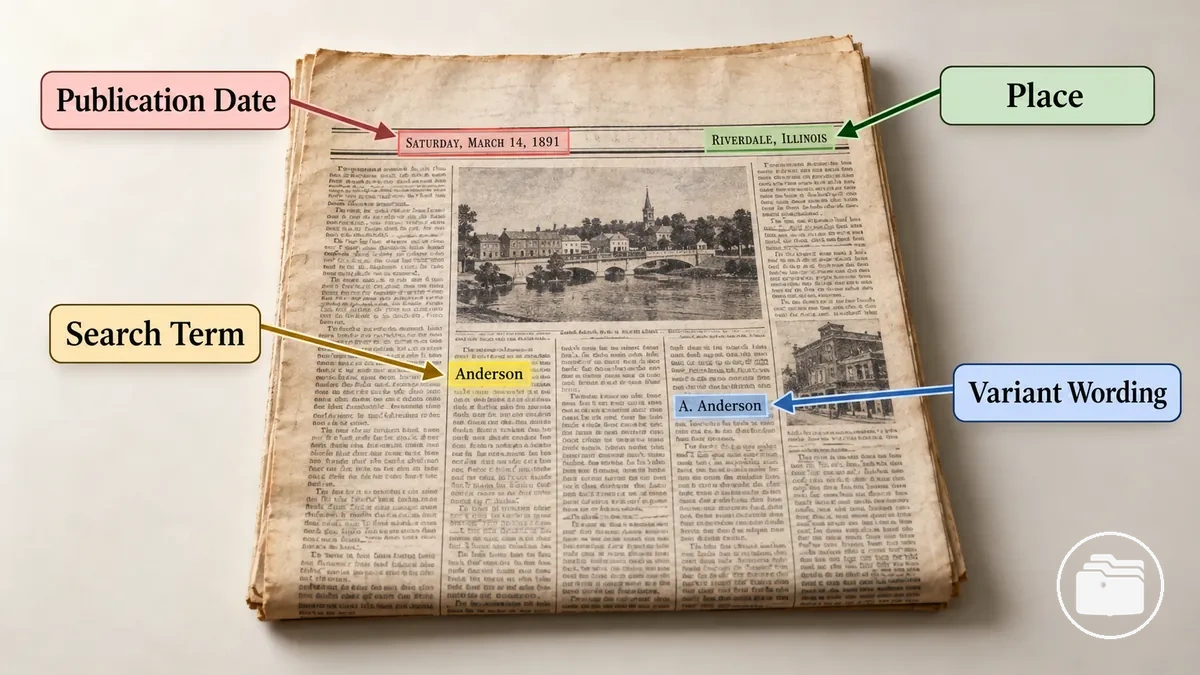
The annotated example below shows how a publication date, place reference, and wording variant can function as retrieval clues.
Use a date window when the event date and publication date may differ, and search historical place names as well as supported modern equivalents where jurisdiction or naming has changed.
Test each name variant separately because spelling, initials, abbreviations, and historical terminology can affect indexing.
An OCR error can also prevent an otherwise relevant page from appearing for an exact search term, so alternative spellings or shorter distinctive terms may recover material that a precise query misses.
Newspaper reporting can help locate what was reported at a particular time and place, but it does not independently establish that every reported claim is accurate.
Publication date and date window: start with the known publication date when available; if timing is approximate, widen the date window around the event and note which dates were actually searched.
Place name: search the locality named in contemporary material, then test supported place-name variants, former administrative names, or relevant jurisdiction terms when the historical wording differs.
Name variant: try supported alternatives such as full names, initials, surnames, aliases, or spelling variants rather than relying on one exact form.
OCR error: if an expected result is absent, test shorter terms, alternate spellings, or nearby identifying words because imperfect OCR can prevent exact text retrieval even when the newspaper page is present.
Historical terminology: use period-appropriate terms for institutions, occupations, places, or events when contemporary wording differs from current terminology, while keeping each variation documented in the research note.
Use Archive Catalogues and Finding Aids to Locate Relevant Records
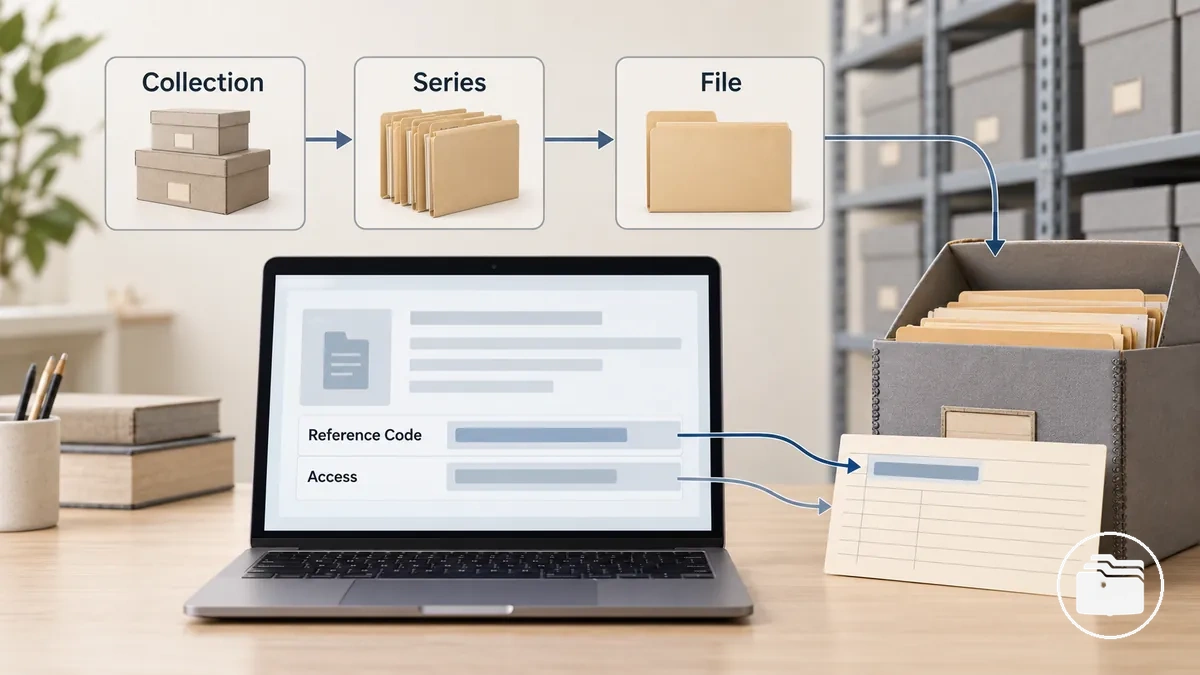
Archive catalogues and finding aids help identify where relevant archival records may sit within a collection, series, file, or other requestable unit.
A catalogue or finding aid can describe the creator, date span, scope, arrangement, identifiers, and access conditions associated with archival holdings, allowing a broad historical question to be narrowed toward a likely record location.
A catalogue description identifies and summarises holdings; it does not establish what an individual file contains.
Catalogue metadata can connect names, agencies, dates, subjects, or functions to a collection and, where the repository provides that level of description, to a series, box, folder, file, or reference code.
The useful retrieval path is metadata attribute to likely record location to the next request or catalogue search.
Repository structures and terminology differ, so use the hierarchy and field names supplied by the specific repository rather than assuming one universal archival arrangement.
The recurring fields below show how catalogue metadata can guide retrieval.
Creator or agency: identifies the person, organisation, office, or body associated with creating or accumulating the records; use it to locate collections or series organised around that creator.
Date span: indicates the period covered by a collection, series, or described unit; compare it with the case period to determine whether the unit is temporally relevant.
Collection or series title: identifies the broader archival grouping; use it to move from a general catalogue result toward the relevant part of the repository's holdings.
Scope note: summarises the subjects, functions, activities, or record types represented in the described material; use it to judge whether the collection or series warrants closer retrieval.
Identifier: distinguishes one described archival unit from another when the repository assigns a catalogue, accession, collection, box, folder, or similar identifier; record it exactly for follow-up searching or requests.
Reference code: provides a repository-specific code for locating or requesting a collection, series, file, or other unit; retain the complete code because its components may correspond to levels within the repository's arrangement.
Access conditions: indicate whether material is open, restricted, permission-based, advance-request only, or subject to another repository-specific condition; check them before treating a catalogue result as immediately retrievable.
Access conditions and descriptive depth vary by repository, and some catalogues describe only a collection or series rather than individual files.
Treat the catalogue record as a guide to what the repository says it holds and how the material is organised or accessed, then examine the underlying record before making claims about its contents.
Use Dates and Record References to Narrow Each Subsequent Search
Each verified date or record reference should narrow the next archival search only after its date type and source context are understood.
Classify the dated reference first, then use it to target the relevant institution, record series, catalogue entry, or cited source.
If the date is disputed, approximate, or retrospective, keep that uncertainty attached to the follow-up search rather than treating it as an exact chronology.
An event date describes when the underlying event occurred, while a publication date describes when a newspaper or other published source reported it.
A filing date or hearing date points toward a procedural record, whereas a record-creation date identifies when a document itself was produced; an archive reference date may instead describe accession, description, or another repository-specific context.
These date types can therefore lead to different search targets even when they concern the same case.
A docket number or archive reference can narrow retrieval further, but it should be checked against the issuing institution and record context before relying on the match.
Classify the dated identifier. Identify whether it is an event date, publication date, filing date, hearing date, record-creation date, or archive reference date, then target the institution or source type associated with that date. Check the source that supplied the date and retain any uncertainty before narrowing the search.
Follow the record reference to its issuing context. Use a docket number, reference code, or other archive reference to target the relevant court, agency, repository, catalogue entry, or record series. Verify that the identifier belongs to the expected institution and period before relying on the result.
Narrow the follow-up search around the verified context. Combine the supported date type or record reference with the relevant institution, collection, series, or cited source to reduce unrelated results. Check that the retrieved description or record matches the identifier rather than relying on a similar date or number alone.
Reassess conflicting or retrospective dates. When sources give different dates, keep each dated reference tied to its source and search implication rather than selecting one automatically. Verify whether each date describes the event, document, proceeding, publication, or archival description before using it to narrow another search.
Work Around Missing, Undigitised, and Fragmented Records
A missing search result is a symptom, not a diagnosis of the historical record’s status.
The immediate problem may be search failure, incomplete indexing, an undigitised record, an access restriction, fragmented custody, or possible record loss.
Repeated failure in one database or search engine therefore shows that a particular search path has not produced the record; it does not by itself establish that the underlying record is absent.
Separate discovery problems from record-status problems before choosing the next action.
A catalogue may reveal holdings that are not fully indexed online, while a repository may hold physical material that has not been digitised or is subject to access conditions.
Records may also be divided among institutions or collections through fragmented custody, and preservation documentation may sometimes establish loss or destruction.
The diagnostic table separates each observable symptom from its possible cause, the check required, and the corrective direction.
Symptom
Possible cause
Check
Corrective direction
No relevant result appears for a known name, date, or reference.
Search failure, spelling variation, incomplete indexing, or insufficient catalogue metadata.
Review the query terms, name and place variants, date range, catalogue fields, and related collection or series descriptions.
Broaden or reformulate the search, then use supported identifiers from related records to test another catalogue or search path.
A catalogue entry describes relevant material, but no digital image or full text is available.
The record may be undigitised, partly digitised, or available through another access route.
Check the catalogue description, digitisation status, repository access information, and whether the referenced physical record or series can be requested.
Follow the repository's stated access route rather than treating the absence of an online copy as evidence of record loss.
The record appears in holdings information but cannot be accessed directly.
An access restriction, closure period, permission requirement, preservation condition, or reading-room procedure may apply.
Check the repository's access conditions and any restrictions attached to the collection, series, file, or record reference.
Follow the stated request or permission process and record the restriction as an access limitation rather than an absence finding.
Related records appear across different archives, agencies, or collections.
Fragmented custody, institutional transfer, changing administrative responsibility, or separately maintained holdings may explain the split.
Compare creator or agency information, record series, reference codes, transfer notes, and related catalogue descriptions across repositories.
Trace each supported custody lead separately and document which institution holds each located fragment instead of assuming one repository contains the complete record set.
No catalogue result or accessible record is found after several search routes are checked.
The material may remain uncatalogued, poorly described, held elsewhere, restricted, affected by preservation gaps, or subject to possible record loss.
Look for related series, institutional histories, finding aids, holdings statements, preservation notes, transfer documentation, or explicit documentation of destruction or loss.
Keep the record status unresolved unless documentary evidence supports a stronger conclusion; pursue indirect references or alternative repositories where supported.
If the available evidence cannot distinguish incomplete indexing, lack of digitisation, access restriction, fragmented custody, preservation failure, and record loss, keep the status unresolved.
A stronger conclusion about destruction or loss requires documentation that specifically supports it.
Until then, record what was searched, what was checked, and which uncertainty remains.
Distinguish Search Gaps From Preservation and Digitisation Gaps
A search gap means the current query, index, or catalogue search has not located a record; a digitisation gap means relevant material may exist in the holdings without an accessible digital image; a preservation gap concerns whether the record has survived or whether documented loss affects what remains.
These are different diagnostic states, so an unsuccessful online search should not be treated as evidence of documented loss.
Use catalogue entries, holdings information, digitisation status, and access evidence together when diagnosing the gap.
A record can be poorly indexed and undigitised at the same time, while restricted access can make an existing physical holding difficult to inspect.
A preservation gap requires stronger evidence about survival, such as repository documentation of loss or destruction, rather than absence from a search result.
The table compares observable conditions with a possible gap type, the next check, and a qualified interpretation.
Observed condition
Possible gap type
Next check
Interpretation
A catalogue entry exists, but no digital image or online copy is available.
Digitisation gap or access limitation.
Check the repository's holdings description, digitisation status, access conditions, and whether the physical record can be requested.
This is consistent with a surviving record that is undigitised or not available through the current online access route; it does not by itself indicate a preservation gap.
No catalogue result appears, although related collections or record series are documented.
Search gap, incomplete indexing, or a possible description gap.
Search broader collection or series terms, creator or agency names, date ranges, reference codes, and related finding aids.
The absence of a direct catalogue result suggests checking discovery and indexing paths before drawing conclusions about the underlying record.
A catalogue or holdings record identifies material, but access is restricted or requires another procedure.
Access gap that may coexist with a digitisation or search gap.
Check access conditions, closure information, request procedures, and whether another repository or format provides lawful access.
The observed condition indicates an access limitation; it does not establish that the record is lost or unpreserved.
Repository documentation specifically records loss, destruction, or non-survival of the relevant material.
Preservation gap.
Verify that the documented loss applies to the correct collection, series, file, date span, or record reference.
Documented loss can support a preservation-gap interpretation for the identified material, but the conclusion should remain limited to the scope of that documentation.
Some records in a related series are digitised or catalogued, while the target item remains unlocated.
Search gap, digitisation gap, preservation gap, or a combination that remains unresolved.
Compare the catalogue structure, holdings coverage, digitisation coverage, access information, and any preservation notes for the specific unit sought.
The mixed evidence does not distinguish the record's status by itself; more repository-specific evidence is needed before assigning one gap type.
When catalogue, holdings, access, and preservation evidence remain incomplete, describe the result as consistent with one or more possible gap types rather than assigning certainty from absence alone.
Move Beyond Online Search When Relevant Records Are Undigitised
Move beyond general online search when catalogue holdings or related archival descriptions indicate that relevant material exists or is likely to exist but the records themselves are not digitally available.
At that point, the useful method becomes a repository-level search through the institution's catalogue, reference service, or permitted access process rather than repeatedly searching the open web.
Confirmed catalogue holdings can identify a collection or record series even when it contains undigitised records, while the repository's access conditions determine what can be requested, viewed, or reproduced.
A catalogue description may therefore provide evidence that the archival trail continues without providing an online copy of the underlying material.
Reference-service availability, reproduction options, and viewing access are separate questions from whether the record is represented in the catalogue.
The criteria below distinguish signals that a record may exist from the access route and limitations that must be checked next.
Confirmed catalogue holdings: when the repository catalogue identifies the relevant collection, series, file, or other archival unit but provides no digital record, use the supplied reference information to identify the repository-level request or discovery route.
Undigitised record series: when a catalogue or finding aid indicates that a relevant series exists but no digital images are available, treat the absence from online search as a digitisation condition and check how the repository provides access to the physical holdings.
Reference service: when the catalogue does not describe the material deeply enough to identify a specific file, check whether the repository offers a reference service or staff assistance that can clarify holdings, retrieval procedures, or applicable restrictions.
Reproduction: when the repository permits copies of relevant material, follow its stated reproduction process and any conditions attached to the record; catalogue discovery alone does not establish that copying is available, immediate, or without restrictions.
Viewing access: when physical or supervised consultation is offered, check location, appointment, identification, handling, closure, or other repository requirements before planning access; the existence of a physical holding does not guarantee that it can be viewed on demand.
Access conditions: when privacy, legal, preservation, donor, institutional, or other restrictions apply, follow the permitted access route and record the limitation. Moving beyond online search means following the archival trail through authorised repository procedures, not bypassing restrictions.
Use Indirect Archive References to Narrow Unresolved Gaps
An indirect archival reference is a search lead, not a substitute for the missing record. Use it to narrow the next repository, record series or institutional search without treating the unavailable source’s contents as known.
A citation, secondary mention, or later reference can point to another repository, record series, or institution while establishing only that the reference was observed, not what the unavailable source actually contained.
Extract searchable attributes from each indirect reference before starting the follow-up search.
A docket number can suggest searching the relevant court or procedural records; an agency name can narrow the responsible institution; an address or date can restrict place and time; and a collection reference can point toward a specific archival grouping or repository.
Newspaper references and later records may also contain a citation or reference code that narrows the reference trail.
Treat each attribute as a lead to verify against the next source rather than as evidence of undocumented facts in the missing record.
Preserve Dates, Provenance, and Historical Context When Interpreting Archive Findings
Archival findings should remain attached to their dates, provenance, creator, and historical context before they are interpreted.
Record where the material came from, when it was created or published, who created or issued it, and the record identifier that allows the source to be located again.
Preserving those attributes keeps a later note from separating a claim from the circumstances in which the record was produced.
It also allows later chronology work to distinguish the date of an event from the dates associated with the documents that describe it.
Interpret without collapsing source context
Provenance
The record’s origin and custodial context: repository, collection, creator or issuing body, and identifying references.
Why it matters
Purpose, audience, administrative function and historical setting can shape what was recorded and how it was expressed.
Boundary
Provenance supports assessment; it does not make a source automatically true. An official record can still contain incomplete, disputed or inaccurate details.
Contemporaneous source
Created or published close to the event. It may preserve period-specific names, claims and wording and can be especially useful for chronology and historical context.
Retrospective source
Created later. It may reorganise the event using later knowledge, terminology or interpretation and can reveal how the case was subsequently understood.
Do not rank either source type by date alone. Keep creation date, publication date, source origin and enough excerpt context visible so differences between contemporary reporting and later interpretation are not collapsed into one narrative.
Repository and source: record the archive, library, institution, newspaper, court, agency, or other source that holds or issued the material because provenance depends on knowing where the finding originated and how it can be traced again.
Collection and record identifier: preserve the collection title, series, file number, catalogue reference, docket number, or other record identifier because these details connect the finding to its archival location rather than to an isolated note.
Creation date: record when the document or record was created when that information is available because a creation date helps distinguish the record's production from the event date or later publication.
Publication date: record the publication date for newspapers, reports, books, and other published material because the timing of publication affects whether the source is contemporaneous, delayed, or retrospective.
Creator or issuing body: identify the person, office, agency, court, newspaper, organisation, or other creator because authorship and institutional purpose can affect the record's language, scope, and intended audience.
Original wording and excerpt context: preserve the relevant wording together with enough surrounding context to show what the passage refers to, especially where historical terminology, qualifications, or attributed claims affect meaning.
Contemporaneous or retrospective status: note whether the information was recorded near the time of the event or interpreted later because the distinction changes how the source contributes to chronology, context, and evidentiary assessment without determining truth by itself.